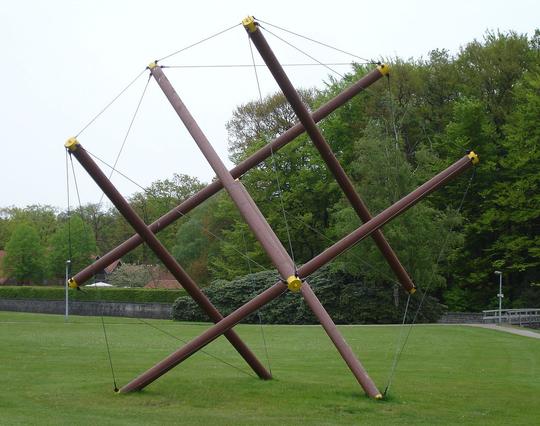
TIL. In April 1974, in the middle of the night, a small group of conspirators secretly installed a large tensegrity icosahedron made from discarded telephone poles on the campus of Twente University in the Netherlands.

It’s still there. People call it Het Ding (“the thing”).

https://www.utwente.nl/en/alumni/inspiring-alumni/ut-canon/stories/het-ding/
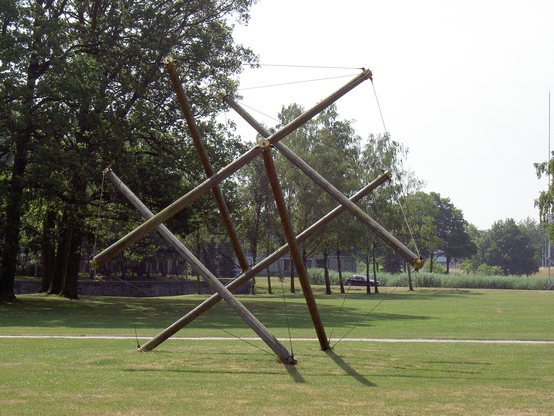
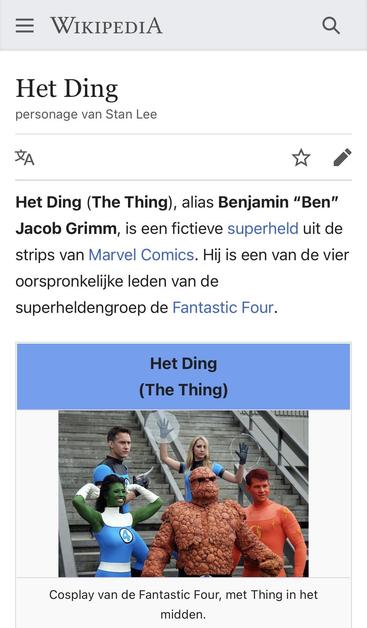
@robinhouston And it's had its own (Dutch) Wikipedia article since 2017: https://nl.wikipedia.org/wiki/Het_ding_(kunstwerk)
Het ding (kunstwerk) - Wikipedia

@11011110 Not to be confused with
@robinhouston Maybe those two are not to be confused, but now I'm confused by something else. The Wikipedia article (read in translation) says that it was mistakenly renovated in mirrored form. But the 6-bar tensegrity is not chiral? Do they maybe mean that it was placed on a different three pole ends than before?

@11011110 @robinhouston I was even more confused when I read the Dutch Wikipedia article in Firefox's translation, because it said

"Together they form a twenty-plane with fourteen equilateral and six equilateral triangles."

That seemed like a strange way of saying "twenty equilateral triangles"! But reverting to the Dutch, it's actually using two different words, fourteen "gelijkbenige" and six "gelijkzijdige". According to Wiktionary, the first of those means "isosceles", not "equilateral". Firefox's translation made a goof.

So this is apparently not a _regular_ icosahedron. Does that affect the question of whether it's chiral, perhaps?

@simontatham I think the tensegrity has the same geometry as Jessen's icosahedron, which is not the same as a regular icosahedron but not chiral either.

@robinhouston that would explain why I couldn't quite see some of the icosahedron edges in the photos! I found it quite hard to work out what was going on, because the wires are so thin and often the same colour as the background.

I did remember a construction I'd seen in a Johnny Ball book as a child, in which you make a regular icosahedron by slotting three 1 × φ rectangular cards together and then connecting the 12 corners of the cards with string. If you changed the aspect ratio of those cards, that would also be a way to make an icosahedron with 14 isosceles faces and 6 equilateral which was still not chiral.

@simontatham @robinhouston I want to know how they put it up in the first place. How does one get it off the ground? Are there special instructions? Is it wired together in a big heap, then raised up with ropes and pulleys like a marionette, and then the wires are tightened?
@mjd @simontatham @robinhouston the Wikipedia article just says it was designed and built by five students. I'd have thought you'd need a crane or something, telephone poles are probably heavy.

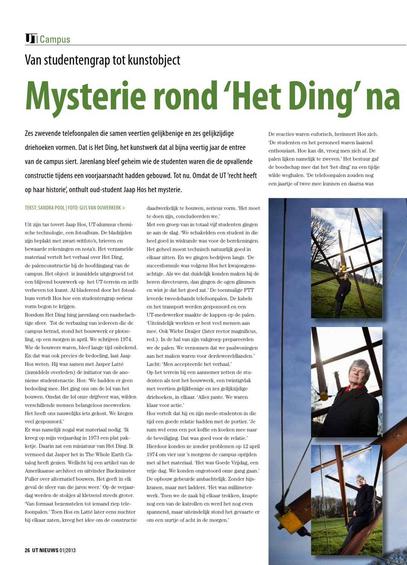
@mjd @simontatham @robinhouston yes, and the article that Wikipedia cites has another photo; the poles are perhaps not as heavy as what I have on my street.

https://issuu.com/utnieuws/docs/utnieuws-13-02-07/26

UT Nieuws Magazine Februari 2013

het februarinummer van UT Nieuws Magazine

Issuu