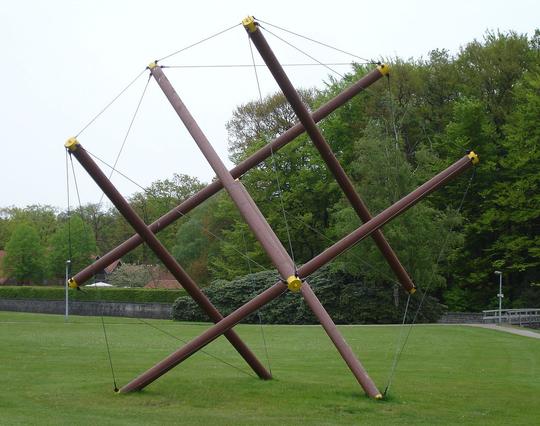
TIL. In April 1974, in the middle of the night, a small group of conspirators secretly installed a large tensegrity icosahedron made from discarded telephone poles on the campus of Twente University in the Netherlands.

It’s still there. People call it Het Ding (“the thing”).

https://www.utwente.nl/en/alumni/inspiring-alumni/ut-canon/stories/het-ding/
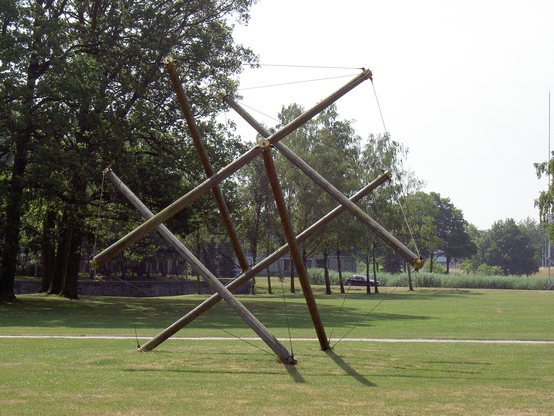
@robinhouston And it's had its own (Dutch) Wikipedia article since 2017: https://nl.wikipedia.org/wiki/Het_ding_(kunstwerk)
Het ding (kunstwerk) - Wikipedia

@11011110 Not to be confused with
@robinhouston Maybe those two are not to be confused, but now I'm confused by something else. The Wikipedia article (read in translation) says that it was mistakenly renovated in mirrored form. But the 6-bar tensegrity is not chiral? Do they maybe mean that it was placed on a different three pole ends than before?

@11011110 @robinhouston I was even more confused when I read the Dutch Wikipedia article in Firefox's translation, because it said

"Together they form a twenty-plane with fourteen equilateral and six equilateral triangles."

That seemed like a strange way of saying "twenty equilateral triangles"! But reverting to the Dutch, it's actually using two different words, fourteen "gelijkbenige" and six "gelijkzijdige". According to Wiktionary, the first of those means "isosceles", not "equilateral". Firefox's translation made a goof.

So this is apparently not a _regular_ icosahedron. Does that affect the question of whether it's chiral, perhaps?

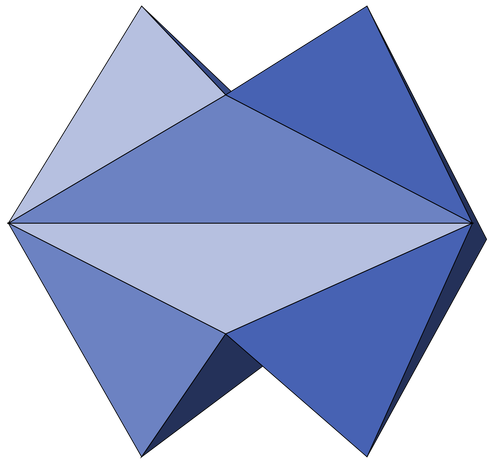
@simontatham I think the tensegrity has the same geometry as Jessen's icosahedron, which is not the same as a regular icosahedron but not chiral either.
@robinhouston @simontatham Yes, it is through editing the Wikipedia article https://en.wikipedia.org/wiki/Jessen%27s_icosahedron in 2021 that I learned about this sculpture
Jessen's icosahedron - Wikipedia