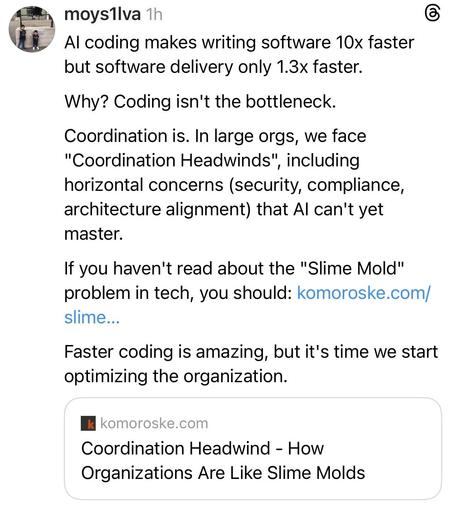
This is the big challenge for companies in the age of AI coding agents.

1. Our quality processes are not designed to handle code creation at this pace (10x the code = 10x the bugs)

2. Our organizational workflows with their various meetings and approval processes are big drags on capturing these productivity gains, yet are important and exist for valid reasons.
@carnage4life I don't think coding was ever the bottleneck 🤔
@olafke @carnage4life
Seriously, I spent far less time coding than I did on all the tasks that came before and after it

@Nerde @olafke @carnage4life
Olaf and Stanley said it well.

I'd generally say: Using AI for coding, does not replace "Software Engineering" -- which is a profession involving multiple disciplines, systems, and processes to delight customers using software products.

Writing code is a fraction of this.

People, planning, systems, troubleshooting/iterating, and measuring still remain.

Also, as a manger, I have always known people are the "hard" part of engineering.

@carnage4life Very generous of you to assume bugs grow only linearly in volume of code. I would expect it to be quadratic or even cubic. (10x the code = 100x or 1000x the bugs)
@carnage4life This is motivated by the idea that most nontrivial bugs emerge from *interactions* between components of software, not in isolation.
@carnage4life at least the conversation has shifted this way. I've been gnashing my teeth about the false productivity of cheap code lo this long year.
@carnage4life It's even more complicated than that. Most of the time, the generated code has zero bugs, but occasionally the model goes completely off the rails and either has 100x the bugs, or major silent but show-stopping failures like forgetting to require authentication. oops!
@carnage4life In this thread: MBAs discover Amdahl's law