
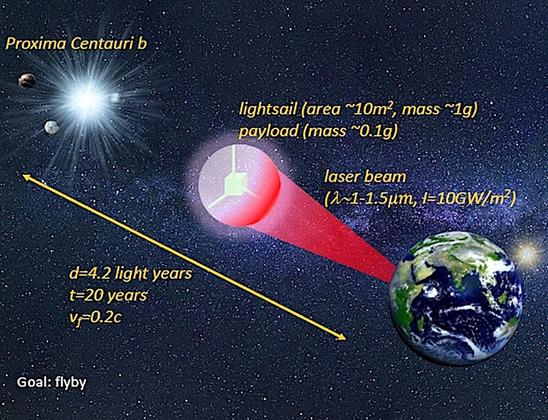
The wild "Starshot" project was conceived to design a probe that could reach Proxima Centauri in about 20 years.

Although project has gone dormant, it has yielded a lot of new ideas (many not widely shared, alas) about how to build a viable interstellar probe.

https://www.centauri-dreams.org/2026/03/10/starshot-is-a-success-part-ii/ #space #science #technology

@coreyspowell Wouldn't it make more sense to try for a proof-of-concept mission to, say, Pluto, that could get results in single-digit years or even faster? (Might even do some useful science when it gets there, for example by giving us a laser spectrophotometry reflector target occulted by Pluto's atmosphere as it heads towards Aphelion.)

@cstross @coreyspowell

One could send a larger lightsail spacecraft 600 au or so in the opposite direction to Proxima Centauri without assuming things like "a laser array that could set the atmosphere on fire".

And it would provide better images of Proxima b than the Starshots would have.

Because of the Sun acting as a gravitational lens and because even if they were possible, the Starshots would not have been able to get more than one low-resolution image each as they flew through.

@michael_w_busch @cstross @coreyspowell
Which is why the slow lane via Alpha Cen is a much more viable approach for actually staying there.

@WellsiteGeo @cstross @coreyspowell

Proxima b is between us and Alpha Cen.

But yes - slowing down necessarily takes as much momentum as speeding up did.

And the Breakthrough Starshot people also unjustifiably handwaved away what dust hits and cosmic ray erosion would do to anything launched so fast.