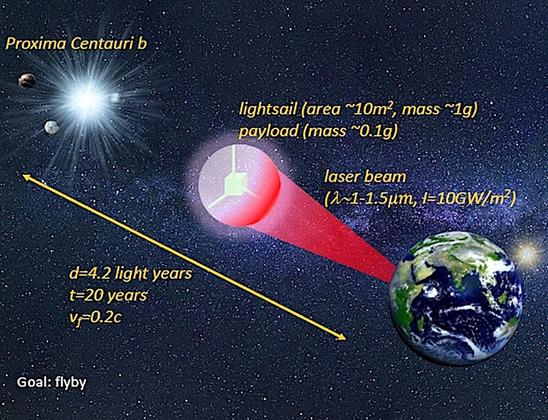
The wild "Starshot" project was conceived to design a probe that could reach Proxima Centauri in about 20 years.

Although project has gone dormant, it has yielded a lot of new ideas (many not widely shared, alas) about how to build a viable interstellar probe.

https://www.centauri-dreams.org/2026/03/10/starshot-is-a-success-part-ii/ #space #science #technology

@coreyspowell Wouldn't it make more sense to try for a proof-of-concept mission to, say, Pluto, that could get results in single-digit years or even faster? (Might even do some useful science when it gets there, for example by giving us a laser spectrophotometry reflector target occulted by Pluto's atmosphere as it heads towards Aphelion.)

@cstross @coreyspowell

One could send a larger lightsail spacecraft 600 au or so in the opposite direction to Proxima Centauri without assuming things like "a laser array that could set the atmosphere on fire".

And it would provide better images of Proxima b than the Starshots would have.

Because of the Sun acting as a gravitational lens and because even if they were possible, the Starshots would not have been able to get more than one low-resolution image each as they flew through.

@michael_w_busch @cstross @coreyspowell
Which is why the slow lane via Alpha Cen is a much more viable approach for actually staying there.

@WellsiteGeo @cstross @coreyspowell

Proxima b is between us and Alpha Cen.

But yes - slowing down necessarily takes as much momentum as speeding up did.

And the Breakthrough Starshot people also unjustifiably handwaved away what dust hits and cosmic ray erosion would do to anything launched so fast.

@cstross @coreyspowell There are numerous ideas for mission concepts using laser sails or high performance solar sails.

One problem is that laser sail propulsion is particularly inefficient at "low" speeds. And by "low", I mean under 30,000km/s. (Several orders of magnitude faster than anything we've launched so far.)

Another big problem is that the laser itself is a humongous expense, so it's good to have alternative uses for it.

@isaackuo @cstross @coreyspowell if people think we can fund AI datacenters, they can fund something genuine instead

We have the resources to take care of everyones physical needs and comfort, then we can dedicate all of the surplus to scientific discovery and art, we just need to purge the concept of wealth hording from the human psyche

@raven667 @cstross @coreyspowell Yes, indeed. But it's still worth looking at what are genuine uses for a high power laser system.

For example, laser sail propulsion is tough for a "slow" space mission, but laser thermal propulsion might be more viable.

@isaackuo
@cstross @coreyspowell

Alternate Use Cases being .. "military"?

Where would they even put the laser? A high plateau? Is there a laser frequency mininmally affected by our atmosphere? Or in Orbit?

@xro @isaackuo @coreyspowell Solar orbit is pretty much essential for deep space missions.
@cstross @xro @isaackuo @coreyspowell
I think you could do it in a Lunar-matching orbit at higher (10°~) inclination to reduce time in the Earth's shadow to the negligible. Not as good, station-keeping wise, as Lagrange point, but fewer eclipses.

@xro @cstross @coreyspowell Probably not military, but it could be useful for de-orbiting bits of space debris, or providing temporary solar power and/or heating to satellites in high orbits.

For some of these applications, it's okay to be blocked by cloud cover some of the time. For others, it could be worth siting on a mountain above most cloud cover.

@isaackuo @xro @cstross @coreyspowell

The graphic implies 100 GW laser - 10 GW/m2 over 10 m2. For comparison, the US military has some 50 kW lasers it uses for aerial defense. Cloud cover wouldn't mean a thing to these propulsion lasers.

@tburkhol @isaackuo @xro @coreyspowell For reference, 100GW is about the energy budget of the UK, or 100km^2 of solar panels in space. This is *not* small. Nor is it a single laser: it's probably an array of a million of the things.

@cstross
@tburkhol @isaackuo @coreyspowell

At that point, utilizing sunlight directly, using an array of millions of precisely controllable and angled prisms in solar orbit to create a collimated beam of sunlight, might be more energy efficient than solar panels and lasers.

(Thinking A.C.C.+Baxter "Sunstorm" here: millions of actuated prisms in space)

Edit: or just concentrated on that very far away point

@xro @cstross @tburkhol @coreyspowell Not really possible to any useful degree. There is no way to reflect or refract sunlight to make a beam tighter than about half a degree across.

There are cases where concentrated sunlight is definitely useful, but it won't be collimated.

@tburkhol @isaackuo @xro @cstross @coreyspowell Cloud cover might mean something to all the life below the clouds which would be rather destructively illuminated by the backscatter from the laser passing through them.