 Ben Lockwood (broadly defined)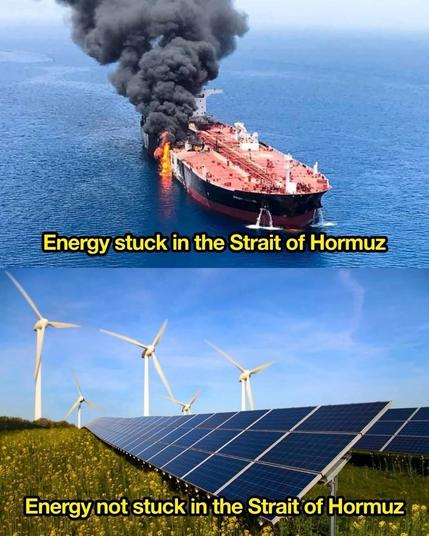
 Ati
Ati@benlockwood Yes it is a huge step forward. That said the latter is deeply stucked in chinese supply chain / dependency on rare earth minerals. Making it independent of dictatorships (mainly China) and Dunkelflaute proof at the same time ... would take a lot of time, money and effort ... that nobody really seems to be making at the moment.

@benlockwood I'm not being pedantic as issues I'm referring to are major. Renewables have their own problems, they ain't 1:1 substitute for big oil yet, and wouldn't be for a long time as everyone's busy hyping how cheap chinese solar panels are but almost nobody's busy building biogas plant every second village to survive that Dunkerflaute without that Hormuz stucked tanker really 💁♂️ So great renewable solutions science gave us, pity nobody's building holistic working system really. 🫣
 MatthewToadAgain
@ati1 @benlockwood Look at the proportion of electricity coming from fossil fuels in various countries.
Over the last year, only 28% of UK electricity came from fossil fuels, and another 7.5% from biomass.
Some other European nations use even less fossil fuels already.
Studies suggest that getting to 95%+ is feasible with only renewables and short term storage.
Sure, there's a problem with the last 5%. There are a number of solutions, all of them have problems.
But biomass isn't a viable answer. You get *hundreds* of times more usable energy from a field of solar panels than from a field of energy crops.
And solar panels don't have to compete with food; they can be put onto buildings, they can be combined with animal shelters, some crops, etc, and they can be put on low grade land. But even if they did, using biofuels will use **WAY** more land.
And, sadly, it already does, thanks to the use of biofuels in transport and (occasionally) electricity.
"Holistic solutions", sure. For electricity that means a mixture of renewable sources, grid interconnectors, dynamic demand, storage etc.
And it means being sensible about demand - gigawatts of datacenters to support a bubble that is bound to burst soon and is already losing money make no sense.
But energy crops are a non-starter. Genuine agricultural waste can only provide a tiny fraction of total energy demand.
That of course means we need to stop flying. It means heat pumps instead of gas boilers for home heating. And so on. Decarbonising electricity is arguably the easy bit.
@ati1 @benlockwood And yes, as far as transport goes, I know there are problems with EVs. In particular, they make up approximately half of the total mining needed for a "green growth" energy transition. And they are heavier so emit more human-hazardous particulate pollution.
And charging costs way more for people who can't charge overnight at home. Replacing every petrol/diesel car with an EV will take longer than we have.
The answer to that is degrowth. Fewer cars and more public transport.
Electric buses weigh the same as hybrid or diesel buses, are quieter, and lower cost to run.
Most shipping could go electric too, depending on the price of batteries.
What isn't practical is flying.
@ati1 @benlockwood And as for the original post, most trade from China to Europe goes through the Suez Canal (at the top of Egypt), not the Strait of Hormuz.
But a lot of oil, gas, and unfortunately fertiliser, goes through the Strait of Hormuz.
Fossil fuel prices will rise. So will food prices, and they've already increased, partly because of various wars, but also because of direct climate impacts.
Everything is connected to the climate crisis or directly to fossil fuels.
Now is a great time to use less fossil fuels!
@MatthewToadAgain @benlockwood It's not a problem where trade with China goes through. It is a problem trade with China and other dictatorships exist. Not to mention it exist to the point we re 100% dependent of them in say solar panels or batteries.
@ati1 @benlockwood On the upside, there are still major European wind turbine manufacturers. And no, they don't manufacture them all in China either.
@ati1 @benlockwood As for China, the main issue with solar panels is forced labor (mostly Uyghur).
However not buying Chinese solar panels at all would likely dramatically slow down the energy transition, since it makes up 80%+ of global production - and panels manufactured elsewhere often contain Chinese polysilicon, manufactured using forced labor in the Xinjiang region.
Biofuels sadly do not provide a way out of this awkward moral dilemma.
So it's mostly a matter of whether you trust certification schemes such as the Solar Stewardship Initiative. Historically these sorts of schemes (e.g. RSPO) have been rather variable depending on whose benefit they are run for.
Can they be trusted? I hope so.
@MatthewToadAgain @ati1 @benlockwood About the EVs: just build small ones for city or short commutes. Most trips are short. A mate has a twizzy. Interesting stupid fact: EV financial support does not apply to the twizzy and other micro cars because they are considered too small.
Yes, in Europe.
Fuck that. All the wrong incentives.
No, personal individual transport is not what we should aim for, but his village is a bit remote and not too many people live there, so bus connections are bad.
@drchaos @MatthewToadAgain @benlockwood Problem is not that we don't know how to do that transition to renewables right. We do know. All electric economy powered by renewables stabilised with biogas run plants plus some batteries/heat accumulators and so on. Problem is nobody's doing that or only doing the easiest part, and still in a wrong, dangerous way. Examples: 1) Instead of building robotised industry 4.0 PV plants producing cheap PV on a scale in EU we outsource it 100% to china 🫣
@drchaos @MatthewToadAgain @benlockwood 2) Instead of stirring debates on where we need to build biogas plants and how to do it fast, and how to connect them with electric grid to survive winter without fossils we have managed to fund putins never ending war multi-houndred-billion $ fund by just throwing his fossil gas at the problem for 30+ years spending money on things like Nord Stream / Nord Stream 2 and fossil gas itself on the way .... Where would we be if we built biogas supply instead?
@drchaos @MatthewToadAgain @benlockwood 3) Instead of educating masses about bicycles / public transport / car sharing or say making them use a Twizzy if one really really needs a car (eldery, or disabled people etc) we take taxpayers money to subsidise 500bhp chinese - made monster EVs for the rich. Making "brap brap" from speakers to satisfy their stupid "needs" and to make sure our cities are still loud after spending all that money 🤣 To add even more insult. And so on and so on....
@ati1 @drchaos @benlockwood I believe we are in agreement about ground transport. More electric buses, ideally trolleybuses and trains, more active travel, and fewer cars. There are lots of problems to solve to make that happen, but mainly funding; buses can be improved quickly fairly cheaply, while new train lines tend to take forever to build in western countries.
But significant amounts of biogas would mean using vast amounts of land for energy crops, just at the point when food costs are increasing due to climate change, and we need to use as much land as possible for rewilding to recover ecosystems and remove carbon. (Which of course also means changing diets, but that's another story)
There are other options for the last 5% of electricity generation. Iron-air batteries are my favourite; cheap, huge energy density, and requires minimal mining. Whether we can scale it up fast enough remains to be seen. Other options include e.g. pumped storage hydropower, hydrogen, other kinds of batteries etc.
Long term heat storage is indeed possible, where you are doing district heating anyway. And so on.
But we're only talking about the last 5% of electricity demand, and electricity is less than 1/5th of carbon emissions.
Biogas is not a viable option for ground transport or air transport.
In fact, in general, biofuels are greenwash. We can produce a tiny amount of genuinely sustainable biofuels, but not enough to make a real difference.
Solar panels can provide hundreds of times more usable energy per hectare than biofuels. Even when you consider the need to store the energy produced, it is a horrifically bad use of land. And it would lead to more imports of food.
Even if you are proposing a largely agrarian society that uses vastly less energy, we will *STILL* need the excess land for rewilding. We cannot afford to grow energy crops, period.
 Dźwiedziu
@MatthewToadAgain
> And they are heavier so emit more human-hazardous particulate pollution.
As we're in a field of pedantry, I'm going to ask for citation about that.
Can be with division per fuel type.
Also transport can go electric without batteries and rubber wheels with rails.
@dzwiedziu @MatthewToadAgain @benlockwood That again might be compliated. If most of our supposedly planet - saving EVs are not electric rail cars, not bikes/cargo bikes, not Twizzies, and not even Corsas but 500bhp chinese made Teslas ... driven in a "whooooah my Tesla does 0-100kph in 2,9s" all the time then, well 💁♂️ 😂 Just look at tires topic on any EV forum. They re full of "how can my tire set possibly be gone in 15kkm" XD. All I am doing is accelerating 0-100 in 3s with a 2 tonnes Tesla XD
@ati1
Still “plural of «anecdote» is not «data»”
And data would be needed to regulate if f.e. such cars don't need a enforced eco mode by default.
Or to regulate mid- and heavy individualised transport in favour of light individual transport and mass transit.
(I'm not going as far as to ask if there is still time for that, I had enough blackpills lately already.)
@dzwiedziu @MatthewToadAgain @benlockwood Sure, you re right, any decisions have to be made on data. For tires use per fuel type / car type we would need to scrutinise every set of tires bought and/or recycled and connect those with number plates. That would give us close to real data. Because if we do some normalised test that doesn't involve how people use their cars we would land with crap on the input crap on the output. Like official data saying hybrid compact uses 1,7L petrol/100km or so 🤣
@ati1
I would rather leave that to proper researchers, as you're right there is a need for proper methodology and statistically sound results.
I will remain silent on the “official” fuel/energy usage statistics not to get myself angry too much.
I will just say that they're the opposite of the above.
Maybe I'll add that the supposed reason for the gear up light in manual transmission cars is to keep the fuel use nearer the theoretical number.
@dzwiedziu @ati1 @benlockwood As far as tyre wear pollution goes, the early figures looked implausible, but more recent studies confirm that most particulate pollution comes from tyres and braking.
Braking is increasingly a non-issue because of regenerative braking (even on some petrol cars).
But tyre pollution is on the order of half of all road particulate pollution. Road abrasion is another quarter (Imperial College London study):
More recently it looks like the two largest sources of microplastics pollution overall are tyre wear and clothing.
However, we have barely scratched the surface on what can be done with better tyres. While the problem can't be solved it can be improved.
More to the point, it's yet another reason for fewer cars and more bikes, active travel, buses and trains.
@dzwiedziu @ati1 @benlockwood And yes, there isn't time to replace every petrol car with an EV.
Nor is there the economic incentive since the bottom end of the market are 1) capital sensitive and 2) pay much more for charging because they can't charge overnight at home if they don't have a garage/driveway.
And in fact even if we did the sheer amount of mining needed would be a serious ecological problem - though not as bad as continuing to extract fossil fuels, which already creates sacrifice zones, killing people and ecosystems alike, let alone the impact of burning the end product.
But again the answer to "we can't replace every car quickly enough" is straightforward: more public transport, more active travel, and replace the remaining cars (and other road vehicles) with electrics.
@MatthewToadAgain @benlockwood I am totally pro transition to renewables. I am just complaining it is done way too slow, even in Europe and also in a stupid way sometimes like when we're trading one dependency on our enemies and evil dictatorships harming people (fossil fuels) for another one say when we're speeding up stansition not by innovation but by handing 100% PV panels production over to China. 🫣
@MatthewToadAgain @benlockwood Also be aware of those "some countries would soon use 95% renewable ELECTRICITY". Check what part ELECTRICITY makes in their total ENERGY use. Electricity is not equal to energy. Even at personal level check how easy it is to go offgrid and power your devices from solar and batteries all year round. Now try doing so with your heating and transport.
@MatthewToadAgain @benlockwood And for a country there's also industry. It'd doable but we're only doing easiest parts for now, already at price of chinese dependency, and decisionmakers are busy making ppl mistake electricity with energy to hide fact that harder (to transition) part like heating, transport and industry is still mostly running on fossils.
@ati1 @benlockwood I did talk about energy vs electricity.
Electricity is less than 1/5th of UK carbon emissions already.
However most of the practical solutions for transport, heating, industry, mining, agriculture etc rely on more green electricity.
There are exceptions. It's not clear whether we can electrify shipping over 3000km for instance. That sector might need some sort of e-fuels, though they'll be expensive.
And as for aviation we're just going to have to stop flying. 15% of people take 70% of flights, and they're mostly for leisure. Classic example of where degrowth demand measures can make a real difference.
But two of the biggest sectors here are ground transport and domestic heating. Both have efficient electric solutions: electric buses/bicycles/cars/ambulances/taxis/lorries/trains and heat pumps.
Other European countries have far more heat pumps installed per capita, though e.g. Germany is backtracking recently on its previous entirely sensible policy of banning gas and oil fired heating in new homes.
@MatthewToadAgain @benlockwood I was rather reffering to success stories like "we have defossified our energy with 20% -> 80% renewables in 2 decades or so. When in fact it is really in electricity generation only an still with fossils as winter / dunkerflaute backup. In whole energy use that usually translates to 5%-> 20% in those 2 decades with biomas making a big chunk and reaching 100% " Hormuz tanker independence" will take 200 years at that lame pace 💁♂️
@ati1 @benlockwood I do not understand your point.
First, in many countries electricity is well on the way to being fossil free, though it's not there yet most places.
There currently needs to be backup for "winter wind droughts" (your "dunkerflaute"). Sure. But that's a few weeks a year at most.
One day that might be long term storage. But it's only 5% of so of the total. And we have plausible technologies - admittedly mostly not yet mature ones - for long term storage.
For the rest of the year, given short term storage (approx 4 hours - lithium or pumped storage). But the last few percent of electricity is a minor problem compared to transport, heat etc.
Transport, heat, industry, agriculture etc, which make up 80% or so of carbon emissions, will need more electricity. Some of that can be scheduled at times when there is plenty of renewable electricity ("dynamic demand").
For instance, long term heat storage (e.g. a *really big* hot water cylinder) combines dynamic demand with long term storage - but it's only viable if you have district heating anyway.
So there is more work to do, and in areas such as heating and transport major government intervention will be needed. Installing heat pumps in domestic properties, for instance, is still much more expensive than installing fossil gas boilers, though it will usually cut energy costs. And of course it vastly reduces carbon emissions, assuming you're already avoiding long haul flights and don't drive.
The market alone will not deliver what we need (e.g. replacing every gas boiler with a heat pump) in any reasonable time; government funding, regulation, and demand reduction measures in sectors such as aviation and beef, will be necessary.
None of that reduces the value of renewables or electrification.
And none of it changes the fact that biofuels are a grotesquely inefficient and damaging solution that prevents rewilding and drive up food prices.
Sure, we'll need a small amount for air ambulances and other essential aviation. And maybe for long haul (>3000km) shipping. But that's about all.
It's also insignificant in energy generation. And the only reason it's significant at all in wider energy use is fuel mandates (X% of petrol must be biofuels). Which are destructive; in carbon terms the energy crop biofuels are barely an improvement over petrol, while alternative solutions (feet, bikes, buses, and electric vehicles) are far preferable.
@MatthewToadAgain @benlockwood I don't know how to say it simplier. We're not in a point where we could possibly replace fossil gas and oil with renewable sourced electricity. Reason being our heating, transport and industry still mostly runs on fossil fuels and uses much more power than whole electric grid produces. To change that we need a lot of investment including biogas (from decomposing organic matter) made ar bcm scale to power our powerplants on those few critical weeks
@MatthewToadAgain @benlockwood No amount of batteries (that we don't make nor have rare metals for, by the way) nor heat batteries would do the trick. So said we re like 80% done making electric grid renewable powered in some countries .... but only maaaybe 25% done on a way to get rid of those fossil fuel tankers And at current pace we need 100+ years to get rid of them as what we already achieved was 1) the easiest part 2) we did it using "100% China dependency" trick
@MatthewToadAgain @benlockwood To make numbers speak - here you have a simulator of future possible polish power system where you can play around with power sources and see how your system would perform using real historic data on weather / electricity production and consumption. It's polish data only but says a lot anyways https://symulatorsystemuenergetycznego.ncbr.gov.pl/en/ Just remember to stay away of those blackouts 🤟😜
@MatthewToadAgain @benlockwood We re talking about different things. I am not talking about biofuels like fuels made of crops that use land. I am talking biogas that uses organic waste we produce anyways. That's the only way I know (instead of maybe building separate nuclear supply for 100% electricity demand) to survive those "just few weeks" with no sun and no wind now. Even more so with future 100% electric renewables powered economy that is not Norway.
@MatthewToadAgain @benlockwood Let's switch to precise examples. My little Poland uses 440GWh of electricity per 24h. That would triple in all electric only electric economy buy leave it for now. Let's talk todays. In like january "dunkerflaute" we often have like 3 weeks with no wind and all clouds. What storage solutions do we have, apart from burning bio(waste) carbon neutral gas, that could hold 21 x 440GWh=9,24 TWh of electric energy over weeks if not months?
@MatthewToadAgain @benlockwood For li ion storage at 2025 average cost of $125/kWh ... 9,24 TWh would cost $30k per every living Pole. Every 15years or whatever lifespan you assume such grid batteries would have. That's $166 /month/person or $600/m/family for batteries only. Global battery output 2025 was 1,6TWh. Poland only would need global li ion batt 6 years supply ...every 15years or so. Poland holds less than 0,5% of world population. What else do we have? Heat storage?
@ati1 @benlockwood Let me be absolutely clear here.
First off, the amount of energy we can produce from genuinely sustainable agricultural waste is *tiny*. Maybe 10% of UK domestic gas demand at best.
And a lot of it is already used; you're diverting waste streams that have other uses.
Practically speaking, "more biofuels" equals "more energy crops". Where do you think the mandatory X% biofuels in petrol in Europe comes from? It's not from agricultural waste. A third of the US maize crop is turned into biodiesel! There simply isn't enough agricultural waste to make a practical difference. What little there is will be needed for e.g. essential, life saving aviation.
See e.g. https://www.biofuelwatch.org.uk/
Second, I never said we should use lithium batteries to cover winter wind droughts. There are other options, including iron-air batteries, heat batteries, pumped storage hydro (okay, that's more medium term), hydrogen, etc.
Of course you also have to factor in grid improvements / bigger, longer interconnectors, dynamic demand, and a reasonable (but not ridiculous) over-build of renewables.
There are numerous options for the last 5%. And that claim is based on models based on actual demand and supply, especially in Australia, but I've seen similar European models.
But in any case the last 5% of electricity is not the biggest problem. The other 80% of the economy is a much more urgent issue! Most of which can be electrified.
In most sectors the most realistic option is electrification.
@MatthewToadAgain @benlockwood In Poland our production potential for biogas is 2x what we need to cover up. For what I know Germany also declares this way. And by the way, who's using iron-air batteries, pumped storage hydro, or 20% round trip efficient hydrogen at multi tWh scale? That's even more sci fi than lithium ion isn't it? Like "replacing" Hormuz stucked tanker with upbeat stories about what might happen in 200years? Like fusion reactors for me. Always 20 years ahead.