 Ben Lockwood (broadly defined)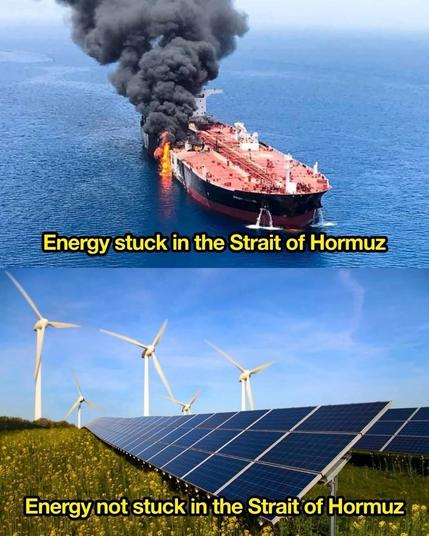
 Ati
Ati@benlockwood Yes it is a huge step forward. That said the latter is deeply stucked in chinese supply chain / dependency on rare earth minerals. Making it independent of dictatorships (mainly China) and Dunkelflaute proof at the same time ... would take a lot of time, money and effort ... that nobody really seems to be making at the moment.

@benlockwood I'm not being pedantic as issues I'm referring to are major. Renewables have their own problems, they ain't 1:1 substitute for big oil yet, and wouldn't be for a long time as everyone's busy hyping how cheap chinese solar panels are but almost nobody's busy building biogas plant every second village to survive that Dunkerflaute without that Hormuz stucked tanker really 💁♂️ So great renewable solutions science gave us, pity nobody's building holistic working system really. 🫣
 MatthewToadAgain
@ati1 @benlockwood Look at the proportion of electricity coming from fossil fuels in various countries.
Over the last year, only 28% of UK electricity came from fossil fuels, and another 7.5% from biomass.
Some other European nations use even less fossil fuels already.
Studies suggest that getting to 95%+ is feasible with only renewables and short term storage.
Sure, there's a problem with the last 5%. There are a number of solutions, all of them have problems.
But biomass isn't a viable answer. You get *hundreds* of times more usable energy from a field of solar panels than from a field of energy crops.
And solar panels don't have to compete with food; they can be put onto buildings, they can be combined with animal shelters, some crops, etc, and they can be put on low grade land. But even if they did, using biofuels will use **WAY** more land.
And, sadly, it already does, thanks to the use of biofuels in transport and (occasionally) electricity.
"Holistic solutions", sure. For electricity that means a mixture of renewable sources, grid interconnectors, dynamic demand, storage etc.
And it means being sensible about demand - gigawatts of datacenters to support a bubble that is bound to burst soon and is already losing money make no sense.
But energy crops are a non-starter. Genuine agricultural waste can only provide a tiny fraction of total energy demand.
That of course means we need to stop flying. It means heat pumps instead of gas boilers for home heating. And so on. Decarbonising electricity is arguably the easy bit.
@ati1 @benlockwood And yes, as far as transport goes, I know there are problems with EVs. In particular, they make up approximately half of the total mining needed for a "green growth" energy transition. And they are heavier so emit more human-hazardous particulate pollution.
And charging costs way more for people who can't charge overnight at home. Replacing every petrol/diesel car with an EV will take longer than we have.
The answer to that is degrowth. Fewer cars and more public transport.
Electric buses weigh the same as hybrid or diesel buses, are quieter, and lower cost to run.
Most shipping could go electric too, depending on the price of batteries.
What isn't practical is flying.
@ati1 @benlockwood And as for the original post, most trade from China to Europe goes through the Suez Canal (at the top of Egypt), not the Strait of Hormuz.
But a lot of oil, gas, and unfortunately fertiliser, goes through the Strait of Hormuz.
Fossil fuel prices will rise. So will food prices, and they've already increased, partly because of various wars, but also because of direct climate impacts.
Everything is connected to the climate crisis or directly to fossil fuels.
Now is a great time to use less fossil fuels!
@MatthewToadAgain @benlockwood It's not a problem where trade with China goes through. It is a problem trade with China and other dictatorships exist. Not to mention it exist to the point we re 100% dependent of them in say solar panels or batteries.
@ati1 @benlockwood On the upside, there are still major European wind turbine manufacturers. And no, they don't manufacture them all in China either.
@ati1 @benlockwood As for China, the main issue with solar panels is forced labor (mostly Uyghur).
However not buying Chinese solar panels at all would likely dramatically slow down the energy transition, since it makes up 80%+ of global production - and panels manufactured elsewhere often contain Chinese polysilicon, manufactured using forced labor in the Xinjiang region.
Biofuels sadly do not provide a way out of this awkward moral dilemma.
So it's mostly a matter of whether you trust certification schemes such as the Solar Stewardship Initiative. Historically these sorts of schemes (e.g. RSPO) have been rather variable depending on whose benefit they are run for.
Can they be trusted? I hope so.