 Daniel Hall
 enderman0125

 Marcy
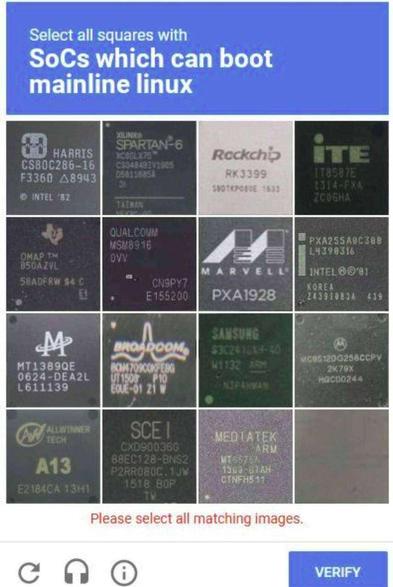
Marcy@mudkip robot capcha
 Graham Sutherland / Polynomial
@mudkip easy. select none. nothing can boot linux without months of heartbreaking work.
 Rairii

@gsuberland @mudkip select all squares with SoCs that can boot NT
@gsuberland @mudkip one day i'll get a bunch of chinesium mediatek/rockchip/etc devices to try my hand at porting actually modern NT to something
 elsa sloth-ringen 🔜GPN
@gsuberland @mudkip easy. select all. everything can boot linux with months of heartbreaking work.
@elsactivitypub @mudkip *hands you a PIC12F*
 Susan Calvin
@gsuberland @elsactivitypub @mudkip if someone booted Linux on a 4004, I'm pretty sure we can get a PIC to do it. But just because we can, does that mean we should? (The not so mad scientist mantra)
 Dan Kegel
@Susan_calvin @gsuberland @elsactivitypub @mudkip
I grew up next to a pile of 4004 systems... A kilobyte was a lot of ram back then, and these system's code was in ROM. It's hard to imagine them outperforming a good Turing machine 🙂
@dkegel @gsuberland @elsactivitypub @mudkip just need another light-year of tape for the Turing machine...
@Susan_calvin @elsactivitypub @mudkip PIC12F is an MCU not an MPU, with no external RAM or bus, and it's Harvard architecture with code on the internal flash space, so I suspect it isn't possible at all outside of the "cheating" approach of writing a small bytecode VM that loads code from an external QSPI flash (which is cheating because at that point you're not really porting Linux to PIC12F, you're designing a bytecode VM arch and porting Linux to that, then writing a PIC12F VM implementation)
@Susan_calvin @elsactivitypub @mudkip it'd also be ungodly slow 'cos not only are you running it on an 8-bit PIC but you're also then adding a bytecode VM abstraction layer on top, and you can't even use the usual JIT approach to make it fast because it's Harvard architecture (no exec from RAM).
also iirc the biggest chip in the 12F lineup has 512 bytes of RAM.
@gsuberland @elsactivitypub @mudkip the 4004 Linux boot emulated a mips core. I have used PIC12 and yeah, probably easier to run a Turing machine and use qspi as tape :)
 Erin 💽✨
@gsuberland @Susan_calvin @elsactivitypub @mudkip and runs at 20mhz at 4 clocks per instruction I imagine
@erincandescent @elsactivitypub @Susan_calvin @mudkip you can run them up to 32MHz with an external clock but that's not much better lol
@gsuberland @erincandescent @elsactivitypub @mudkip no over clocking community here.
Mind you, port the RTL to a modern procesa node and watch the die melt.
@erincandescent @gsuberland @elsactivitypub @mudkip I mean half the "theory of computation" concepts make you cry for a single fucking register in a risc machine with an ALU. https://github.com/craigthelinguist/minsky isn't even the worst.

 rastilin
This is absolutely brutal and I unironically love it, it should be a real captcha.
 RootWyrm 🇺🇦
@mudkip trick question. NONE of them can reliably boot without weeks and months of fighting with things.
 Marcin Juszkiewicz 🙃
@mudkip long long time ago, when this meme was not fresh anymore I replied:
No, depends, yes, no,
Yes, yes, yes, yes,
No, meh broadcom shit, yes, no,
Yes, no, yes, empty.
Does this answer satisfies your curiosity?
 Debby ⁂📎🐧
@hrw @mudkip
I can try to solve it too:
No, no, yes, no,
Yes, yes, yes, no,
No, no, yes, no,
Yes, no, no, empty.
The RK3399, OMAP TM B50A2VL, and Allwinner A13 are widely supported in mainline Linux.
I think Rockchip, the QUALCOMM MSM8916, MARVELL PXA1928, PXA255A0C300 (Intel), and Samsung S3C2416 may have mainline Linux support.
So, am I right?
Now comes the real head-scratcher: which of these are supported by FreeBSD, OpenBSD, NetBSD, or other BSD systems, based on community support?
 Apicultor 🐝
 Constantin A.
@mudkip The Broadcom one will require an expensive enterprise subscription to run though and every time you ask why or complain, the price increases by 10000%.
 Purple

 hexaheximal
@mudkip I SWEAR I'VE SEEN THIS BEFORE
 IvanDSM
@mudkip MT1389 hell yeah! Though my unit has the XviD-less MT1379... But that's ok, MPEG-2 still rules :)
 Ra (Freyja) (it/its)𒀭𒈹𒍠𒊩
@mudkip which SoCs are listed?
 Stacey Campbell
@mudkip Can't quite make out which Spartan-6 that is, but it could probably do it with a little help from some friends.
 Jacket
@mudkip I actually never taught of what is officially supported or not.
 Mirppc
@mudkip
None as each one has some part of the soc that requires a propritary blob. Now i will lurk off to curl in a corner having dealt with some of those soc's.
Mali == frglx in trauma.
@mudkip Xilinx Spartan is an FPGA not an SoC 🧐
 phooky
@mudkip lower right is just flat out murdering me
 Jan
Jan@mudkip
If you make a mistake you're human.
If you make a mistake you're human.
 Rue Mohr