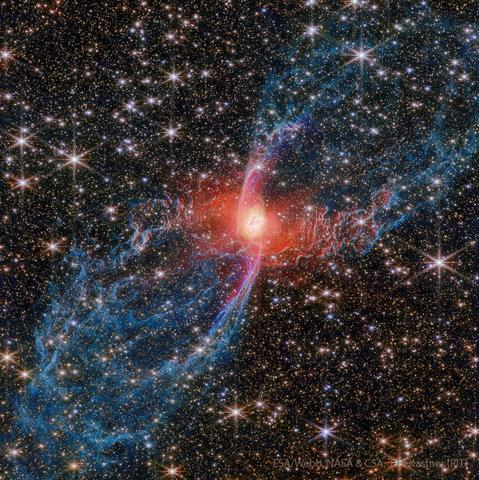
Double detonation: new image shows remains of star destroyed by pair of explosions

2 July 2025

For the first time, astronomers have obtained visual evidence that a star met its end by detonating twice. By studying the centuries-old remains of supernova SNR 0509-67.5 with the European Southern Observatory’s Very Large Telescope (ESO’s VLT), they have found patterns that confirm its star suffered a pair of explosive blasts. Published today, this discovery shows some of the most important explosions in the Universe in a new light.

Most supernovae are the explosive deaths of massive stars, but one important variety comes from an unassuming source. White dwarfs, the small, inactive cores left over after stars like our Sun burn out their nuclear fuel, can produce what astronomers call a Type Ia supernova.

"The explosions of white dwarfs play a crucial role in astronomy,” says Priyam Das, a PhD student at the University of New South Wales Canberra, Australia, who led the study on SNR 0509-67.5 published today in Nature Astronomy. Much of our knowledge of how the Universe expands rests on Type Ia supernovae, and they are also the primary source of iron on our planet, including the iron in our blood. “Yet, despite their importance, the long-standing puzzle of the exact mechanism triggering their explosion remains unsolved," he adds.

All models that explain Type Ia supernovae begin with a white dwarf in a pair of stars. If it orbits close enough to the other star in this pair, the dwarf can steal material from its partner. In the most established theory behind Type Ia supernovae, the white dwarf [...]

VIDEO:
Zooming into a star that detonated twice

For more details, check: https://www.eso.org/public/news/eso2511/.

Credit:

ESO/L. Calçada/N. Risinger (skysurvey.org)/VMC Survey/Digitized Sky Survey 2/P. Das et al. Background stars (Hubble): K. Noll et al. Music: Azul Cobalto

#space #nebula #astrophotography #photography #science #astronomy #physics #nature #NASA #ESA #education
2008 January 15

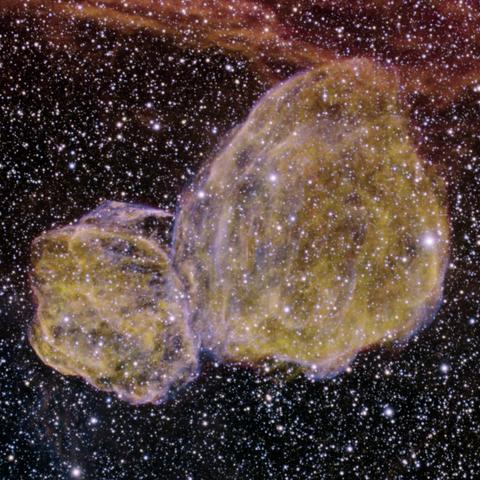
Double Supernova Remnants DEM L316
* Credit & Copyright: Gemini Observatory, GMOS-South, NSF
https://www.gemini.edu/
https://www.nsf.gov/

Explanation:
Are these two supernova shells related? To help find out, the 8-meter Gemini Telescope located high atop a mountain in Chile was pointed at the unusual, huge, double-lobed cloud dubbed DEM L316. The resulting image, shown above, yields tremendous detail. Inspection of the image as well as data taken by the orbiting Chandra X-Ray Observatory indicate how different the two supernova remnants are. In particular, the smaller shell appears to be the result of Type Ia supernova where a white dwarf exploded, while the larger shell appears to be the result of a Type II supernova where a massive normal star exploded. Since those two stellar types evolve on such different time scales, they likely did not form together and so are likely not physically associated. Considering also that no evidence exists that the shells are colliding, the two shells are now hypothesized to be superposed by chance. DEM L316 lies about 160,000 light years away in the neighboring Large Magellanic Cloud (LMC) galaxy, spans about 140 light-years across, and appears toward the southern constellation of the Swordfish (Dorado).

https://apod.nasa.gov/apod/ap080115.html

#space #nebula #astrophotography #photography #science #astronomy #physics #nature #NASA #ESA #education

2025 July 29

A Helix Nebula Deep Field
* Image Credit & Copyright: George Chatzifrantzis
https://app.astrobin.com/u/pithagoras#gallery

Explanation:
Is the Helix Nebula looking at you? No, not in any biological sense, but it does look quite like an eye. The Helix Nebula is so named because it also appears that you are looking down the axis of a helix. In actuality, it is now understood to have a surprisingly complex geometry, including radial filaments and extended outer loops. The Helix Nebula (aka NGC 7293) is one of brightest and closest examples of a planetary nebula, a gas cloud created at the end of the life of a Sun-like star. The remnant central stellar core, destined to become a white dwarf star, glows in light so energetic it causes the previously expelled gas to fluoresce. The featured picture, taken in red, green, and blue but highlighted by light emitted primarily by hydrogen was created from 12 hours of exposure through a personal telescope located in Greece. A close-up of the inner edge of the Helix Nebula shows complex gas knots the origin of which are still being researched.
https://chandra.harvard.edu/deadstar/helix.html
https://en.wikipedia.org/wiki/Helix_Nebula
https://en.wikipedia.org/wiki/Planetary_nebula

https://mathworld.wolfram.com/Helix.html
http://www.astronomyknowhow.com/hydrogen-alpha.htm
https://youtu.be/WnWIt0iz00A

https://apod.nasa.gov/apod/ap250729.html

#space #nebula #astrophotography #photography #science #astronomy #physics #nature #NASA #ESA #education

2023 May 7

The Helix Nebula from CFHT
* Image Credit: CFHT, Coelum, MegaCam, J.-C. Cuillandre (CFHT) & G. A. Anselmi (Coelum)
https://www.cfht.hawaii.edu/
https://www.coelum.com/
https://www.cfht.hawaii.edu/Instruments/Imaging/Megacam/
https://www.cfht.hawaii.edu/~jcc/

Explanation:
Will our Sun look like this one day? The Helix Nebula is one of brightest and closest examples of a planetary nebula, a gas cloud created at the end of the life of a Sun-like star. The outer gasses of the star expelled into space appear from our vantage point as if we are looking down a helix. The remnant central stellar core, destined to become a white dwarf star, glows in light so energetic it causes the previously expelled gas to fluoresce. The Helix Nebula, given a technical designation of NGC 7293, lies about 700 light-years away towards the constellation of the Water Bearer (Aquarius) and spans about 2.5 light-years. The featured picture was taken with the Canada-France-Hawaii Telescope (CFHT) located atop a dormant volcano in Hawaii, USA. A close-up of the inner edge of the Helix Nebula shows complex gas knots of unknown origin.
https://en.wikipedia.org/wiki/Aquarius_(constellation)

https://apod.nasa.gov/apod/ap230507.html

#space #nebula #astrophotography #photography #science #astronomy #physics #nature #NASA #ESA #education
Helix Nebula Zoom

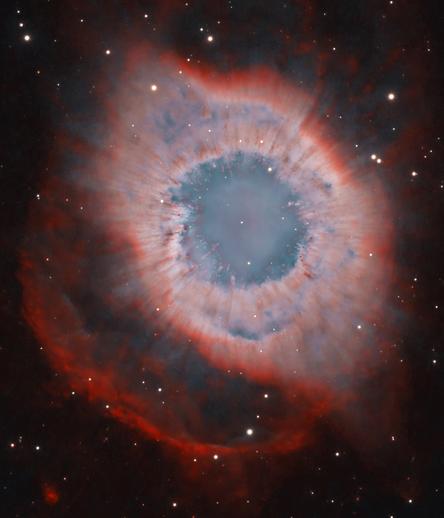
The Helix Nebula, NGC 7293, lies about 700 light-years away in the constellation of Aquarius (the Water Bearer). It is one of the closest and most spectacular examples of a planetary nebula. These exotic objects have nothing to do with planets, but are the final blooming of Sun-like stars before their retirement as white dwarfs. Shells of gas are blown off from a star’s surface, often in intricate and beautiful patterns, and shine under the harsh ultraviolet radiation from the faint, but very hot, central star. The main ring of the Helix Nebula is about two light-years across or half the distance between the Sun and its closest stellar neighbour.

[...] * see ALT-Text

Although the Helix looks very much like a doughnut, studies have shown that it possibly consists of at least two separate discs with outer rings and filaments. The brighter inner disc seems to be expanding at about 100 000 km/h and to have taken about 12 000 years to have formed.

Because the Helix is relatively close — it covers an area of the sky about a quarter of the full Moon — it can be studied in much greater detail than most other planetary nebulae and has been found to have an unexpected and complex structure. All around the inside of the ring are small blobs, known as “cometary knots”, with faint tails extending away from the central star. They look remarkably like droplets of liquid running down a sheet of glass. Although they look tiny, each knot is about as large as our Solar System. These knots have been extensively studied, both with the ESO Very Large Telescope and with the NASA/ESA Hubble Space Telescope, but remain only partially understood.

https://www.eso.org/public/videos/eso0907a/

CREDIT
ESO
(European Organisation for Astronomical Research in the Southern Hemisphere)

#space #nebula #astrophotography #photography #science #astronomy #physics #nature #NASA #ESA #education
2008 April 13

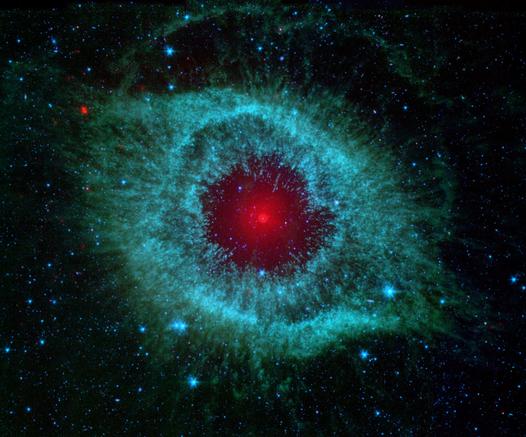
Curious Cometary Knots in the Helix Nebula
* Credit: C. R. O'Dell and K. Handron (Rice University), NASA
http://www.nasa.gov/

Explanation:
What causes unusual knots of gas and dust in planetary nebulas? Seen also in the Ring Nebula, the Dumbbell Nebula and NGC 2392, the knots' existence was not initially predicted and their origins are still not well understood. Pictured above is a fascinating image of the Helix Nebula by the Hubble Space Telescope showing tremendous detail of its mysterious gaseous knots. The above cometary knots have masses similar to the Earth but have radii typically several times the orbit of Pluto. One hypothesis for the fragmentation and evolution of the knots includes existing gas being driven out by a less dense but highly energetic stellar wind of the central evolving star. The Helix Nebula is the closest example of a planetary nebula created at the end of the life of a Sun-like star. The Helix Nebula, given a technical designation of NGC 7293, lies about 700 light-years away towards the constellation of Aquarius.

https://en.wikipedia.org/wiki/Rayleigh%E2%80%93Taylor_instability
https://en.wikipedia.org/wiki/Stellar_wind
https://ui.adsabs.harvard.edu/abs/2020MNRAS.491..758A/abstract

https://apod.nasa.gov/apod/ap080413.html

#space #nebula #astrophotography #photography #science #astronomy #physics #nature #NASA #ESA #education
From Wikipedia, the free encyclopedia

[...]
The Helix Nebula is thought to be shaped like a prolate spheroid with strong density concentrations toward the filled disk along the equatorial plane, whose major axis is inclined about 21° to 37° from our vantage point. The size of the inner disk is 8×19 arcmin in diameter (0.52 pc); the outer torus is 12×22 arcmin in diameter (0.77 pc); and the outer-most ring is about 25 arcmin in diameter (1.76 pc). The outer-most ring appears flattened on one side due to it colliding with the ambient interstellar medium.

Expansion of the whole planetary nebula structure is estimated to have occurred in the last 6,560 years, and 12,100 years for the inner disk. Spectroscopically, the outer ring's expansion rate is 40 km/s, and about 32 km/s for the inner disk.
The Helix Nebula was the first planetary nebula discovered to contain cometary knots. Its main ring contains knots of nebulosity, which have now been detected in several nearby planetary nebulae, especially those with a molecular envelope like the Ring nebula and the Dumbbell Nebula.

These knots are radially symmetrical (from the CS) and are described as "cometary", each centered on a core of neutral molecular gas and containing bright local photoionization fronts or cusps towards the central star and tails away from it. All tails extend away from the Planetary Nebula Nucleus (PNN) in a radial direction. Excluding the tails, each knot is approximately the size of the Solar System, while each of the cusp knots are optically thick due to Lyc photons from the CS. There are about 40,000 cometary knots in the Helix Nebula.
[...] * more in the ALT-Text

CREDIT
+ Text excerpt
by Contributors to Wikimedia projects
+ Video credit
Magnetosheath (YT)
https://www.youtube.com/channel/UC2wcz4CLDO7CrSKOUl9o8qg/about

#space #nebula #astrophotography #photography #science #astronomy #physics #nature #NASA #ESA #education
2021 October 14

NGC 7293: The Helix Nebula
* Image Credit & Copyright: Ignacio Diaz Bobillo
https://www.pampaskies.com/gallery3/index.php

Explanation:
A mere seven hundred light years from Earth, toward the constellation Aquarius, a sun-like star is dying. Its last few thousand years have produced the Helix Nebula (NGC 7293), a well studied and nearby example of a Planetary Nebula, typical of this final phase of stellar evolution. A total of 90 hours of exposure time have gone in to creating this expansive view of the nebula. Combining narrow band image data from emission lines of hydrogen atoms in red and oxygen atoms in blue-green hues, it shows remarkable details of the Helix's brighter inner region about 3 light-years across. The white dot at the Helix's center is this Planetary Nebula's hot, central star. A simple looking nebula at first glance, the Helix is now understood to have a surprisingly complex geometry.
https://www.pampaskies.com/gallery3/Deep-Space-Objects/Helix_Oxygen_crop2_small
https://science.nasa.gov/missions/hubble/a-new-twist-on-an-old-nebula/

https://apod.nasa.gov/apod/ap211014.html

#space #nebula #astrophotography #photography #science #astronomy #physics #nature #NASA #ESA #education
2009 December 31

Dust and the Helix Nebula
* NASA, JPL-Caltech, Kate Su (Steward Obs., U. Arizona), et al.
http://ssc.spitzer.caltech.edu/
https://astro.arizona.edu/
https://arxiv.org/abs/astro-ph/0702296
http://www.nasa.gov/home/index.html

Explanation:
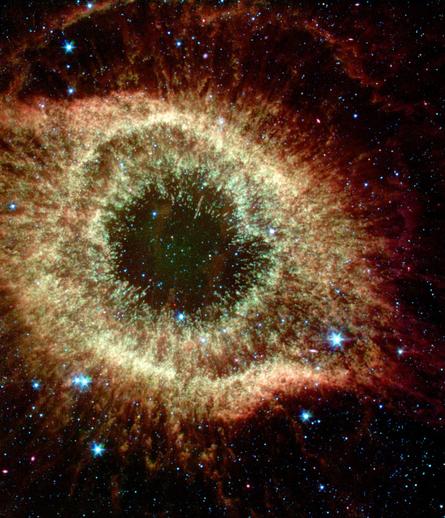
Dust makes this cosmic eye look red. The eerie Spitzer Space Telescope image shows infrared radiation from the well-studied Helix Nebula (NGC 7293) a mere 700 light-years away in the constellation Aquarius. The two light-year diameter shroud of dust and gas around a central white dwarf has long been considered an excellent example of a planetary nebula, representing the final stages in the evolution of a sun-like star. But the Spitzer data show the nebula's central star itself is immersed in a surprisingly bright infrared glow. Models suggest the glow is produced by a dust debris disk. Even though the nebular material was ejected from the star many thousands of years ago, the close-in dust could be generated by collisions in a reservoir of objects analogous to our own solar system's Kuiper Belt or cometary Oort cloud. Formed in the distant planetary system, the comet-like bodies would have otherwise survived even the dramatic late stages of the star's evolution.

https://coolcosmos.ipac.caltech.edu//
http://maps.seds.org/Stars_en/Fig/aquarius.html
https://apod.nasa.gov/apod/ap041210.html
http://www2.ess.ucla.edu/~jewitt/kb.html
!> https://en.wikipedia.org/wiki/Stellar_evolution

https://apod.nasa.gov/apod/ap091231.html

#space #nebula #astrophotography #photography #science #astronomy #physics #nature #NASA #ESA #education
2006 January 12

Infrared Helix
* Credit: J. Hora (Harvard-Smithsonian CfA) et al., (SSC/Caltech), JPL-Caltech, NASA
https://www.cfa.harvard.edu/
https://irsa.ipac.caltech.edu/data/SPITZER/docs/
http://www.jpl.nasa.gov/
http://www.nasa.gov/home/index.html

Explanation:
Over six hundred light years from Earth, in the constellation Aquarius, a sun-like star is dying. Its last few thousand years have produced the Helix Nebula (NGC 7293), a well studied and nearby example of a Planetary Nebula, typical of this final phase of stellar evolution. Emission in this infrared Spitzer Space Telescope image of the Helix comes mostly from the nebula's molecular hydrogen gas. The gas appears to be clumpy, forming thousands of comet-shaped knots each spanning about twice the size of our solar system. Bluer, more energetic radiation is seen to come from the heads with redder emission from the tails, suggesting that they are more shielded from the central star's winds and intense ultraviolet radiation. The nebula itself is about 2.5 light-years across. The Sun is expected to go through its own Planetary Nebula phase ... in another 5 billion years.

!> http://hawastsoc.org/deepsky/aqr/index.html

https://apod.nasa.gov/apod/ap060112.html

#space #nebula #astrophotography #photography #science #astronomy #physics #nature #NASA #ESA #education
2025 July 31

Supernova 2025rbs in NGC 7331
* Image Credit: Ben Godson (University of Warwick)
https://warwick.ac.uk/fac/sci/physics/research/astro/people/bengodson/

Explanation:
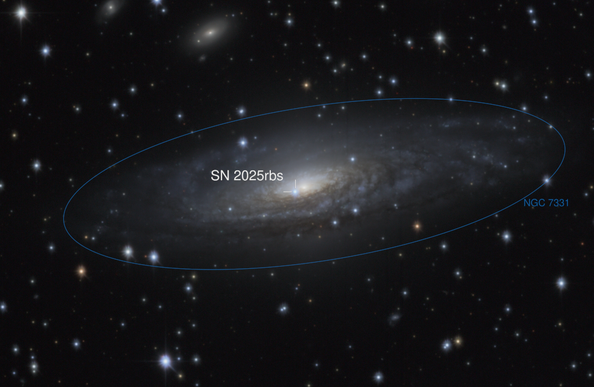
A long time ago in a galaxy 50 million light-years away, a star exploded. Light from that supernova was first detected by telescopes on planet Earth on July 14th though, and the extragalactic transient is now known to astronomers as supernova 2025rbs. Presently the brightest supernova in planet Earth's sky, 2025rbs is a Type Ia supernova, likely caused by the thermonuclear detonation of a white dwarf star that accreted material from a companion in a binary star system. Type Ia supernovae are used as standard candles to establish the distance scale of the universe. The host galaxy of 2025rbs is NGC 7331. Itself a bright spiral galaxy in the northern constellation Pegasus, NGC 7331 is often touted as an analog to our own Milky Way.
https://goto-observatory.org/bright-supernova-2025rbs-discovered-by-goto/
https://www.wis-tns.org/object/2025rbs
https://rochesterastronomy.org/supernova.html

https://apod.nasa.gov/apod/ap250731.html

#space #supernova #astrophotography #photography #science #astronomy #physics #nature #NASA #ESA #education
Type Ia Supernovae
By jmbrill

Roman will use type Ia supernovae to measure cosmic distances, which will help us understand how the universe has expanded over time.

* Video Credit:
NASA Goddard's Scientific Visualization Studio

Roman will see thousands of exploding stars called supernovae across vast stretches of time and space. Using these observations, astronomers aim to shine a light on several cosmic mysteries – primarily dark energy. Roman will use type Ia supernovae to measure cosmic distances, which will help us understand how the universe has expanded over time.

Roman’s supernova survey will help clear up clashing measurements of how fast the universe is currently expanding, and even provide a new way to probe the distribution of dark matter, which is detectable only through its gravitational effects. One of the mission’s primary science goals involves using supernovae to help pin down the nature of dark energy – the unexplained cosmic pressure that’s speeding up the expansion of the universe.

Roman will use multiple methods to investigate dark energy. One involves surveying the sky for a special type of exploding star, called a type Ia supernova.

Many supernovae occur when massive stars run out of fuel, rapidly collapse under their own weight, and then explode because of strong shock waves that propel out of their interiors. These supernovae occur about once every 50 years in our Milky Way galaxy. But evidence shows that type Ia supernovae originate from some binary star systems that contain at least one white dwarf – the small, hot core remnant of a Sun-like star. Type Ia supernovae are much rarer, happening roughly once every 500 years in the Milky Way.
[...]
Read more in next reply

https://science.nasa.gov/mission/roman-space-telescope/type-ia-supernovae/

You might also be interested in:
TOPIC> "As Far As We Can See" https://defcon.social/@grobi/114626118056153533

#space #supernova #astrophotography #photography #science #astronomy #physics #nature #NASA #ESA #education
By jmbrill

[...]
In some cases, the dwarf may siphon material from its companion. This ultimately triggers a runaway reaction that detonates the thief once it reaches a specific point where it has gained so much mass that it becomes unstable. Astronomers have also found evidence supporting another scenario, involving two white dwarfs that spiral toward each other until they merge. If their combined mass is high enough that it leads to instability, they, too, may produce a type Ia supernova.

These explosions peak at a similar, known intrinsic brightness, making type Ia supernovae so-called standard candles – objects or events that emit a specific amount of light, allowing scientists to find their distance with a straightforward formula. Because of this, astronomers can determine how far away the supernovae are by simply measuring how bright they appear.

Astronomers will also use Roman to study the light of these supernovae to find out how quickly they appear to be moving away from us. By comparing how fast they’re receding at different distances, scientists will trace cosmic expansion over time. This will help us understand whether and how dark energy has changed throughout the history of the universe.

Previous type Ia supernova surveys have concentrated on the relatively nearby universe, largely due to instrument limitations. Roman’s infrared vision, gigantic field of view, and exquisite sensitivity will dramatically extend the search, pulling the cosmic curtains far enough aside to allow astronomers to spot thousands of distant type Ia supernovae.

Roman will study dark energy’s influence in detail over more than half of the universe’s history, when it was between about 4 and 12 billion years old. Exploring this relatively unprobed region will help scientists add crucial pieces to the dark energy puzzle.

Video Credit:
NGSVS

https://science.nasa.gov/mission/roman-space-telescope/type-ia-supernovae/

#space #supernova #astrophotography #photography #science #astronomy #physics #nature #NASA #ESA #education

2025 August 22

A Tale of Two Nebulae
* Image Credit & Copyright: Kent Biggs
https://www.kentbiggs.com/index.htm

Explanation:
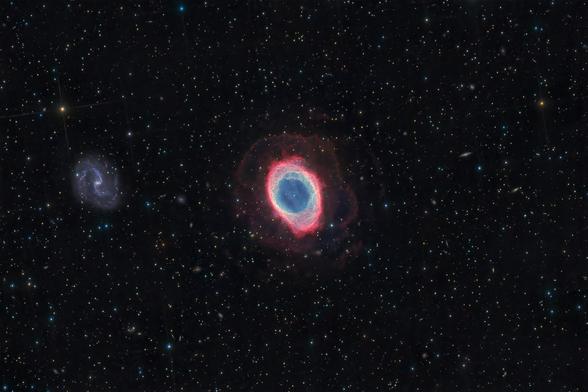
This colorful telescopic view towards the musical northern constellation Lyra reveals the faint outer halos and brighter central ring-shaped region of M57, popularly known as the Ring Nebula. To modern astronomers M57 is a well-known planetary nebula. With a central ring about one light-year across, M57 is definitely not a planet though, but the gaseous shroud of one of the Milky Way's dying sun-like stars. Roughly the same apparent size as M57, the fainter and more often overlooked barred spiral galaxy at the left is IC 1296. In fact, over 100 years ago IC 1296 would have been known as a spiral nebula. By chance the pair are in the same field of view, and while they appear to have similar sizes they are actually very far apart. At a distance of a mere 2,000 light-years M57 is well within our own Milky Way galaxy. Extragalactic IC 1296 (aka PGC62532) is more like 200,000,000 light-years distant. That's about 100,000 times farther away than M57 but since they appear roughly similar in size, former spiral nebula IC 1296 must also be about 100,000 times larger than planetary nebula M57. Look closely at the sharp 21st century astroimage to spot even more distant background galaxies scattered through the frame.
https://www.kentbiggs.com/images/planetaries/M57.htm
https://webbtelescope.org/contents/media/images/01H82G0PP38P6PBXQ11BEVSMY0

https://en.wikipedia.org/wiki/Planetary_nebula
https://physics.weber.edu/palen/phsx1040/lectures/lplanneb.html
https://courses.ems.psu.edu/astro801/content/l9_p2.html

https://apod.nasa.gov/apod/ap250822.html

#space #nebula #astrophotography #photography #science #astronomy #physics #nature #NASA

2025 August 24

The Spinning Pulsar of the Crab Nebula
* Image Credit: NASA: X-ray: Chandra (CXC)
https://www.nasa.gov/
https://chandra.harvard.edu/
* Optical: Hubble (STScI)
https://www.stsci.edu/hst
* Infrared: Spitzer (JPL-Caltech)
https://www.spitzer.caltech.edu/

Explanation:
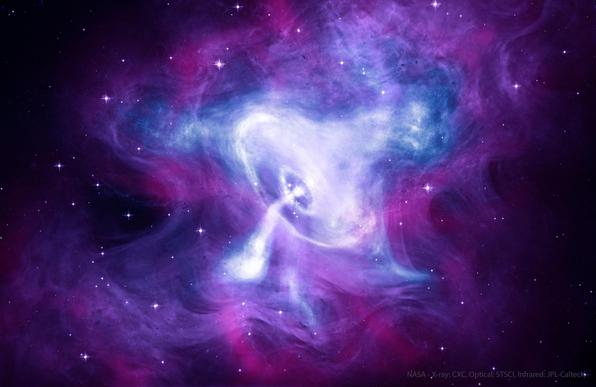
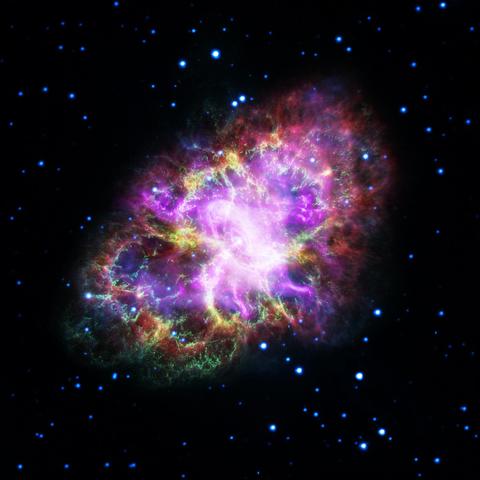
At the core of the Crab Nebula lies a city-sized, magnetized neutron star spinning 30 times a second. Known as the Crab Pulsar, it is the bright spot in the center of the gaseous swirl at the nebula's core. About twelve light-years across, the spectacular picture frames the glowing gas, cavities and swirling filaments near the Crab Nebula's center. The featured picture combines visible light from the Hubble Space Telescope in purple, X-ray light from the Chandra X-ray Observatory in blue, and infrared light from the Spitzer Space Telescope in red. Like a cosmic dynamo, the Crab pulsar powers the emission from the nebula, driving a shock wave through surrounding material and accelerating the spiraling electrons. With more mass than the Sun and the density of an atomic nucleus,the spinning pulsar is the collapsed core of a massive star that exploded. The outer parts of the Crab Nebula are the expanding remnants of the star's component gases. The supernova explosion was witnessed on planet Earth in the year 1054.
https://chandra.harvard.edu/photo/2018/crab/
https://chandra.harvard.edu/chronicle/0201/vela.html
https://apod.nasa.gov/apod/ap010602.html
https://en.wikipedia.org/wiki/Crab_Pulsar
https://en.wikipedia.org/wiki/Neutron_star
http://hyperphysics.phy-astr.gsu.edu/hbase/Nuclear/nucuni.html

https://defcon.social/@grobi/114793535752274563
https://defcon.social/@grobi/114793623955569092

https://apod.nasa.gov/apod/ap250824.html

#space #nebula #supernova #pulsar #astrophotography #photography #science #astronomy #physics #nature #NASA

2022 March 4

The Multiwavelength Crab
* Image Credit: NASA, ESA, G. Dubner (IAFE, CONICET-University of Buenos Aires) et al.;
A. Loll et al.; T. Temim et al.; F. Seward et al.; VLA/NRAO/AUI/NSF; Chandra/CXC;
Spitzer/JPL-Caltech; XMM-Newton/ESA; Hubble/STScI

https://arxiv.org/abs/1704.02968

Explanation:
The Crab Nebula is cataloged as M1, the first object on Charles Messier's famous list of things which are not comets. In fact, the Crab is now known to be a supernova remnant, expanding debris from massive star's death explosion, witnessed on planet Earth in 1054 AD. This brave new image offers a 21st century view of the Crab Nebula by presenting image data from across the electromagnetic spectrum as wavelengths of visible light. From space, Chandra (X-ray) XMM-Newton (ultraviolet), Hubble (visible), and Spitzer (infrared), data are in purple, blue, green, and yellow hues. From the ground, Very Large Array radio wavelength data is shown in red. One of the most exotic objects known to modern astronomers, the Crab Pulsar, a neutron star spinning 30 times a second, is the bright spot near picture center. Like a cosmic dynamo, this collapsed remnant of the stellar core powers the Crab's emission across the electromagnetic spectrum. Spanning about 12 light-years, the Crab Nebula is 6,500 light-years away in the constellation Taurus.

https://apod.nasa.gov/apod/ap220304.html

#space #nebula #pulsar #astrophotography #photography #science #astronomy #physics #nature #NASA

The ultimate movie (SOUND ON!) of the millisecond pulsar in the heart of the Crab Nebula, a spinning neutron star rotating once every 33 milliseconds, or 30 times each second.
This nasahubble movie shows dynamic rings, wisps and jets of matter and antimatter around the pulsar in the Crab Nebula as observed in optical light. The Crab Pulsar is one of very few pulsars to be identified optically. The optical pulsar is roughly 20 kilometres (12 mi) in diameter.

CREDIT
NASA/nasahubble

#space #nebula #astrophotography #photography #science #astronomy #physics #nature #NASA

2024 July 23

The Crab Nebula from Visible to X-Ray
* Image Credit: NASA, ESA, ASI, Hubble, Chandra, IXPE
https://www.nasa.gov/
https://www.esa.int/
https://www.asi.it/
https://science.nasa.gov/mission/hubble/
https://www.nasa.gov/mission/chandra-x-ray-observatory/
https://www.nasa.gov/mission/imaging-x-ray-polarimetry-explorer-ixpe/

Explanation:
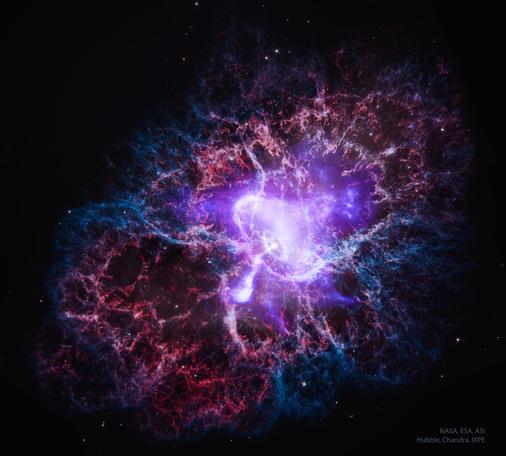
What powers the Crab Nebula? A city-sized magnetized neutron star spinning around 30 times a second. Known as the Crab Pulsar, it is the bright spot in the center of the gaseous swirl at the nebula's core. About 10 light-years across, the spectacular picture of the Crab Nebula (M1) frames a swirling central disk and complex filaments of surrounding and expanding glowing gas. The picture combines visible light from the Hubble Space Telescope in red and blue with X-ray light from the Chandra X-ray Observatory shown in white, and diffuse X-ray emission detected by Imaging X-ray Polarimetry Explorer (IXPE) in diffuse purple. The central pulsar powers the Crab Nebula's emission and expansion by slightly slowing its spin rate, which drives out a wind of energetic electrons. The featured image released today, the 25th Anniversary of the launch of NASA's flagship-class X-ray Observatory: Chandra.

https://apod.nasa.gov/apod/ap240723.html

#space #nebula #pulsar #astrophotography #photography #science #astronomy #physics #matter #antimatter #nature #NASA #ESA #ASI

2024 August 23

Supernova Remnant CTA 1
* Image Credit & Copyright: Thomas Lelu

Explanation:
There is a quiet pulsar at the heart of CTA 1. The supernova remnant was discovered as a source of emission at radio wavelengths by astronomers in 1960 and since identified as the result of the death explosion of a massive star. But no radio pulses were detected from the expected pulsar, the rotating neutron star remnant of the massive star's collapsed core. Seen about 10,000 years after the initial supernova explosion, the interstellar debris cloud is faint at optical wavelengths. CTA 1's visible wavelength emission from still expanding shock fronts is revealed in this deep telescopic image, a frame that spans about 2 degrees across a starfield in the northern constellation of Cepheus. While no pulsar has since been found at radio wavelengths, in 2008 the Fermi Gamma-ray Space Telescope detected pulsed emission from CTA 1, identifying the supernova remnant's rotating neutron star. The source has been recognized as the first in a growing class of pulsars that are quiet at radio wavelengths but pulse in high-energy gamma-rays.

https://apod.nasa.gov/apod/ap240823.html

#space #nebula #pulsar #astrophotography #photography #science #astronomy #physics #nature #NASA

2024 April 16

Filaments of the Vela Supernova Remnant
* Image Credit: CTIO, NOIRLab, DOE, NSF, AURA
https://noirlab.edu/public/programs/ctio/
https://noirlab.edu/
https://www.energy.gov/
https://www.nsf.gov/
https://www.aura-astronomy.org/
* Processing: T. A. Rector (U. Alaska Anchorage), M. Zamani & D. de Martin (’s NOIRLab)
http://aftar.uaa.alaska.edu/
https://www.uaa.alaska.edu/
https://mahdizamani.com/about
https://noirlab.edu/

Explanation:
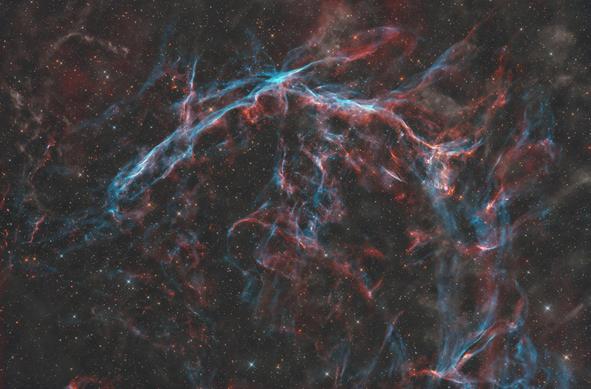
The explosion is over, but the consequences continue. About eleven thousand years ago, a star in the constellation of Vela could be seen to explode, creating a strange point of light briefly visible to humans living near the beginning of recorded history. The outer layers of the star crashed into the interstellar medium, driving a shock wave that is still visible today. The featured image captures some of that filamentary and gigantic shock in visible light. As gas flies away from the detonated star, it decays and reacts with the interstellar medium, producing light in many different colors and energy bands. Remaining at the center of the Vela Supernova Remnant is a pulsar, a star as dense as nuclear matter that spins around more than ten times in a single second.

https://apod.nasa.gov/apod/ap240416.html

#space #nebula #astrophotography #photography #science #astronomy #physics #nature #NASA

2025 August 31

NGC 7027: The Pillow Planetary Nebula
* Image Credit: NASA, ESA, Hubble
http://www.nasa.gov/
https://www.esa.int/
https://science.nasa.gov/mission/hubble/overview/about-hubble/
* Processing: Delio Tolivia Cadrecha
https://www.instagram.com/deliotolivia/

Explanation:
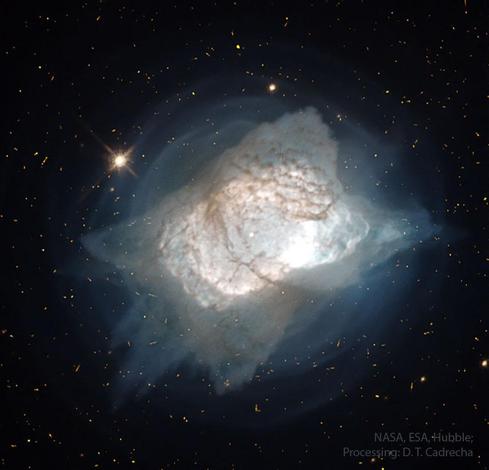
What created this unusual planetary nebula? Dubbed the Pillow Nebula and the Flying Carpet Nebula, NGC 7027 is one of the smallest, brightest, and most unusually shaped planetary nebulas known. Given its expansion rate, NGC 7027 first started expanding, as visible from Earth, about 600 years ago. For much of its history, the planetary nebula has been expelling shells, as seen in blue in the featured image by the Hubble Space Telescope. In modern times, though, for reasons unknown, it began ejecting gas and dust (seen in brown) in specific directions that created a new pattern that seems to have four corners. What lies at the nebula's center is unknown, with one hypothesis holding it to be a close binary star system where one star sheds gas onto an erratic disk orbiting the other star. NGC 7027, about 3,000 light years away, was first discovered in 1878 and can be seen with a standard backyard telescope toward the constellation of the Swan (Cygnus).

https://apod.nasa.gov/apod/ap250831.html

#space #nebula #astrophotography #photography #science #astronomy #physics #nature #NASA #ESA

2025 September 3

Cir X-1: Jets in the Africa Nebula
* Image Credit: J. English (U. Manitoba) & K. Gasealahwe (U. Cape Town), SARAO, MeerKAT, ThunderKAT
http://www2.physics.umanitoba.ca/u/english/
https://umanitoba.ca/science/physics-and-astronomy
https://www.researchgate.net/profile/Kelebogile-Gasealahwe
https://science.uct.ac.za/departments/astronomy
https://www.sarao.ac.za/
https://www.sarao.ac.za/science/meerkat/
* Science: K. Gasealahwe, K. Savard (U. Oxford) et al.
https://www.physics.ox.ac.uk/our-people/savard
https://www.physics.ox.ac.uk/
https://arxiv.org/abs/2507.22998
* Text: J. English & K. Savard

Explanation:
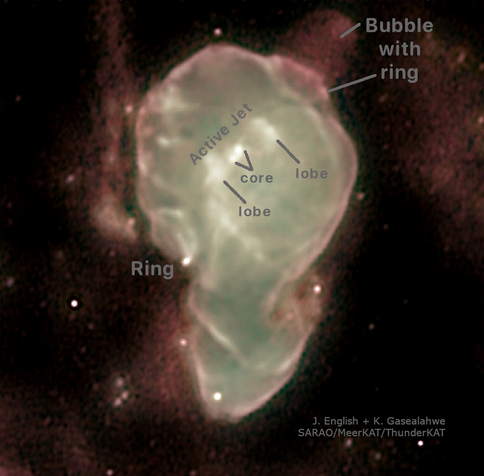
How soon do jets form when a supernova gives birth to a neutron star? The Africa Nebula provides clues. This supernova remnant surrounds Circinus X-1, an X-ray emitting neutron star and the companion star it orbits. The image, from the ThunderKAT collaboration on the MeerKAT radio telescope situated in South Africa, shows the bright core-and-lobe structure of Cir X-1’s currently active jets inside the nebula. A mere 4600 years old, Cir X-1 could be the "Little Sister" of microquasar SS 433*. However, the newly discovered bubble exiting from a ring-like hole in the upper right of the nebula, along with a ring to the bottom left, demonstrate that other jets previously existed. Computer simulations indicate those jets formed within 100 years of the explosion and lasted up to 1000 years. Surprisingly, to create the observed bubble, the jets need to be more powerful than young neutron stars were previously thought to produce.

https://en.wikipedia.org/wiki/Circinus_X-1
https://science.nasa.gov/universe/neutron-stars-are-weird/

https://apod.nasa.gov/apod/ap250903.html

#space #nebula #astrophotography #photography #science #astronomy #physics #nature #NASA #ESA

Type 1a Supernova Animation

This animation represents a binary star system in which a white dwarf accretes matter from a normal companion star. Matter streaming from the red star accumulates on the white dwarf until the dwarf explodes. With its partner destroyed, the normal star careens into space. This scenario results in what astronomers refer to as a Type Ia supernova.

Credits: NASA's Goddard Space Flight Center/Walt Feimer

#space #nebula #astrophotography #photography #science #astronomy #physics #nature #NASA #ESA

2025 November 24

Apep: Unusual Dust Shells from Webb
* Image Credit: NASA, ESA, CSA, STScI, JWST
https://www.nasa.gov/
https://www.esa.int/
https://www.asc-csa.gc.ca/eng/
https://www.stsci.edu/
https://science.nasa.gov/mission/webb/about-overview/
* Science: Y. Han (Caltech), R. White (Macquarie U.)
https://www.gps.caltech.edu/people/yinuo-han
https://www.gps.caltech.edu/
https://researchers.mq.edu.au/en/persons/ryan-white/
https://www.mq.edu.au/
* Image Processing: A. Pagan (STScI)
https://www.linkedin.com/in/alyssa-pagan-058170144

Explanation:
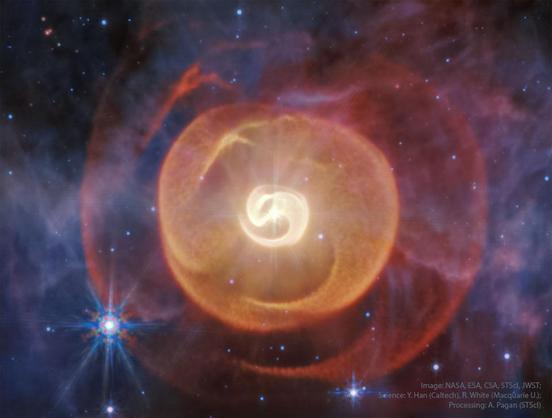
What created this unusual space sculpture? Stars. This unusual system of swirls and shells, known as Apep, was observed in unprecedented detail by NASA’s James Webb Space Telescope in infrared light in 2024. Observations indicate that the unusual shape originates from two massive Wolf-Rayet stars orbiting each other every 190 years with each close passes causing a new shell of dust and gas to be expelled. Holes in these shells are thought to be caused by a third orbiting star. This stellar dust dance will likely continue for hundreds of thousands of years, possibly ending only when one of the massive stars runs out of internal nuclear fuel and explodes in a supernova punctuated by a burst of gamma-rays.
https://science.nasa.gov/asset/webb/wolf-rayet-apep-miri-image/
https://apod.nasa.gov/apod/ap250129.html
https://en.wikipedia.org/wiki/List_of_most_massive_stars
https://en.wikipedia.org/wiki/Apep_(star_system)
https://science.nasa.gov/universe/stars/
https://science.nasa.gov/ems/07_infraredwaves/
https://science.nasa.gov/mission/webb/
https://www.nsf.gov/news/all-we-are-dust-interstellar-wind
https://apod.nasa.gov/apod/ap200304.html
https://www.youtube.com/watch?v=wymMn-SmALYhttps://www.youtube.com/watch?v=wymMn-SmALY
https://science.nasa.gov/universe/gamma-ray-bursts-harvesting-knowledge-from-the-universes-most-powerful-explosions/

https://apod.nasa.gov/apod/ap251124.html

#space #nebula #astrophotography #photography #science #astronomy #physics #nature #NASA #ESA #apod

Wolf-Rayet Apep Visualization — James Webb Space Telescope

This scientific visualization models what three of the four dust shells sent out by two Wolf-Rayet stars in the Apep system look like in 3D based on mid-infrared observations from NASA’s James Webb Space Telescope. Apep is made up of two Wolf-Rayet binary stars that are orbiting together with a third supergiant star. For 25 years during every 190-year orbit, the Wolf-Rayet stars’ winds collide, producing and sending out new waves of amorphous carbon dust. The width of the widest bubble is at least 4.6 light-years across.

Credit:
Video: NASA, ESA, CSA, STScI
Simulation: Yinuo Han (CALTECH), Ryan White (Macquarie University)
Image processing: Alyssa Pagan (STScI)
Visualization: Christian Nieves (STScI)

#space #nebula #astrophotography #photography #science #astronomy #physics #nature #NASA #ESA #APOD

2025 November 28

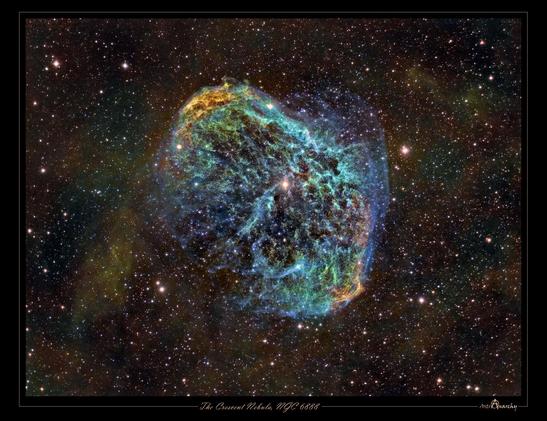
NGC 6888: The Crescent Nebula
* Image Credit & Copyright: Greg Bass
https://app.astrobin.com/u/1loosetooth#gallery

Explanation:
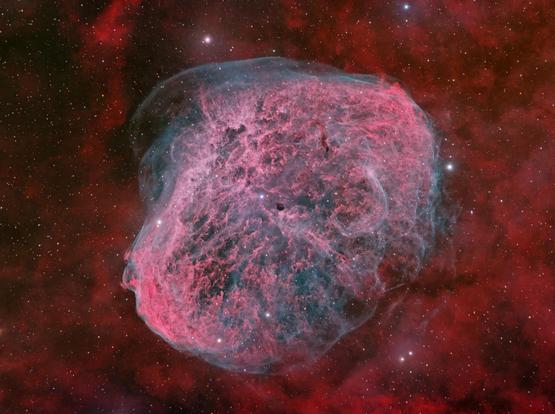
NGC 6888, also known as the Crescent Nebula, is a about 25 light-years across, a cosmic bubble blown by winds from its central, massive star. This deep telescopic image includes narrowband image data, to isolate light from hydrogen and oxygen atoms. The oxygen atoms produce the blue-green hue that seems to enshroud the nebula's detailed folds and filaments. Visible within the nebula, NGC 6888's central star is classified as a Wolf-Rayet star (WR 136). The star is shedding its outer envelope in a strong stellar wind, ejecting the equivalent of the Sun's mass every 10,000 years. In fact, the Crescent Nebula's complex structures are likely the result of this strong wind interacting with material ejected in an earlier phase. Burning fuel at a prodigious rate and near the end of its stellar life, this star should ultimately go out with a bang in a spectacular supernova explosion. Found in the nebula rich constellation Cygnus, NGC 6888 is about 5,000 light-years away.
https://app.astrobin.com/i/8p42ig
https://science.nasa.gov/missions/hubble/hubble-watches-star-tear-apart-its-neighborhood/
http://cfa-www.harvard.edu/~pberlind/atlas/htmls/wrstars.html
https://oneminuteastronomer.com/5995/crescent-nebula-ngc-6888/
http://chandra.harvard.edu/photo/2003/ngc6888/
https://en.wikipedia.org/wiki/Wolf%E2%80%93Rayet_star#Supernovae
https://en.wikipedia.org/wiki/Stellar_wind

https://apod.nasa.gov/apod/fap/ap251128.html

#space #nebula #astrophotography #photography #science #astronomy #physics #nature #NASA #ESA #apod

2012 August 16

NGC 6888: The Crescent Nebula
* Image Credit & Copyright: J-P Metsävainio (Astro Anarchy)
https://astroanarchy.blogspot.com/

Explanation:
NGC 6888, also known as the Crescent Nebula, is a cosmic bubble about 25 light-years across, blown by winds from its central, bright, massive star. This colorful portrait of the nebula uses narrow band image data combined in the Hubble palette. It shows emission from sulfur, hydrogen, and oxygen atoms in the wind-blown nebula in red, green and blue hues. NGC 6888's central star is classified as a Wolf-Rayet star (WR 136). The star is shedding its outer envelope in a strong stellar wind, ejecting the equivalent of the Sun's mass every 10,000 years. The nebula's complex structures are likely the result of this strong wind interacting with material ejected in an earlier phase. Burning fuel at a prodigious rate and near the end of its stellar life this star should ultimately go out with a bang in a spectacular supernova explosion. Found in the nebula rich constellation Cygnus, NGC 6888 is about 5,000 light-years away.
https://astroanarchy.blogspot.com/2011/01/ngc-6888-crescent-nebula-reprocessed.html
http://hubblesite.org/gallery/behind_the_pictures/meaning_of_color/eagle.php
https://apod.nasa.gov/apod/ap080424.html
https://apod.nasa.gov/apod/ap060430.html

https://apod.nasa.gov/apod/ap120816.html

#space #nebula #astrophotography #photography #science #astronomy #physics #nature #NASA #ESA

2015 December 4

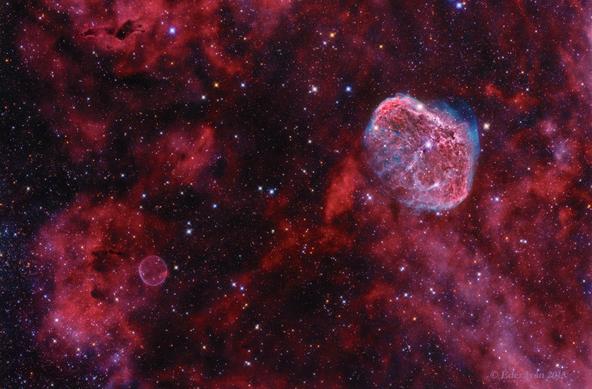
Cygnus: Bubble and Crescent
* Image Credit & Copyright: Ivan Eder
https://www.astroeder.com/

Explanation:
These clouds of gas and dust drift through rich star fields along the plane of our Milky Way Galaxy toward the high flying constellation Cygnus. Caught within the telescopic field of view are the Soap Bubble (lower left) and the Crescent Nebula (upper right). Both were formed at a final phase in the life of a star. Also known as NGC 6888, the Crescent was shaped as its bright, central massive Wolf-Rayet star, WR 136, shed its outer envelope in a strong stellar wind. Burning through fuel at a prodigious rate, WR 136 is near the end of a short life that should finish in a spectacular supernova explosion. recently discovered Soap Bubble Nebula is likely a planetary nebula, the final shroud of a lower mass, long-lived, sun-like star destined to become a slowly cooling white dwarf. While both are some 5,000 light-years or so distant, the larger Crescent Nebula is around 25 light-years across.
https://www.astroeder.com/ngc6888_bub_eder_en.html

https://apod.nasa.gov/apod/ap151204.html

#space #nebula #astrophotography #photography #science #astronomy #physics #nature #NASA #ESA

2015 January 13

The Soap Bubble Nebula
* Credit & Copyright: T. Rector (U. Alaska Anchorage), H. Schweiker (WIYN), NOAO, AURA, NSF
https://www.aura-astronomy.org/
https://www.nsf.gov/

Explanation:
Adrift in the rich star fields of the constellation Cygnus, this lovely, symmetric nebula was only recognized a few years ago and does not yet appear in some astronomical catalogs. In fact, amateur astronomer Dave Jurasevich identified it as a nebula on 2008 July 6 in his images of the complex Cygnus region that included the Crescent Nebula (NGC 6888). He subsequently notified the International Astronomical Union. Only eleven days later the same object was independently identified by Mel Helm at Sierra Remote Observatories, imaged by Keith Quattrocchi and Helm, and also submitted to the IAU as a potentially unknown nebula. The nebula, appearing on the left of the featured image, is now known as the Soap Bubble Nebula. What is the newly recognized nebula? Most probably it is a planetary nebula, a final phase in the life of a sun-like star.

https://apod.nasa.gov/apod/ap150113.html

#space #nebula #astrophotography #photography #science #astronomy #physics #nature #NASA #ESA

2006 March 24

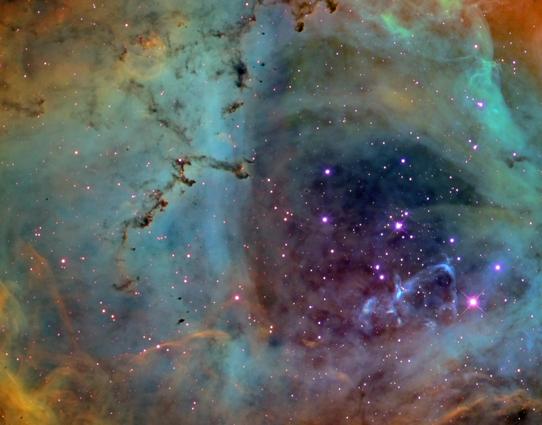
When Roses Aren't Red
* Credit & Copyright: Jay Ballauer (All About Astro, 3RF)

Explanation:
Not all roses are red of course, but they can still be very pretty. Likewise, the beautiful Rosette Nebula and other star forming regions are often shown in astronomical images with a predominately red hue - in part because the dominant emission in the nebula is from hydrogen atoms. Hydrogen's strongest optical emission line, known as H-alpha, is in the red region of the spectrum, but the beauty of an emission nebula need not be appreciated in red light alone. Other atoms in the nebula are also excited by energetic starlight and produce narrow emission lines as well. In this gorgeous view of the Rosette's central regions, narrow band images are combined to show emission from sulfur atoms in red, hydrogen in blue, and oxygen in green. In fact, the scheme of mapping these narrow atomic emission lines into broader colors is adopted in many Hubble images of stellar nurseries. This image spans about 50 light-years in the constellation Monoceros, at the 3,000 light-year estimated distance of the Rosette Nebula.

https://apod.nasa.gov/apod/ap060324.html

#space #nebula #astrophotography #photography #science #astronomy #physics #nature #NASA #ESA

2025 December 29

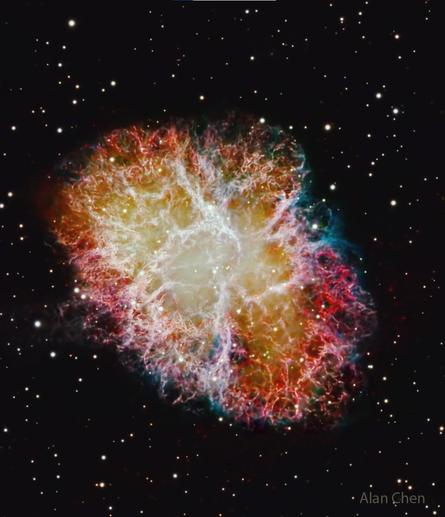
M1: The Crab Nebula
* Image Credit & Copyright: Alan Chen
https://www.heavenlyview.com/about.htm

Explanation:
This is the mess that is left when a star explodes. The Crab Nebula, the result of a supernova seen in 1054 AD, is filled with mysterious filaments. The filaments are not only tremendously complex but appear to have less mass than expelled in the original supernova and a higher speed than expected from a free explosion. The featured image was taken by an amateur astronomer in Leesburg, Florida, USA over three nights last month. It was captured in three primary colors but with extra detail provided by specific emission by hydrogen gas. The Crab Nebula spans about 10 light years. In the Nebula's very center lies a pulsar: a neutron star as massive as the Sun but with only the size of a small town. The Crab Pulsar rotates about 30 times each second.
https://science.nasa.gov/mission/hubble/science/explore-the-night-sky/hubble-messier-catalog/messier-1/
https://spaceplace.nasa.gov/supernova/en/
http://www.messier.seds.org/more/m001_sn.html
https://www.youtube.com/watch?v=5VnJ9pRR8-8
https://apod.nasa.gov/apod/ap980208.html
https://ui.adsabs.harvard.edu/abs/1995ApJ...454L.129F/abstract
https://ui.adsabs.harvard.edu/abs/1998PASP..110..831N/abstract
https://en.wikipedia.org/wiki/RGB_color_model
https://en.wikipedia.org/wiki/Hydrogen-alpha
https://spinoff.nasa.gov/NASA_Hydrogen_History_Informs_World%E2%80%99s_Hydrogen_Future
https://en.wikipedia.org/wiki/Crab_Nebula
https://science.nasa.gov/exoplanets/what-is-a-light-year/
https://www.planetary.org/space-images/comet-67p-compared-to-los-angeles
https://apod.nasa.gov/apod/ap020920.html
https://defcon.social/@grobi/115081987454568071
https://defcon.social/@grobi/114793535752274563

https://apod.nasa.gov/apod/ap251229.html

#space #nebula #astrophotography #photography #science #astronomy #physics #nature #NASA #apod

2026 January 5
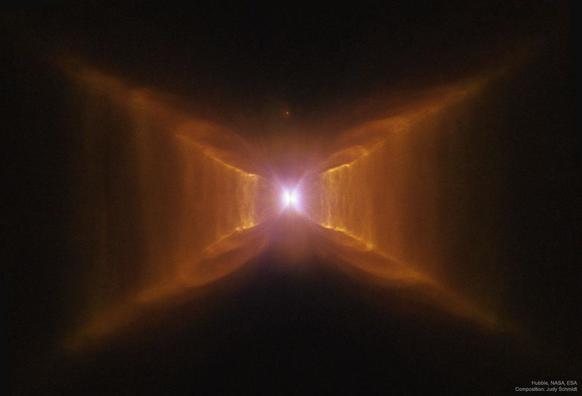
A dark field surrounds a red nebula. The shape of the nebula appears like the letter

The Red Rectangle Nebula from Hubble
* Image Credit: NASA, ESA, Hubble
https://www.nasa.gov/
http://www.esa.int/
https://science.nasa.gov/mission/hubble/
* Processing & License: Judy Schmidt
https://science.nasa.gov/people-of-nasa/meet-a-citizen-scientist-judy-schmidt/

Explanation:
How was the unusual Red Rectangle nebula created? At the nebula's center is an aging binary star system that surely powers the nebula but does not, as yet, explain its colors. The unusual shape of the Red Rectangle is likely due to a thick dust torus which pinches the otherwise spherical outflow into tip-touching cone shapes. Because we view the torus edge-on, the boundary edges of the cone shapes seem to form an X. The distinct rungs suggest the outflow occurs in fits and starts. The unusual colors of the nebula are less well understood, however, and speculation holds that they are partly provided by hydrocarbon molecules that may actually be building blocks for organic life. The Red Rectangle nebula lies about 2,300 light years away towards the constellation of the Unicorn (Monoceros). The nebula is shown here in great detail as a reprocessed image from Hubble Space Telescope. In a few million years, as one of the central stars becomes further depleted of nuclear fuel, the Red Rectangle nebula will likely bloom into a planetary nebula.

https://apod.nasa.gov/apod/ap260103.html

#space #nebula #astrophotography #photography #science #astronomy #physics #nature #NASA #apod

2026 January 7

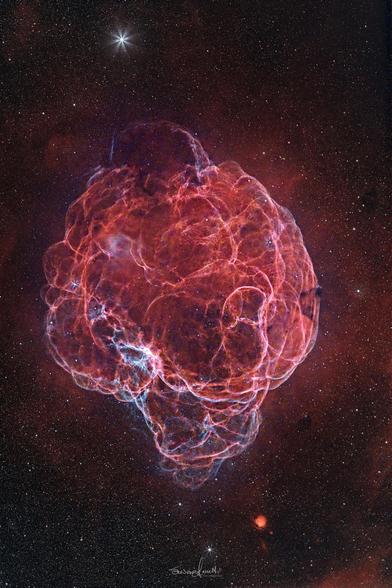
Simeis 147: The Spaghetti Nebula Supernova Remnant
* Image Credit & Copyright: Saverio Ferretti
https://www.instagram.com/sferretti70/

Explanation:
Its popular nickname is the Spaghetti Nebula. Officially cataloged as Simeis 147 and Sharpless 2-240, it is easy to get lost following the looping and twisting filaments of this intricate supernova remnant. Seen toward the boundary of the constellations of the Bull (Taurus) and the Charioteer (Auriga), the impressive gas structure covers nearly 3 degrees on the sky, equivalent to 6 full moons. That's about 150 light-years at the stellar debris cloud's estimated distance of 3,000 light-years. The supernova remnant has an estimated age of about 40,000 years, meaning light from this powerful stellar explosion first reached the Earth when woolly mammoths roamed free. Besides the expanding remnant, this cosmic catastrophe left behind a pulsar, a fast-spinning neutron star that is the remnant of the original star's core. The featured image was captured last month from Forca Canapine, Italy.
https://en.wikipedia.org/wiki/Simeis_147
https://chandra.harvard.edu/xray_sources/supernovas.html
https://apod.nasa.gov/apod/ap101220.html
https://spaceplace.nasa.gov/constellations/en/
https://en.wikipedia.org/wiki/Taurus_(constellation)
https://en.wikipedia.org/wiki/Auriga
https://www.1728.org/angsize.htm
https://apod.nasa.gov/apod/ap200925.html
https://spaceplace.nasa.gov/light-year/en/
https://www.youtube.com/watch?v=wymMn-SmALY
https://en.wikipedia.org/wiki/Pulsar
https://apod.nasa.gov/apod/ap170501.html

https://apod.nasa.gov/apod/ap260107.html

#space #nebula #astrophotography #photography #science #astronomy #physics #nature #NASA #apod

2026 January 19

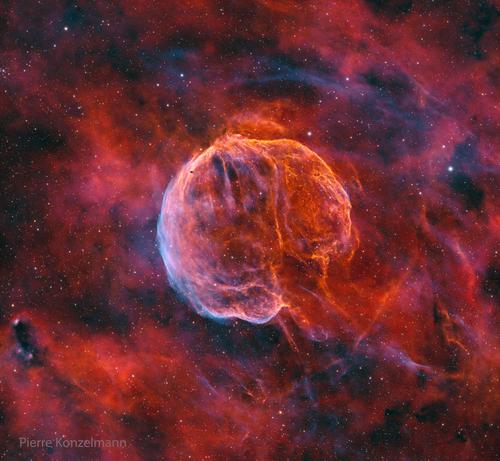
CTB 1: The Medulla Nebula
* Image Credit: Pierre Konzelmann
https://app.astrobin.com/u/konzy

Explanation:
What powers this unusual nebula? CTB 1 is the expanding gas shell that was left when a massive star toward the constellation of Cassiopeia exploded about 10,000 years ago. The star likely detonated when it ran out of elements, near its core, that could create stabilizing pressure with nuclear fusion. The resulting supernova remnant, nicknamed the Medulla Nebula for its brain-like shape, still glows in visible light because of the heat generated by its collision with confining interstellar gas. Why the nebula also glows in X-ray light, though, remains a topic of research. One hypothesis holds that an energetic pulsar was created and powers the nebula with a fast outwardly moving wind. Following this lead, a pulsar was found in radio waves that appears to have been expelled by the supernova explosion at over 1000 kilometers per second. Although the Medulla Nebula appears as large as a full moon, it is so faint that it took 84-hours of exposure with a small telescope in Texas, USA, to create the featured image.
https://en.wikipedia.org/wiki/Cassiopeia_(constellation)
http://large.stanford.edu/courses/2011/ph241/olson1/
https://en.wikipedia.org/wiki/Nuclear_fusion
https://en.wikipedia.org/wiki/Supernova_remnant
https://en.wikipedia.org/wiki/Medulla_oblongata
https://science.nasa.gov/ems/09_visiblelight
https://apod.nasa.gov/apod/fap/ap130924.html
https://ui.adsabs.harvard.edu/abs/2018PASJ...70..110K/abstract
https://science.nasa.gov/ems/11_xrays
https://www.barkbusters.co.uk/images/articles/7a4120f095480e9f2a2ad2a165d90313.jpg
https://en.wikipedia.org/wiki/Pulsar
https://ui.adsabs.harvard.edu/abs/2019sros.confE.158K/abstract
https://science.nasa.gov/ems/05_radiowaves
https://apod.nasa.gov/apod/ap190813.html
https://youtu.be/aysiMbgml5g
https://www.gxccd.com/art?id=543&cat=1&lang=409
https://apod.nasa.gov/apod/ap160201.html
https://en.wikipedia.org/wiki/Texas
https://en.wikipedia.org/wiki/United_States
https://app.astrobin.com/u/konzy?i=tvj0k3#gallery

https://apod.nasa.gov/apod/ap260119.html

#space #nebula #astrophotography #photography #science #astronomy #physics #nature #NASA #apod

2026 January 23

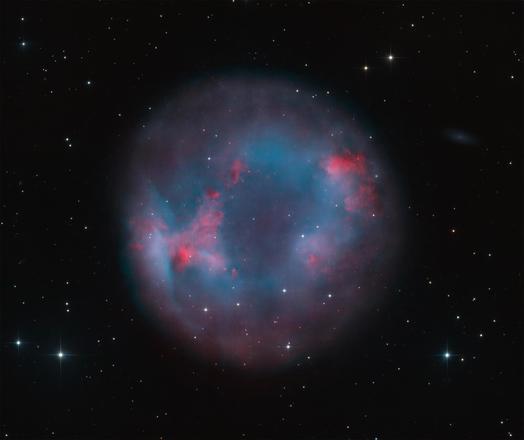
Planetary Nebula Abell 7
* Image Credit & Copyright: Martin Pugh
https://www.martinpughastrophotography.space/

Explanation:
Very faint planetary nebula Abell 7 is about 1,800 light-years distant. It lies just south of Orion in planet Earth's skies toward the constellation Lepus, The Hare. Posing with scattered Milky Way stars, its generally simple spherical shape about 8 light-years in diameter is revealed in this deep telescopic image. The beautiful and complex shapes seen within the cosmic cloud are visually enhanced by the use of long exposures and narrowband filters that capture emission from hydrogen and oxygen atoms. Otherwise Abell 7 would be much too faint to be appreciated by eye. A planetary nebula represents a very brief final phase in stellar evolution that our own Sun will experience 5 billion years hence, as the nebula's central, once sun-like star shrugs off its outer layers. Abell 7 itself is estimated to be 20,000 years old. But its central star, seen here as a fading white dwarf, is some 10 billion years old.
http://www.allthesky.com/constellations/big/lepus28vm-b.jpg
http://arxiv.org/abs/1210.6226
https://apod.nasa.gov/apod/ap111013.html
https://en.wikipedia.org/wiki/Planetary_nebula
https://www.futuretimeline.net/beyond.htm
https://www.nasa.gov/feature/goddard/2019/citizen-scientist-finds-ancient-white-dwarf-star-encircled-by-puzzling-rings
https://www.nasa.gov/universe/citizen-scientist-finds-ancient-white-dwarf-star-encircled-by-puzzling-rings/

https://apod.nasa.gov/apod/ap260123.html

#space #nebula #astrophotography #photography #science #astronomy #physics #nature #NASA #apod

2026 February 3

Red Spider Planetary Nebula from Webb
* Image Credit: ESA/Webb, NASA & CSA, J. H. Kastner (RIT)
https://esawebb.org/
https://www.nasa.gov/
https://www.asc-csa.gc.ca/
https://www.rit.edu/directory/jhkpci-joel-kastner
https://www.rit.edu/

Explanation:
Oh what a tangled web a planetary nebula can weave. The Red Spider Planetary Nebula shows the complex structure that can result when a normal star ejects its outer gases and becomes a white dwarf star. Officially tagged NGC 6537, this two-lobed symmetric planetary nebula houses one of the hottest white dwarfs ever observed, probably as part of a binary star system. Internal winds flowing out from the central stars, have been measured in excess of 1,000 kilometers per second. These winds expand the nebula, flow along the nebula's walls, and cause waves of hot gas and dust to collide. Atoms caught in these colliding shocks radiate light shown in the featured false-color infrared picture by the James Webb Space Telescope. The Red Spider Nebula lies toward the constellation of the Archer (Sagittarius). Its distance is not well known but has been estimated by some to be about 4,000 light-years.
http://www.bartleby.com/100/338.25.html
https://en.wikipedia.org/wiki/Planetary_nebula
https://apod.nasa.gov/apod/ap980106.html
https://apod.nasa.gov/apod/ap251207.html
https://apod.nasa.gov/apod/ap000910.html
https://apod.nasa.gov/apod/binary_stars.html
https://science.nasa.gov/sun/what-is-the-solar-wind/
https://apod.nasa.gov/apod/ap200121.html
http://periodic.lanl.gov/1.shtml
https://apod.nasa.gov/apod/ap030706.html
https://en.wikipedia.org/wiki/Atom
https://esawebb.org/images/potm2510a/
https://science.nasa.gov/ems/07_infraredwaves/
https://science.nasa.gov/mission/webb/
https://ui.adsabs.harvard.edu/abs/2000A%26A...362L..17P/abstract
https://spaceplace.nasa.gov/constellations/
http://www.astronomical.org/constellations/sgr.html
https://media.tenor.com/x6G8GKIQPcUAAAAe/thinking-cat.png
https://science.nasa.gov/exoplanets/what-is-a-light-year/

https://apod.nasa.gov/apod/ap260203.html

#space #nebula #astrophotography #photography #science #astronomy #physics #nature #NASA #apod

2026 February 6

Supernova Remnant Cassiopeia A
+ Image Credit: NASA, ESA, CSA, STScI; D. Milisavljevic (Purdue University), T. Temim (Princeton University), I. De Looze (University of Gent)
https://www.nasa.gov/
https://www.esa.int/
https://www.asc-csa.gc.ca/eng/
https://www.stsci.edu/

Explanation:
Massive stars in our Milky Way Galaxy live spectacular lives. Collapsing from vast cosmic clouds, their nuclear furnaces ignite and create heavy elements in their cores. After only a few million years for the most massive stars, the enriched material is blasted back into interstellar space where star formation can begin anew. The expanding debris cloud known as Cassiopeia A is an example of this final phase of the stellar life cycle. Light from the supernova explosion that created this remnant would have been first seen in planet Earth's sky about 350 years ago, although it took that light 11,000 years to reach us. This sharp NIRCam image from the James Webb Space Telescope shows the still-hot filaments and knots in the supernova remnant. The whitish, smoke-like outer shell of the expanding blast wave is about 20 light-years across. A series of light echoes from the massive star's cataclysmic explosion are also identified in Webb's detailed images of the surrounding interstellar medium.
https://en.wikipedia.org/wiki/Stellar_evolution#Massive_stars
https://apod.nasa.gov/apod/ap190801.html
https://universe.nasa.gov/stars/basics/
https://spider.seds.org/spider/Vars/casA.html
https://webbtelescope.org/contents/media/images/2023/149/01HGGZ4TPD8XFNPCBTZ2QYM0ZM
https://science.nasa.gov/missions/webb/nasas-webb-reveals-intricate-layers-of-interstellar-dust-gas/

https://apod.nasa.gov/apod/ap260206.html

#space #nebula #astrophotography #photography #science #astronomy #physics #nature #NASA #apod

2026 February 25

The Egg Nebula from the Hubble Telescope
* Image Credit & Copyright: ESA/Hubble & NASA, B. Balick (U. Washington)
https://esahubble.org/
https://www.nasa.gov/
https://astro.washington.edu/people/bruce-balick
https://astro.washington.edu/

Explanation:
Ever wonder what it would look like to crack open the Sun? The Egg Nebula, a dying Sun-like star, can unscramble this question. Pictured is a combination of several visible and infrared images of the nebula (also known as RAFGL 2688 or CRL 2688) taken with the Hubble Space Telescope. The star has shed its outer layers, and a bright, hot core>/a> (or "yolk") now illuminates the milky "egg white" shells of gas and dust surrounding the center. The central lobes and rings are structures of gas and dust recently ejected into space, with the dust being dense enough to block our view of the stellar core. Light beams emanate from that blocked core, escaping through holes carved in the older ejected material by newer, faster jets expelled from the star’s poles. Astronomers are still trying to figure out what causes the disks, lobes, and jets during this short (only a few thousand years!) phase of the star’s evolution, making this an egg-cellent image to study!
https://en.wikipedia.org/wiki/Egg_Nebula
https://www.stellarcatalog.com/stars.php?starcategory=104
https://esahubble.org/images/heic2604a/
https://science.nasa.gov/mission/webb/science-overview/science-explainers/infrared-astronomy/
https://apod.nasa.gov/apod/ap960129.html
https://apod.nasa.gov/apod/ap230409.html
https://science.nasa.gov/missions/hubble/nasas-hubble-captures-light-show-around-rapidly-dying-star/
https://astro4edu.org/resources/glossary/term/478/
https://apod.nasa.gov/apod/ap231224.html
https://apod.nasa.gov/apod/ap221118.html
https://www.nasa.gov/wp-content/uploads/2023/03/solarpolarity.jpg
https://www.rochester.edu/newscenter/how-stellar-death-can-lead-to-twin-celestial-jets/
https://starwalk.space/en/infographics/star-life-cycle

https://apod.nasa.gov/apod/ap260225.html

#space #nebula #astrophotography #photography #science #physics #astrophysics #nature #NASA #apod

2026 February 27

Sharpless 249 and the Jellyfish Nebula
* Image Credit & Copyright: Katelyn Beecroft
https://app.astrobin.com/u/kates.universe#gallery

Explanation:
Normally faint and elusive, the Jellyfish Nebula is caught in this alluring telescopic field of view. Floating in the interstellar sea, the nebula is anchored right and left by two bright stars, Mu and Eta Geminorum, at the foot of the celestial twins. The Jellyfish Nebula itself is right of center, seen as a brighter arcing ridge of emission with dangling tentacles. In fact, this cosmic jellyfish is part of bubble-shaped supernova remnant IC 443, the expanding debris cloud from a massive star that exploded. Light from the explosion first reached planet Earth over 30,000 years ago. Like its cousin in astrophysical waters the Crab Nebula supernova remnant, the Jellyfish Nebula is known to harbor a neutron star, the ultradense remnant of the collapsed stellar core. An emission nebula cataloged as Sharpless 249 fills the field at the upper left. The Jellyfish Nebula is about 5,000 light-years away. At that distance, this image would be about 300 light-years across.
https://app.astrobin.com/u/kates.universe?i=tzo0ou#gallery
http://stars.astro.illinois.edu/sow/tejat.html
http://stars.astro.illinois.edu/sow/propus.html
https://science.nasa.gov/solar-system/skywatching/night-sky-network/gemini-constellation/
https://apod.nasa.gov/apod/ap060602.html
http://chandra.harvard.edu/xray_sources/supernovas.html
http://arxiv.org/abs/1002.2198
https://apod.nasa.gov/apod/ap180317.html
http://chandra.harvard.edu/photo/2000/1083/index.html
https://svs.gsfc.nasa.gov/13832
https://ui.adsabs.harvard.edu/abs/1953ApJ...118..362S/abstract

https://apod.nasa.gov/apod/fap/ap260227.html

#space #nebula #astrophotography #photography #science #physics #astrophysics #nature #NASA #apod

2026 March 4

Shapley 1: An Annular Planetary Nebula
* Image Credit & Copyright: Peter Bresseler
https://pixlimit.com/
* Text: Keighley Rockcliffe (NASA GSFC, UMBC CSST, CRESST II)
https://kerockcliffe.com/
https://science.gsfc.nasa.gov/sci/bio/keighley.e.rockcliffe
https://www.nasa.gov/goddard/
https://physics.umbc.edu/research/astrophysics/
https://csst.umbc.edu/directory/
https://cresst2.umd.edu/

Explanation:
What’s looking back at you isn’t a cosmic eye, but Shapley 1, a beautifully symmetric planetary nebula. Shapley 1, also known as the Fine Ring Nebula or PLN 329+2.1, bejewels the southern sky constellation of the Carpenter's Square (Norma). The nebula is the result of a star near the mass of our Sun running out of fuel and shedding its outer layers. Glowing oxygen from those expelled layers makes up the circular halo. The bright central point is actually a binary: a white dwarf, the remaining stellar core after the outer layers are expelled into space, and another star, orbiting each other every 2.9 days. Shapley 1’s annular shape is due to our top-down view of the system and provides insight into the influence of central stars on planetary nebula structures.
https://www.eso.org/public/images/potw1131a/
https://esahubble.org/wordbank/planetary-nebula/
https://apod.nasa.gov/apod/ap110816.html
https://en.wikipedia.org/wiki/Steel_square
https://noirlab.edu/public/education/constellations/norma/
https://science.nasa.gov/missions/hubble/hubble-witnesses-the-final-blaze-of-glory-of-sun-like-stars/
https://imagine.gsfc.nasa.gov/science/objects/dwarfs1.html
https://media1.tenor.com/m/uhwiRs3LAVgAAAAd/beyonce-ring.gif
https://svs.gsfc.nasa.gov/5290/#media_group_374408
https://ui.adsabs.harvard.edu/abs/2012MNRAS.420.2271J/abstract

https://apod.nasa.gov/apod/ap260304.html

#space #nebula #astrophotography #photography #science #physics #astrophysics #nature #NASA #apod

2026 March 9

The Cranium Nebula from the Webb Telescope
* Image Credit: NASA, ESA, CSA, STScI
https://www.nasa.gov/
https://www.esa.int/
https://www.asc-csa.gc.ca/eng/
https://www.stsci.edu/
* Processing: J. DePasquale (STScI)
https://jdepasquale.com/

..highest resolution of this image available:
https://apod.nasa.gov/apod/image/2603/Cranium_Webb_8832.jpg

Explanation:
What's going on inside the head of this nebula? Dubbed the Exposed Cranium Nebula for its similarity to the human brain, what created the nebula remains a mystery. One thought is that the Cranium Nebula, also known as PMR 1, is a planetary nebula surrounding a white dwarf star. In this mode, the outer atmosphere was expelled when the original Sun-like star ran out of central nuclear fuel and contracted. A competing thought is that the central star is much more massive, possibly a Wolf-Rayet star, that is ejecting gas and dust via turbulent stellar winds. Adding to the intrigue is the dark vertical central division and the thin outer gaseous shell. The featured image was taken by the Webb Space Telescope in mid- infrared light, while a second image, included as a rollover, is in near-infrared. Future observations may reveal if this brainy system will quietly just fade from view or, many years from now, suddenly erupt in a powerful supernova.
https://science.nasa.gov/missions/webb/nasas-webb-examines-cranium-nebula/
https://en.wikipedia.org/wiki/Human_brain#/media/File:Visible_Human_head_slice.jpg
https://en.wikipedia.org/wiki/Planetary_nebula
https://science.nasa.gov/photojournal/pj-white-dwarf-stars/
https://en.wikipedia.org/wiki/Stellar_evolution#Mid-sized_stars
https://imagine.gsfc.nasa.gov/science/objects/dwarfs1.html
https://apod.nasa.gov/apod/ap250203.html
https://science.nasa.gov/universe/dust-in-the-stellar-wind-a-cosmological-primer/
https://apod.nasa.gov/apod/ap000318.html
https://www.reddit.com/r/aww/comments/sf84rb/does_anyone_elses_dog_tilt_their_head_when_they/#lightbox
https://esawebb.org/images/weic2605a/
https://science.nasa.gov/mission/webb/
https://celliant.com/pulse/all/infrared-light/
https://science.nasa.gov/ems/07_infraredwaves/
https://en.wikipedia.org/wiki/Infrared
https://youtu.be/wymMn-SmALY

https://apod.nasa.gov/apod/ap260309.html

#space #nebula #astrophotography #photography #science #physics #astrophysics #nature #NASA #apod

2026 May 7

Supernova in a Sideways Spiral
* Video Credit: Hunter Outten & Kaleb Jordan
https://ssr.app.astrobin.com/u/OuttenAstrophotography
https://app.astrobin.com/u/Kaleb_Jordan
* Text: Cecilia Chirenti (NASA GSFC, UMCP, CRESST II)
https://science.gsfc.nasa.gov/sci/bio/cecilia.chirenti

Explanation:
A long time ago, in a distant galaxy, a massive star was destroyed in a supernova explosion. The light of this event travelled for tens of millions of years and reached Earth last week as Supernova 2026kid. The featured video shows a time-lapse over three nights of the host galaxy NGC 5907, an edge-on spiral also known as the Splinter or Knife Edge Galaxy, as the supernova appears and becomes brighter. (The occasional streaks are satellites in Earth orbit.) At its brightest, a supernova can outshine the sum of all other stars in its galaxy. Supernova 2026kid appears relatively dim, probably because we are seeing it through the edge-on disk of the galaxy. Such explosions typically happen about once per century in galaxies similar to the Milky Way, and their light can take months to fade away. The brightest supernova in recorded history was SN 1006; it is reported to have been brighter than Venus, and even visible in the sky during daytime.
https://images.unsplash.com/photo-1472457897821-70d3819a0e24
https://en.wikipedia.org/wiki/Type_II_supernova
https://blast.scimma.org/transients/2026kid/
https://app.astrobin.com/i/ndq527
https://www.rochesterastronomy.org/sn2026/sn2026kid.html
https://science.nasa.gov/universe/galaxies/types/#spiral-galaxies
https://apod.nasa.gov/apod/ap260427.html
https://esahubble.org/wordbank/supernova/
https://en.wikipedia.org/wiki/Extinction_(astronomy)
https://science.nasa.gov/resource/the-milky-way-galaxy/
https://astronomy.swin.edu.au/cosmos/*/Type+II+Supernova+Light+Curves
https://www.nasa.gov/universe/supernova-remnant-sn-1006/

https://apod.nasa.gov/apod/fap/ap260507.html

#space #nova #supernova #astrophotography #photography #science #physics #astronomy #nature #NASA #ESA