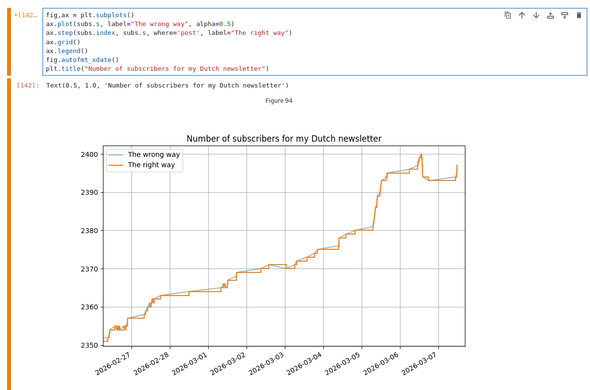
I read graphs like other people savor fine wine. And I'm in a pedantic mood today. So here's the thing, if you plot discrete numbers, like subscriber counts, use a *step* graph. Your subscriber count does not smoothly go up by 1 over a 12 hour period! The step graph shows what is actually happening & when:
@bert_hubert Prometheus is the worst for this? Happily interpolating values that were never recorded
@jmason also I've had huge trouble with it not understanding non-integers. Have to multiply everything by 1000 in some places!
@jmason A fifth of your readers get this, while a full 20% won't be able to grasp it even if it's explained to them. @bert_hubert

@bert_hubert hey, that's a valid approach if you get a new data point *whenever* something changes. (which it looks like that's what's happening in your graph.)

But if the data points are measurements describing something integrating over time and you just sample that once in a while (periodically? aperiodically? specific cond.?), just using step plots lies at least as much as an interpolation (not necessarily a linear one, though) between points. It all then depends on *how* you'd like to lie.

@funkylab @bert_hubert This is closer to my reaction - if I saw the "wrong way" (but should be marked with points) I would assume that the sampling was just irregular (only taken at every point) and that the actual event (subscription action) timestamps were not accessible.
@bert_hubert
You learned me something today, bert.
Now to find a context in which to use it.
@bert_hubert so a good present would be the classic 1983 tufte visual display batch from the quantitative information hills. Perfect information to ink ratio, reduced to bare necessities, no vulgar or overbearing notes.