15 years ago, I co-authored my first paper in the field of #LightPollution studies: https://doi.org/10.1371/journal.pone.0017307

Up to that point, work on artificial brightening of the sky had been done almost entirely by astronomers, who (for obvious reasons) weren't really interested in cloudy nights. But because I was involved closely with ecologists from the Leibniz Institute of Freshwater Ecology and Inland Fisheries @LeibnizIGB, we realized that it's also important to measure the extent to which overcast and clear nights differ.

Through a bunch of twists and turns I now work on #RemoteSensing using nighttime light, but that was the paper that launched me into this direction.

Most people in brightly lit countries probably take for granted that clouds are bright at night, but this is completely unnatural. You can see it better in this pair of photos we published in a later paper (titled "Red is the new black"): https://doi.org/10.1111/j.1365-2966.2012.21559.x

This probably matters a great deal for nocturnal animals, because it's a reversal of an environmental condition that existed during the hundreds of millions of years that life evolved.

@skyglowberlin I teach large university science courses. Hundreds of fairly privileged students in the room. It has been my habit to ask them to raise their hands if they have ever seen the Milky Way.

The results have always been disappointing. Over the past 20 years it has gotten worse and worse. Recently many students don't even know what I mean by the question, and I have to explain what a dark sky looks like.

"Raise your hand if you have ever been awed by a clear dark sky full of countless, countless stars." Always less than 5%.

@jameshowell Yeah, it's rough to hear things like that. I remember hearing from some people from (I think) the US NPS that they created a scene with virtual reality goggles to show people what a natural sky looks like when you are dark adapted, and a lot of the people who experienced it didn't believe that it could be real 😥

@skyglowberlin When I teach about retinal physiology, it breaks my heart. Often there isn't a single student who has ever experienced vision after true dark adaptation.

It turns out that—it takes time, but it's real—you can see by starlight. And the faintest stars you see? That's a single rod cell detecting A SINGLE PHOTON. Your retina is that sensitive.

Before 1879 this was an absolutely universal human experience. Now it's exotic, unimaginable.

@jameshowell Yup. If I won the lottery, one of the studies I would love to fund would be to see whether adults who grew up in rural settings have superior night vision to those who grew up in the city.

If you never train your visual system to see with rods only, does it still develop normally?

@skyglowberlin Almost certainly not.

It's an empirical question: you have to do the experiment. But all of developmental neurobiology shows us that disuse leads to loss, and disuse during critical developmental windows leads to permanent loss. Your hypothesis is almost certainly correct.

@jameshowell @skyglowberlin reading this on my glowing rectangle with aging eyes is super depressing!

I've seen things you people wouldn't believe. The milky way with my naked eyes. I navigated a trail by the moonlight. All those moments will be lost in time, like tears in rain. Time to die.

@skyglowberlin @jameshowell I’ve been an amateur astronomer since I was 11 and had a home darkroom for photography soon after. I’ve let people know what can be done and seen in low light.

One time, winter hiking in New Hampshire, my flashlight batteries died and I hiked another 2 miles under just the illumination of a clear night sky. Mars was the brightest thing out.

@glasspusher @jameshowell There's a path through the woods in Brandenburg that I've walked several kilometers along on starlit nights without a moon. I couldn't actually see the ground because of the foliage, but I could follow the path because of the lighter areas between the trees.

This isn't a great idea, though - if someone had dug a big hole in the ground I would likely have fallen in. But it shows what's possible when you know the area and the pathway is flat.

@skyglowberlin @jameshowell

Yes, when I did the above hike, I could see the trail in front of me- footsteps in the snow.

Back when I lived in Oakland, one night I walked my regular jogging trail through a park( very narrow). I was under tree cover which made it darker, as I was looking for luminescent mushrooms. I found I could keep on the path by feeling, as I walked, that the ground was harder on the trail than the edges.

Pushed the limits of what I could see in low light, and noticed that my other senses were filling in the experience more.

@glasspusher @jameshowell Yes, walking slowly and feeling the ground your feet is very important in such a situation.

@jameshowell @siracusa @skyglowberlin What I miss most about my hometown in rural eastern Washington State is the night sky.

It wasn't akin to being in Antarctica or anything, but I DID grow up being able to stare up to see the “band” of the Milky Way. One of my first major interests as a kid was astronomy. Even had my own telescope.

@jameshowell @siracusa @skyglowberlin I now live just outside of Los Angeles.

LA has made great strides in reducing air pollution, but light pollution still basically precludes any real observation of the night sky. Stars are barely a thing here.

If I were a kid living here I very much doubt I'd have developed that interest in astronomy.

@jeff @jameshowell @siracusa @skyglowberlin Ditto my hometown in eastern Idaho. I remember flying home from school in Houston for Christmas back in the late 1980s, stepping out the airport door, and OMG, I haven't seen so many stars in a loooong time.
@jeff @jameshowell @siracusa You can still see the Milky Way outside of the small town where I grew up, but it's a lot more washed out than it was when I was a child, and the glow from Edmonton that used to be contained towards one horizon has stretched to the Zenith.
@jameshowell @skyglowberlin When I would take my kids camping far far away from the city lights, we would always go out late at night, down to the beach at the river and lay there in the dark, looking at the stars for 30-60 minutes. And the kids always wanted to use their flashlights but I forbid them. They never had problems getting back to camp on the way back. :)
@jameshowell @skyglowberlin a few years ago I joined a Meetup for a night walk in the Japanese alps. The guide, who also sailed, gave us red LEDs to get to our starting point, where there was no artificial light. Then we turned the torches off and waited half an hour for our eyes to adapt. It was amazing, I’d never experienced anything like it.

@jontringham @jameshowell @skyglowberlin on a high school field science trip, we descended into some abandoned mines out in the California desert at night. The complete darkness and silence was pretty unnerving, but when our vision had adapted and we came back up, the clear night desert sky was glorious.

I've never experienced that since.

@jameshowell
I used to go in deep caves. I've sat there until all I could see was mental static, then turned my digital watch on pointing it away. I did not expect the way the shape of the cave formed up in my vision. Try it sometime (though maybe not with a modern smartwatch).
@skyglowberlin
@vik @jameshowell I don't have much experience with caves (or access to them), but I've had similar experiences in indoor spaces with strong light shielding.
@jameshowell @skyglowberlin if you talk to people who experienced the three-day power outage in Ontario in a big city you’ll often find that is one of their most profound memories of the event.
@[email protected] @[email protected] I grew up in a rural area in the late 1970s. The Milky Way was vivid in the sky at night and I remember many nights standing outside watching for meteors and taking the presence of the Milky Way for granted. By the time I left for college, there was usually too much light pollution to see it. In the late 1990s I went on a camping trip in Australia and was astonished by how many stars were visible at night, and of course the Milky Way was prominent in the sky. It reminded me of what my hometown's sky had been like. Till then it hadn't sunk in that I'd lost it.

I feel a sense of loss and grief that the Milky Way is effectively gone for so many people, and will be gone for so many more as time passes. And when/where it is visible, it'll be streaked with satellite trails because of the apparent arms race to fill low Earth orbit with as many satellites as possible. What a terrible loss.
@abucci @skyglowberlin Yeah, it's not a happy story. The nice stories are exceptional, and we should cherish them, in the context of a heinous collective loss.

@jameshowell @skyglowberlin

I first saw the Milky Way in July 2006. I was about 80 km north of Kandahar, Afghanistan. It was absolutely amazing. (I was sleeping in a hole in the ground, so I could just enjoy it until I fell asleep.)

@venya @skyglowberlin I can't beat that story, but I got two stories.

In 2005 outside the refugio just below the summit of Champaqui about 60 km southwest of Córdoba Argentina. Clearest darkest sky I have experienced and golly, the southern hemisphere sky is disorienting. We were far from home.

In 1990 in rural Ohio with two young women who had grown up in Tokyo. They had never seen a non-urban night sky. Parked the car next to a cornfield, told them I had a treat for them. They flew into a blind panic. Screaming, crying, covering their eyes.

@jameshowell @venya What happened next? Did they calm down? And how did they describe the experience afterwards?
@skyglowberlin They jumped back in the car and calmed down. We kept on to our destination. I was too young really even to understand what had happened, much less how to react constructively. I don't remember what I said. I was probably an asshole to them.

@jameshowell Oh no, sorry to hear that.

The Adler Teens program has taken Chicago teenagers to a park outside of the city and had the experience that some of the kids were terrified of getting off the bus, because "going out in the dark is dangerous" has been so deeply drilled into them by (well meaning) adults.

I think if I've remembered right they've generally had success getting everyone to see the stars, but it's a scary process for some people.

@skyglowberlin They were not afraid of the dark. They had a genuinely Lovecraftian moment when "CONFRONTED WITH THE COSMOS."
@jameshowell Got it. Man, what a scene, I can imagine why that stuck with you as a memory.

@jameshowell @venya @skyglowberlin
This reminds me of the Krikkiters as told by Douglas Adams.

«Upon first witnessing the glory and splendor of the Universe, they casually, whimsically, decided to destroy it, remarking, "It'll have to go."»

https://hitchhikers.fandom.com/wiki/Krikkit

Krikkit

Krikkit is a planet located in a dust cloud composed chiefly of the disintegrated remains of the enormous spaceborne computer Hactar. Hactar was originally created by the Silastic Armorfiends of Striterax to design the Ultimate Weapon. Hactar produced a very, very small bomb that, when activated, would connect every star to every other star, cause them to all go supernova simultaneously and, thus, destroy the universe. The bomb proved dysfunctional because Hactar had designed it with a tiny...

Hitchhikers

@venya @jameshowell Glad you had a chance to enjoy that (despite the rest of the experience).

I remember @SaraBPritchard quoting from women's experience of seeing the stars while held in a Nazi concentration camps. I can't remember the exact details, but my recollection is that seeing the stars provided a similar sublime experience despite being caged in a place designed to destroy your humanity.

We all lose something by not regularly having that experience.

@skyglowberlin @venya @SaraBPritchard Wow. Now there is a little vignette that summarizes the human condition all right

@jameshowell @GeoffWozniak @skyglowberlin My wife and kid and I have often tried, where practical, to catch meteor showers, sometimes planning road trips to countryside areas when they’re going to happen. None have ever been mind blowing, and yet those occasions are some of the most memorable moments I have, the bonding experiences and just taking all that in as a whole. I’m sure it’s a big part of the reason our (now) teen has been toying with the idea of getting into astrophysics.

Heartbreaking to realize how few even privileged people have ever taken the time to simply look up at night, or as you say, know what major celestial references even mean.

@reay @jameshowell @GeoffWozniak These days seeing the Milky Way in a natural setting is something that is experienced mainly by only the poorest of the poor and the richest of the rich.

@skyglowberlin @jameshowell @GeoffWozniak I get your point but respectfully disagree.

Anyone already in less populated areas can just look up at night and have a good shot at spotting the Milky Way.

People in more populated places but with a vehicle — not terribly uncommon — can head out of their city to get less light pollution and probably see the Milky Way. Here in Toronto, even if you head down to the lake (a walk for some, a cheap transit ride for most others), you can see way more in the night sky over the water than one may expect.

I suspect the larger reason people aren’t seeing it is just way more attention on produced entertainment (phones and streaming, etc.) than on interest in natural phenomena. No matter how accessible something may be, if you have no interest in it, it’s the same result.

@reay @jameshowell @GeoffWozniak You are right that you often don't have to go so far to get a hint of the Milky Way. In fact, I've seen it (and photographed it) from the city center of Potsdam, Germany (population ~180,000).

But catching a fuzzy glimpse of the Milky Way and "seeing the Milky Way in a natural setting" (as I said above) are completely different experiences.

When you see the Milky Way in an area with some degree of light pollution, it's a nice experience and it looks kind of interesting. When you see it in a place with no or next to no light pollution you are CONFRONTED WITH THE COSMOS.

Algonquin National Park is 250 km from Toronto and still has a zenith sky brightness that's ~1% brighter than natural - and the horizon will be far brighter than that. You have to get 350 km from Toronto until the zenith is natural, and even then the horizon in most directions is going to be bright rather than dark.

That being said, getting to ANY place that's not lit by directly artificial lights, even an urban rooftop or park, will allow you to see far more than you would guess.

@jameshowell @skyglowberlin @siracusa It’s truly awe inspiring, isn’t it?

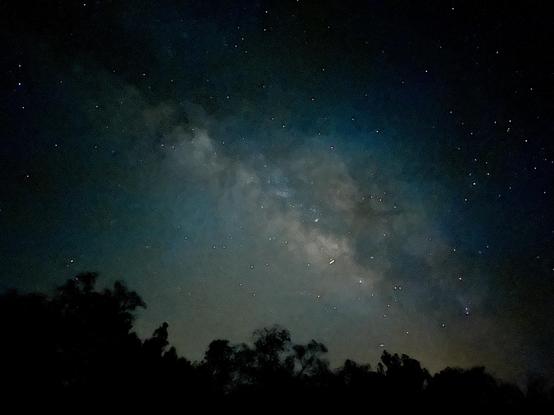
Copper Breaks State Park, TX — Bortle Class 2 dark sky designated.

Taken with my iPhone 14 Pro, merely leaning against a bench, in July 2024.

@jameshowell @skyglowberlin

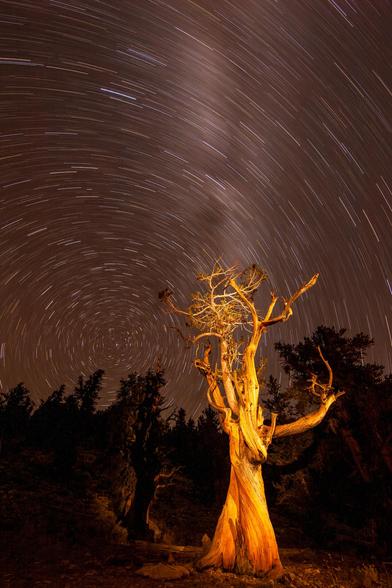
I've seen it! It was a smudge in my light painting photo ;-)

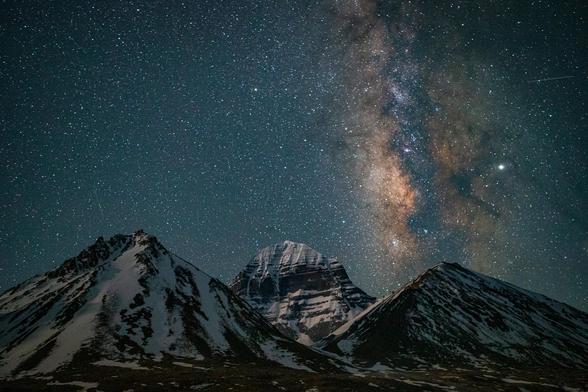
@jameshowell @skyglowberlin On thinking about it more... I may have also seen it from a previous trip I took to Tibet :-)

@jameshowell @skyglowberlin

Thirty years ago I went on a weeklong journey through an African desert. We slept on the sand under the stars. I had never seen anything like it and I've never seen anything like it ever again. It changed my view of the world.

@jameshowell @skyglowberlin I grew up in Chicago. In college, I took a class on the history of astronomy (great class), and I was puzzled how all those naked-eye astronomers could make their observations. Then I went on a road trip through the western states with a roommate, and at some point around 3 AM in the middle of New Mexico, he pulled over and said “get out.” I got out. He said “look up.” I looked up. And I got it.
@adamrice @jameshowell @skyglowberlin I also have fond memories of nights with numerous stars and a clear Milky Way. Living in the Netherlands, that is something special for me. But for all humans until a few generations ago this was absolutely normal. You might not see it every night (clouds/moon) but very often. That's a staggering loss. Can you imagine that in a few generations 95% of all people will have never seen a forest? This seems similar but hardly anyone realises that.

@royvangrunsven @skyglowberlin I grew up in a rural area of northern Germany. When I came home late at night, and I walked the few steps to our house from the barn where we parked the car, I always looked up in the sky and the view of the stars never ceased to amaze me.

I am still trying to find an opportunity to show my own kid something like that.

@felwert @royvangrunsven Sternenpark Eifel and Rhön aren't soooo far away 🙂
@skyglowberlin @felwert True but a star filled sky has become a travel destination in stead of an everyday thing like @felwert describes.

@jameshowell @skyglowberlin

Went on vacation with some friends to a beach on the gulf coast. We're out one night and one of them says "what is that in the sky?"

He meant the Milky Way.

He'd never seen it and thought the name was just a metaphor for something. Or just a candy bar. I was floored. He's not a young guy.

@jameshowell @skyglowberlin I thought you meant that as a trick question. Technically, everything we see is part of the Milky Way.