 KMWool
 Pete Prodoehl 🍕
Hey kids, in the olden days you bought (instead of “rented”) software and it came in a box with a disc and it was yours to use forever!
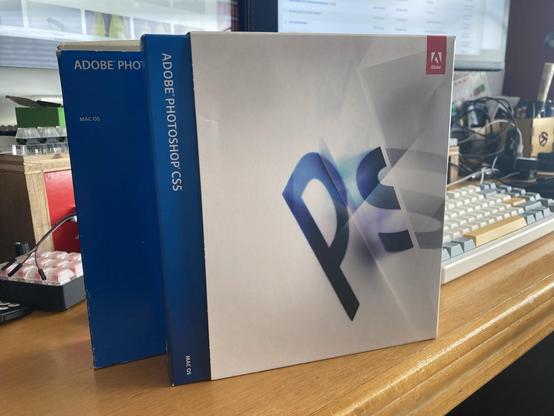
Well, the “forever” part was tricky because it might break due to OS upgrades or computer architecture/chip changes.
But making a one-time purchase and using software 5 or 10 years was not unheard of.
I think I paid $500 for Photoshop and it came out to under $9 per month if I do the math right… that’s for 10 years of use.
If it’s still $20 per month for a subscription and you do 10 years that’s $2,400.
@rasterweb The disaster is one can be locked out of software you paid for if the internet is down or vendor's servers are down because you cannot authenticate that you have paid for the software. They do not even provide alternative authentication like a key. The software keeps needing re-authentication and it is not a one-off. It is like renting a house and not being able to open the door unless the telephone line is working and the landlord's answering machine is not full.
A total disaster.
@adingbatponder That is a scandal, for sure. There's no good reason that local authentication should not be available.
As I said elsewhere, I blame inadequate regulation. Vendors can be made to do this, if enough people push for it.
@rasterweb The mortgage/rent comparison is popular, but I think probably faulty, because these are also very different cost/benefit structures. A tenant may pay more per m^2, but they're also not responsible for many things that a homeowner would be. And in nearly all cases, a flat with the same floorspace and amenitites as most private homes would demand much higher rent.
In my mind, the biggest difference is that renters cannot build equity.
/2
@rasterweb 2/ I would liken software to being more like a personal vehicle, which you can buy, rent, or lease. Probably lease. A new car depreciates over time, no matter how well cared for. A leased car has aspects of both ownership or rental, but is replaced periodically.
But no one can build equity in software, no matter how you access it or for how long. There's no appreciation, no resale value, for anyone.
@wesdym If you want to be pedantic (which I am fine with):
I can own it for as long as like and/or as long as I am able.
Is that better?
So what is the software equivalency of this?
In the old days maybe it would have been getting a used computer with software already installed from the previous owner that you could still use?
@rasterweb Ironic that you should accuse me of pedantry.
Take a powder. And try not to be this tiresome and immature in the future, okay?
@wesdym Apologies, I meant no insult. I am pedantic and hold no ill will towards others who are.
My mind is a little fuzzy from medication today so if I read things poorly please know I did not mean to do so.
@rasterweb mortgages are rent control for the middle class
(Or at least, that’s what they *were*)
@rasterweb My own sense is that how, why, and how often essential support software or hardware is upgraded has been accelerating. I'm not qualified to say if that's how it should or must be, but that seems to be how it is. Consequently, application software must also upgrade more frequently, and sometimes radically. Since those upgrades cost money for the company providing them, someone else must pay for them.
Again, I agree that this relationship can be and often is exploitative.
/2
@rasterweb 2/ My sense is that's the general system of frequent upgrade is necessary, but too many vendors take advantage of that fact to squeeze end-users in various ways, because current regulation does not adequately discourage that.
Regulation needs beefing up, with a few unusually egregious vendors made examples for everyone. But the subscription model is otherwise a reasonable alternative to replacing software more frequently, as long as it doesn't become exploitative.
@wesdym If I look back 15 years ago I knew people who would skip a version of a large software purchase/upgrade, or they would purposely just not upgrade for as long as possible because the software did what they needed.
Often it was dealing with another user who had a newer version that forced an upgrade.
And in the good old days, you bought magazines that came with a bonus disk containing a whole operating system along a bunch of softwares that were yours to use forever.

I have a pile of these disks on my bookshelves, my girlfriend thinks that it is a waste of space and asks why I’m keeping these. I don’t need these, I can download whatever I want.
I keep these because it is so cool.
Pieces of long gone era that I have known.

@MichelPatrice There's rarely any 'forever' when it comes to any software.
I actually have the very first Ubuntu release, and it definitely won't run on anything I have now.
Yes, I understand all this.
But can find cool to have an old (now useless) Ubuntu disk from back in the days?
And can we just not tell my girlfriend that this pile of old disks is now useless?
@MichelPatrice Sure. I still have it myself.
I wouldn't necessarily call it 'useless', either. You could in theory run it in VM, and that could be cool.
@rasterweb Worthwhile sentiment, but misleading argument.
Software in a fixed (non-updating) state always becomes obsolete. In the past, you had to buy new software at some point.
The business models have changed, but the underlying reality has not. You cannot run MS Office 98 on anything anyone's using right now.
Modern subscription models are indeed often exploitative, and yes, that's a scandal. But that doesn't make the concept wrong or bad, or invalidate the reasons why.
 adingbatponder
  👾
👾 Michael 🤨
 WesDym
 Alan Bucknam
 John Wilson
 No soy Mario
 Jer 🚲
Jer 🚲 Kauz
Kauz DaveKaz
 apgarcia
 Michel Patrice
 Morten Juhl-Johansen
 Ashe Dryden 🙆🏼♀️🐈🐈⬛
 phobos_UAC
 Copy Moon Joy 🌕❤️
 Edward L Platt
 xchangeee
 dnparadice