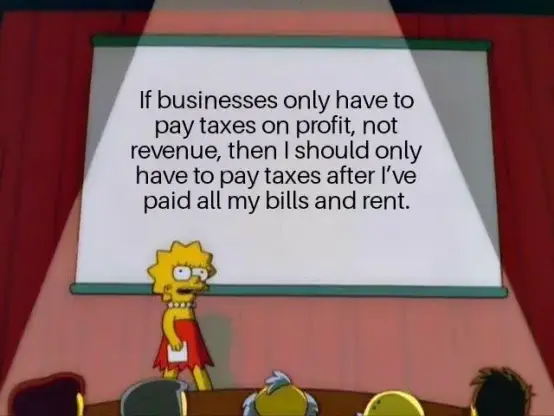

Businessmen don’t get to write off their living expenses either, but feasibly you could start a business and become a contractor for your employer so you could write off things like footwear, home office square footage, and a standard deduction per mil driven between two work locations.

Best part is the IRS will never audit you unless they have the staff and they can get more out of you than the cost of the audit (roughly 20k minimum).

I know a guy who started a business just to throw parties for his friends. He’d take a cover charge at the door and buy booze tax free and make sure to never turn a profit.
I knew a retired carpet cleaner who did that. He wasn’t wealthy by any means but if he was going to owe more than 3k in Taxes it was always better for him to spend it on a “business trip”.

home office square footage

Can you not do that as an employee in Canada?

In Australia employees who work from home can either calculate all your actual work from home expenses and deduct that, or use the standard fixed rate (which varies by year, but last financial year was 70 c per hour) which includes utilities and stationary/consumables. With the fixed rate you can still additionally deduct depreciating assets like computers and furniture (proportional to how often they are actually used for work).

tbh I’m not sure, I’ve never attempted it in Canada. Works that way in the US.
I believe you can deduct up to 30% of your rental costs, depending on square footage dedicated to office space in Canada.

If you work from home in the US you can deduct for a dedicated home office. I did it but it didn’t save me a penny tax wise. Not sure if my office is to small or my income to low.

irs.gov/…/simplified-option-for-home-office-deduc…

Simplified option for home office deduction | Internal Revenue Service

Beginning in tax year 2013 (returns filed in 2014), taxpayers may use a simplified option when figuring the deduction for business use of their home

The problem is that in the US, most tax deductions are concurrent with the standard deduction. So even if (for example) you donate $10k to a charity, the fact that it’s tax deductible is meaningless unless your total deductions are more than $16,100 (or more if married or head of household). It’s yet another way that tax deductions favor the rich - past a certain tax bracket, it makes sense to donate to a charity (that you control) to lower your taxes; for random Joe Peasant, it’s completely pointless.
In the US that’s usually a bad deal because you lose employer-sponsored healthcare.
then you just guide everything as a bill and subsidize yo life.
Like companies do?
Things you buy for work are also tax deductible, it’s more noticeable for businesses since they don’t generally make employees pay business expenses.
Where are you from?
I can file a lot of the bills for my flat (e.g. things like repairs and facility service) at the tax office, as well as stuff like child care and most of my car’s mileage (or my bike’s mileage :-) ), to be exempted from income taxing at least (there are still other taxes).
Rent money would be fully taxed, though, as well as other cost of living like food and clothing.
Country is Germany.

I wrote a free spec script for a charity organization, enabling me to write off ~$50k in charitable donations for putting in a few hours of work.

Everyone should be looking for loopholes and ways to prevent the US government from getting their money.

I intend to pass the loophole my parents gave me to my children, really grateful for it
I asked a CPA about this idea a couple months ago and was told that it doesn’t work that way, and everything I can find on the internet backs that up. Can you provide a source saying otherwise?
I’m gonna agree with you. If OP gets audited, this will not hold up. OP cannot deduct money for a service that the charity pays nothing for. Only unreimbursed or out of pocket expenses can be deducted this way

If OP gets audited, this will not hold up.

The IRS actually already did look it over. They decided (rather arbitrarily) that the script I donated was worth ~50,000 instead of ~70,000 as I was trying to claim. Definitely not a full audit, but they already reviewed it at some level and it passed muster.

Right because you’re donating intellectual property which is property. And that distinction is fucking nonsense but here we are.

They’d be like “hey now, this didn’t cost you that.”

But would not that depend on how OP’s time is valued in this case? OP could argue that their expertise costs $14000/hour ($70000 over 5 hours). I am sure that they would argue the hour cost, I have not clue how the IRS handles something like this.

They don’t let you deduct the cost of your own labor ever. The property thing is the loophole.

They don’t let you deduct the cost of your own labor ever.

Yes, but … if you use your own labor to create a product, and then donate the product, you can deduct the value of the product.

But my point is technically you can deduct the cost of the product. Lets say you knitted an Afghan that you can sell on Etsy and donated it to someone. You can only deduct the cost of the yarn.
Would the IRS have a problem with writing of the value of the yarn or the “market value” of the product?
The value of the yarn is deductible if you make the product. If you sell the product to someone they can deduct the full value if they donate it while you pay income taxes on the profit. Trying to backdoor your labor as a deduction is what the IRS has a problem with because you’re not allowed to do that.

As I understand it, technically the “thing of value” is the script itself - because it doesn’t have a clearly defined value you can get away with claiming some fairly crazy valuations.

There’s a very similar tax loophole popular with the wealthy where you get a “great deal” on some slightly valuable art, donate it to charity, get it valued by an “expert” you know, who just happens to think it’s worth many times what you paid, then write that off on your taxes. Basically free money.

If you ask me they should only be able to deduct the capital gains rate from that (which they would have to pay and thus be a wash).

Do you know if this expert has to have some kind of credentials? Or could John Smith start a non-profit, Jenny Smithy have James Smithens who is an “expert” say the value (of some object) is more than Jenny owns, have Jenny donate this object to John’s non-profit and then tax $0?

(I know it technically can be done, but do you know if there is some threshold were it will be flagged? Writing of more than you own would be a flag and call for an audit but what about something worth $1000?)

Other than my tax returns from that year? Not really.
You sound like every business man ever.
You must learn from your enemy to defeat them.
This has “I….DECLARE……BANKRUPTCY!!!” vibes.
Need to file to open a corporation in your own name.
I’ve tried writing everything off, but it’s always been less than the standard deduction.
That is basically why the Standard Deduction exists.
But if I itemize instead, I can’t count those things.
True, and perhaps credible for a married couple with a 31k deduction, but the 15k deduction for an individual might be a bit rough for single folks.
It doesn’t really make a difference if both parents are working and make similar amounts. Then that part is no different from filing separately.
Exactly. It’s to incentivize one person to be a bread winner and one to make less and be a home maker (or something with less hours) so you get the tax benefits. It would be a nice system if expenses weren’t so damn high.
Yeah, I don’t know any couples my age who don’t both work.
Homemaker or not, marriage promotes economic stability because of tying folks outcomes together. As an edifice, the State likes that a spouse probably steps in before aid programs or whatever.
Married couples get the same tax benefits regardless. A raise for the lower earner always means more money for the family, so no, it doesn’t incentivize having a breadwinner over having equal pay.

Hmmm…

Let’s do a quick exercise without real numbers. Please let me know if I’m wrong because this is what I thought. If I make 150k and am maxed out on my standard deduction, but then I make 250k and there’s no difference on my standard deduction, I’m not getting more standard deduction. If my wife is a stay at home mom and I make $250k, I am getting more standard deduction now, right?

This is how married taxes work, right? Am I wrong on that? We get different brackets and different rules. I’ve been marred for 7 years and my first year I got all my taxes back because she didn’t work that year. Am I wrong?

No. You’re correct. You would get less money back on your taxes if your wife’s income went up. However, the amount your taxes go up is less than the increase to your wife’s income, so you still end up ahead as a couple. You get the largest individual tax breaks when you have a breadwinner, but the total financial incentive (after tax returns) is for both partners to make as much money as possible.

That said, finances are very emotionally charged and how people should approach their finances depends on how they think about this stuff. That’s why snowball debt strategies work - not because they are optimal financially, but because they play into the psychology of a human paying off debt. With that in mind, I suppose you could still feel incentivized to have a large difference in incomes because of the tax breaks - it just isn’t financially optimal if there is a free opportunity for the lower earner to bring in more money.

Point is a couple shares rent. A couple’s residence is unlikely to be twice the cost of a single residence, unless you have roommates. So 30k for a couple guess further than 15k living alone.
It’s complete bullshit. What city can you rent an apartment for 15k/year even with roommates?
I’m very lucky, I rent half a house for under $10k a year in a city. But I also manage the property.
Some states allow you to deduct a portion of your property taxes, including renters (a set % of your rent). On top of the standard deduction.

From State tax, but that’s still not related to the federal deduction, where it only kicks in you itemize.

However while you may not be able to deduct your property taxes if you own a house with standard deduction, you do get to if you are a landlord regardless of standard deduction.

Depends on what you define as a city. A quick search of a random city (Saginaw, MI), I see some 2 bedrooms for 985 a month.

Of course people from LA might not call that a city, but, to people from towns of 800 people, it is huge at about 44k people.

I dunno how it works in the US but in Aus I can’t deduct anything unless it’s related to work, apparently feeding and housing myself doesn’t contribute to that …
In a lot of places a part of your income is exempt from taxes (eg brackets where you pay 0-20k @ 0%, 30-60k @ 30%, 60-100k @ 40%, 100k+ @ 50%; then your first 20k is not taxed), i think this is what they are talking about.
I guess you could argue that that’s the reasoning behind the progressive tax regime. Australia’s progressive tax lines up with the low end of that but if you were going to claim that the tax free threshold was to cover general living expenses then it’s going to need to be a lot larger, 20k bere is not enough to cover rent, food and utilities here, a 3x2 near Perth is like $800/week for rent and I would argue interest on a mortgage is comparable and Perth is on the cheap end of Australian cities. That’s like 40k without utilities and food. So either the tax free threshold was poorly implemented without indexation against inflation and cost of living or the driver of it isn’t to cover basic cost of living and is more to ease the burden on the poor end of town. I guess you could say it’s a little bit of both but arguably indexation should be implemented.

Standard deduction is slightly different than an exemption. You’re deducting a set amount (instead of itemizing it, which only makes sense to do if the total is more than the standard deduction, which it won’t be for most professions).

An exception exemption would be removing a portion of the taxable income before it is taxed.

Pretty similar outcome for most people, but still an important distinction.

Edit: fixed autocorrect error

Yes, and businesses do also pay taxes on more than their profits. Payroll tax is a huge one.
Payroll tax is not a tax on business, it’s also a tax on workers, it’s just business is deducting it automatically, and paying it to government, to reduce the amount of transactions.
Yes and no. You’re right not course that part of pay is withheld and paid as tax, but that isn’t what I was referring to. There is an additional component, beyond what is withheld from employee pay, which is paid directly from the business to the state which the employee never sees. It’s a similar amount.

Yeah but even that is sort of a tax on employees

When our business decides how much we can afford to pay someone for a position, the math is always with what that payroll tax is included.

So without the payroll tax we may be able to afford paying someone $25/hour.

With it we may only be able to afford to pay them $22/hour.

It reduces the amount we can afford to pay the employee, even though it’s technically never given to them in the first place it’s money that could have gone to them.

I would love to pay more but that tax takes it out of my hands.

But that doesn’t mean it’s a tax on the employee. That’s like saying sales tax is on the business, when it’s actually on the customer.