 not_IO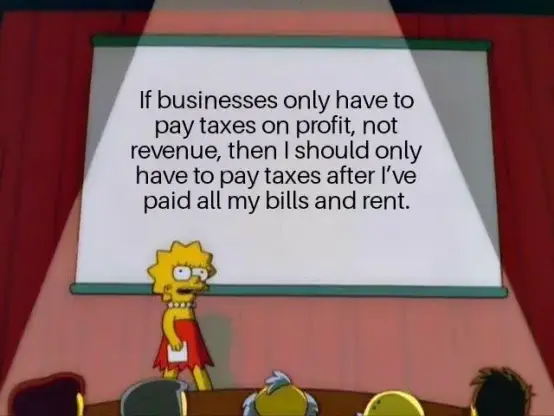
 paultimate14
That is basically why the Standard Deduction exists.
Yes, and businesses do also pay taxes on more than their profits. Payroll tax is a huge one.
Payroll tax is not a tax on business, it’s also a tax on workers, it’s just business is deducting it automatically, and paying it to government, to reduce the amount of transactions.
Yes and no. You’re right not course that part of pay is withheld and paid as tax, but that isn’t what I was referring to. There is an additional component, beyond what is withheld from employee pay, which is paid directly from the business to the state which the employee never sees. It’s a similar amount.
 Pyr
PyrYeah but even that is sort of a tax on employees
When our business decides how much we can afford to pay someone for a position, the math is always with what that payroll tax is included.
So without the payroll tax we may be able to afford paying someone $25/hour.
With it we may only be able to afford to pay them $22/hour.
It reduces the amount we can afford to pay the employee, even though it’s technically never given to them in the first place it’s money that could have gone to them.
I would love to pay more but that tax takes it out of my hands.
But that doesn’t mean it’s a tax on the employee. That’s like saying sales tax is on the business, when it’s actually on the customer.
I take it that they mean that it is indirectly a tax on the employee in the sense that it is money the employee could have earned but does not because the company has to pay the tax. Could have earned as in the salary could have been higher without it.
On the otherhand, that is true for any tax a company has to pay, just not as directly releated.
(Or I could be wrong and they mean something else.)
that is true for any tax a company has to pay, just not as directly releated
Not really, salary and automatic tux deduction is the same line of the budget for the company, it’s money they spend directly on employer. For them there is absolutely no difference do the money come to employer or to the government, they spend X amount of money so the employer works for them, it’s the same chunk of money regardless of what percentage goes where.
That’s, like, completely the opposite of the argument. Saying that payroll tax is a tax on business is like saying sales tax is a tax on business. In both cases, the tax is paid from the money that otherwise could come to a human, it’s just business is deducting it automatically.
In both cases, the tax is paid from the money that otherwise could come to a human, it’s just business is deducting it automatically.
Sales tax is paid by the customer, not the business. I … don’t know why you think it’s automatically deducted by the business? Unless you mean B2B purchases
Do you, a person buying your whatever the fuck, then later sending a separate transfer to the government with sales tax? Or, if you’re paying cash, do you later set your sales tax for that purchase aside and send it to the government in a separate envelope?