pov: you wake up to receive a package with a vacuum chamber and discover that the vendor is a crackhead and a menace to society

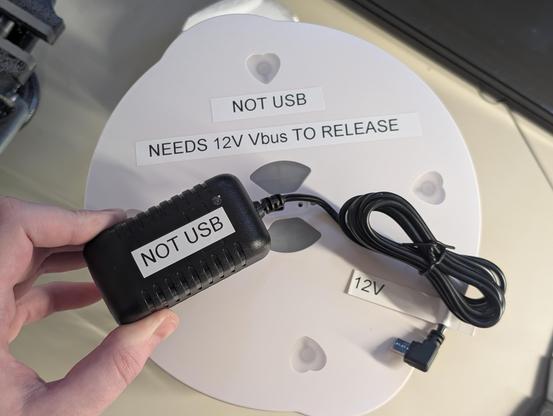
this is a vacuum chamber. the power supply that comes with it has a type-C connector and it puts 12V on Vbus unconditionally. the pump works off both 5V and 12V, so it can pull vacuum off a normal type-C power supply. but the solenoid release valve (that lets you open the chamber once you're done) requires their illegal type-C-shaped power supply. also, not only does the chamber not support PD negotiation, it does not even have a CC pulldown.

to add insult to injury, it's using a NEMA 1-15P plug.
@whitequark

But the EU said everything had to have a USB connector.

@geoffl this is not a USB connector. this is a USB-shaped connector. there's a big difference
@whitequark @geoffl I have a device that delivers 12v power via a 2.5mm audio connector and I wonder what audiophile hurt this person

@ricci @whitequark @geoffl man, I got you all beat.

You are faced with a PC that has two cards with 4 RJ45 ports on them. Surely that's quad ethernet, right?

NOPE!
2 ports of 100baseT with bypass.
And 8 ports of RS232 running at 15V!

Extremely expensive hilarity ensues.

@rootwyrm @ricci @whitequark @geoffl Cisco RS232 is very much a thing, quite common in networking gear.

But if properly designed it and Ethernet can be mated nondestructively. Passive PoE probably not. But regular Ethernet shouldn't hurt RS232 and vice versa if actually spec compliant design.

@azonenberg @ricci @whitequark @geoffl oh, you sweet summer child, the 100bT with bypass should have been your first hint.

When you dump 15 volts from 4+ sources into an early 100bT *hub*, good things do not result.

When you dump 15 volts into a 100bT hub *AND* your 3640's Ethernet port instead of it's console port, TAC is not amused.

When you dump 15 volts into the PRI interfaces, they do not care. Till you're sending on pins 7 and 8. Then they care a *LOT*.

@rootwyrm @azonenberg @ricci @whitequark @geoffl What curséd magnetics-free shit are we talking about here? I've only been doing networking since 1997, but can't recall seeing any likely candidates. Everything I can recall would've been fine with the amount of current your typical MAX232/knockoff can swing with its adorables little charge pump.
@xek @rootwyrm @azonenberg @ricci @geoffl isn't MAX232 capable of sourcing like 50 mA+ of current through that dinky little charge pump somehow? or am I misremembering?

@whitequark @rootwyrm @azonenberg @ricci @geoffl TI's datasheet says ±10mA, and the voltage/load-Z graph in Fig 5-1 makes me think that's being generous. (SLLS047N, p5, "5.6 Electrical Characteristics, Driver" and p6 Fig 5-1)

I suppose there's ~15µC of charge on the caps that could be dumped all at once when you plug a cable?

But, I dunno, I've swapped Fast Ethernet and console cables plenty of times without any problems. Aside from my life being slightly shorter due to the stress of not having a recent enough backup of the configuration for business-critical gear which has gone totally non-responsive.

@xek @whitequark @azonenberg @ricci @geoffl yeah, you're not even close. These were literally custom made cards that were nothing like what you've ever seen. Designed by a maniac. It's been 30 years, but I remember some details.

PCI 2.1, with a Molex for both 12V *and* additional 5V. They were absolutely massive. I don't remember the exact part, but the new version would be TL16C2752.

That configurable trigger level is about to get very important.

@xek @whitequark @azonenberg @ricci @geoffl if you're unfamiliar with PCI, there is a 256 byte configuration register space. These cards used the configuration register space to set the output. These cards defaulted to 'full send' if uninitialized.

I don't know or remember any of those ICs, but I remember the enormous tantalums and several parts under heatsinks.

It was theoretically capable of 200ft+ RS232 links on Cat3. You can do that math. Neat, right?

Except when the cable is 4.5 feet.

@xek @whitequark @azonenberg @ricci @geoffl but it was fine, right? Surely it can't get more insane!

It had LOTS of configurability so it could work with any nightmare fuel, like DCD vs DTR. And it had smarts for dealing with things like low returns.
As long as it was initialized. And didn't get confused.

Ethernet, for example, was very confusing to it, it's disturbingly large capacitors, and it turned out wholly insufficient separation and protection!