Omg so much yes to what @daniel_bohrer wrote. You should even if you know it's a drill actually still leave the building because that's the point of a drill.
The only situation where that's clearly not necessary is: they are inspecting the fire alarm system itself. But that would be communicated very clearly in advance.
@daniel_bohrer @tagir_valeev @betalars @Matt_999
I do siren tests as part of my job (as well as setting the bells off for the 6 monthly fire drill), if its a bell test I always warn everyone in person (its a small office so not a big problem), any other time they should follow emergency evacuation procedure if the alarm sounds..
@daniel_bohrer @Matt_999 @tagir_valeev I mean, it's a free break that you can't be penalised for. Might suck if it's bad weather out, but still, it's a break.
Don't dawdle while leaving or you'll be trampled by the smokers. Extra smoke break!!!
@TerryBTwo @tagir_valeev No one would ask this question while shuffling down a crowded stairwell and turn back? Or be in the bathroom and hoping not to have to rush out?
It's weird to assume that people won't be a little lazy when LLMs are so successful BECAUSE people are eager to be lazy. Also weird to focus only on a very specific event as how "AI will kill us" when we already have machines driving cars into people, deleting production databases, encouraging people to kill themselves, etc.
@tagir_valeev LLM-cosplaying-as-AI has already killed a bunch of people.
It will keep killing.
@tagir_valeev Has Glean been a well evidenced data driven positive impact on the business?
If not, this would be a great opportunity to campaign to remove such tooling that which may not be providing the positive impact the business was intending
I’ve found AI chatbots via Slack has not worked out worked out well for our teams
I don't know, man. If I had just received "advice" that might have caused physical harm or even death, I wouldn't just suppress this specific error and happily continue evaluating, because the bot looks like getting better, "otherwise".
I hope accountability for such decisions is well documented. That won't prevent harm from happening, but at least give employees or their surviving relatives a chance with respect to liability issues and compensations.
@tagir_valeev @mathowie Decades ago, I read a story (I want to say on Slashdot?) about a baffling email sent to thousands of employees at a large corporation, that said, simply, “DO NOT LEAVE IT IS NOT REAL.” Ultimately, it turned out that one of their buildings at one location had a false fire alarm, and some well-meaning person emailed everybody to inform them of that fact.
In 2026, we have automated DO NOT LEAVE IT IS NOT REAL, and it's wrong.
@tagir_valeev München Calling...
Engines stop runnin', but I have no fear
'Cause London is drownin' and I live by the river
Jebus. The fire alarm goes off and their reaction is to ... start a Slack thread?
Not, "get up from desk and leave expeditiously" like you practice in the fire drills?
Some people have no common sense.
@cazabon The Slack thread was started after the person evacuated:
As it gets much more attention, than I expected, here are two clarifications: 1. The Slack message was written after the person evacuated properly. It was written via phone while staying at the designated area outside the building. 2. Nobody asked AI advice explicitly. It was configured to answer automatically if it thinks it can help you. The configuration was updated after this incident.
If it was a test then folks should do what they are supposed to do in a fire alarm to test the complete system.
@tagir_valeev More galling still, a scheduled test of a fire alarm system typically *still includes evacuation.* Leaving the building *is* the drill. I have never worked in an office where there was any condition under which occupants are told to ignore the alarm.
Ignoring alarms leads to alarm fatigue which then leads to failure. Alarms either exist for a reason or they don't. A device that says otherwise is a broken device. You're right, devices like that will kill.
@sbourne @tagir_valeev I don't agree with this because no alarm should go ignored, but I do understand why it's done that way in the real world. And why it's the default method.
Nobody[1] calls a reliability engineer before putting together their building maintenance punchlist and sending dudes with ladders.
1. note: nobody except my kid's boyfriend who is a chief facilities engineer, or my kid who is a marine engineer and grew up around rigid high-reliability high-risk operations. They're exceptions.
@majick @tagir_valeev There could be some cases where the test checks sound etc, where evacuation is not the drill, but those indeed would be exceptions.
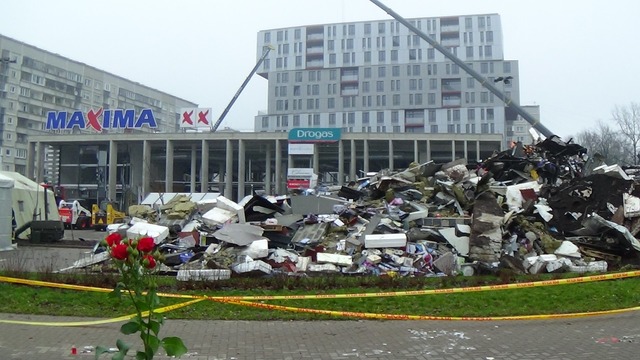
In Latvia, in 2013 fire alarms were repeatedly set off in a supermarket. Security just reset them, and employees & shoppers returned, then ignored the alarms.
The building collapsed and 54 people died.
Whenever I hear a fire alarm, I first get the fuck out, then I figure out what's happening.
https://lv.wikipedia.org/wiki/Lielveikala_%22Maxima%22_sagr%C5%AB%C5%A1ana_R%C4%ABg%C4%81
@richlv @tagir_valeev Operators resetting/muting the alarm without understanding why it fired is a perfect example of alarm fatigue. A tragedy like that underscores why it's a Big Fuckin' Deal to avoid it.
The root cause of a failure like that is almost never the dude who did that. It's the circumstances that led to that dude thinking it was the correct thing to do.
Then people die.
My own opinion that evacuation is always the drill. Working on the alarm device, be it wiring, programming, or the noise that comes out of it, is part of working on an end-to-end system that includes people going away from the alarm.
@richlv @tagir_valeev Yeah, I completely agree those factors can very much influence how bad something like that turns out to become. Rarely does someone think a thing they do routinely is actually high risk.
I'd say they fall into the category of "factors" I mentioned as root causes: cultural, management-based (I've lived that life), and so on. Fatigue's one thing, for sure, not the only thing, and sometimes it's stuff like that deprioritizing the seriousness of an alarm. A different cause of fatigue/blasé attitude/misinterpretation.
Like I said, it's almost never the dude and almost always what influenced the dude to be the last link in the chain up to a horrible tragedy.
Fwiw I’ve worked in buildings with a regularly-scheduled alarm test (same time and day every week) which you were expected to ignore, reporting if there was a fault. It was preceded by a recorded announcement saying it was a rest, and followed by one saying the test was over and any further alarms should be responded to normally by evacuating.
(The drills where you do leave are more common, of course.)
@tagir_valeev As 90% of fire alarms are drills, it makes perfect sense to respond with the most likely scenario.
( /s in case it wasn’t obvious. Rather startling that people are arguing with you.)