THE BOUBA/KIKI EFFECT

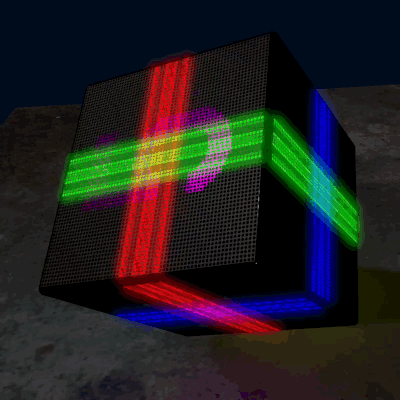
Which of these shapes looks like the sound "bouba", and which looks like the sound "kiki"?

People of all cultures agree on this, and now it's been found that baby chicks do too:

https://phys.org/news/2026-02-bouba-kiki-effect-baby-chicks.html

It may seem weird that sounds should robustly match with shapes, but I think it follows from physics - and living as we do in the physical world, it pays for us to make these associations.

For more:

https://en.wikipedia.org/wiki/Bouba/kiki_effect

Thanks to Alex at https://mathstodon.xyz/@WizardOfDocs@wandering.shop/116115329367345332 for pointing out the news about baby chicks!

@johncarlosbaez
> It may seem weird that sounds should robustly match with shapes, but I think it follows from physics

When I found out about the effect via linguistics, I too concluded it was likely due to physics.

This news about baby chicks makes that seem even more likely.

@johncarlosbaez
Displacement of higher versus lower frequency airwaves --> different higher versus lower sounds?

@johncarlosbaez

There are other similar phenomena:

Vowel pitch: High pitch/small size low pitch/large size. (large objects vibrate with lower frequency)

Taste: Roundness equals sweet or creamy; angularity equals sour, bitter, or salty.

Grapheme-color synesthesia

There may be deep neurological reasons for conceptual metaphors, and these are just the lowest level. There are cultural mappings or individual level mappings developed later in life, such as spatial metaphors where the future is in front and the past is behind, argument is a war, time is a landscape, resentment is bitter, functors are metaphors.

@maxpool - nice! There's probably a useful "coarse theory of reality" lurking in all these observations.
@johncarlosbaez You are probably already familiar with applied category theorist Joseph A. Goguen, UCSD? He wrote "What is a concept?" (2005) https://cseweb.ucsd.edu/~goguen/pps/iccs05.pdf where he sketched a way to bring together cognitive, social, pragmatic and mathematical view of concepts and integrate them in same system.

@johncarlosbaez

Even the shapes of the written letters show this effect, which is pretty wild when you consider all of the history that those letters went through.

@atif

According to Wikipedia, the effect is slightly stronger in languages that use the Latin script, but still present in others. The original research was done in Georgia, presumably in Georgian written with the Mkhedruli script, where pretty much all of the letters look bouba.

@TobyBartels I was wondering about this yesterday, thanks. I would guess it’s not that uncommon that non-Latin script users are aware of the Latin script and how it translates to their native one. So it’d be interesting to know if the participants knew the latin alphabet. Also I’d like to note that Georgian k-s look a bit more kiki than their b, and I’d speculate especially so to the natives, since it kind of makes sense that they developed a finer sensitivity to kikiness within their already high baseline bouba alphabet
@johncarlosbaez Are we talking about the things' relative spectra, or is there something more/different?
@johncarlosbaez Might just be the brain matching information densities that it detects and registers brain-wide. Earl K Miller has been talking about brain-wide EMF waves that the brain produces that could carry this sort of information.

@johncarlosbaez are you thinking rounded things are more likely to make rounded booming sounds? Maybe tree stumps and such. Sharp pointy things are more likely to make sharp crunchy plinky noises. Dried seed pods, shards of rock, maybe bone fragments?

But then, rounded flints can be very plinky! Hmm

@benjohn - I think you're right. Round fruits, rubber balls, all that sort of stuff is more bouba-y. Of course there are exceptions, but presumably what matters is what we meet the most.
@johncarlosbaez tummies are very Bouba :-) Heh.

@johncarlosbaez

More importantly, both of them sound like "Bourbaki".

@weekend_editor - The mathematics of Bourbaki is sharp and pointed at one end, and rounded at the other.

@johncarlosbaez

I guess I never found the rounded end, then. :-)

@johncarlosbaez

I’m calling BS on this one, even without reading the paper.

If you want to know why, search Google for Clever Hans.

I spent my PhD years studying honeybee behaviour. Animal experiments are very often biased by the human experimenter in unconscious ways.

It just seems too far fetched for me: An cognitive effect in humans innately manifest in baby chicks? I doubt it.

Having said all that, I should read the paper and try to pinpoint specific weaknesses. But I’m busy and lazy.

@TonyVladusich - it's not supposed to be a linguistic effect, but rather a sonic effect: a correlation between sounds and shapes. We certainly know what sounds "wet" and animals should too. We also know what sounds "raspy and sharp", and what sounds "bouncy and rounded".

But yes: a skeptic should carefully study and question these findings with a careful comb.

@johncarlosbaez

How is that not linguistic? Sounds and shapes are cognitive constructs not physical ones!

@TonyVladusich @johncarlosbaez

Cognition and association-making don't require language.

Hard objects have give sharp transient acoustic signatures like kiki sound. Soft objects have slower rise times like bouba sound.

Crystal-like image on the left associates with hard, leaf-like image on the right associates with soft.

@maxpool @johncarlosbaez

Sure but language "requires" cognition and perception.

Constructs like hard and sharp are cognitive, not physical.

@TonyVladusich - Everything is cognitive insofar as I'm cognizant of it, but as a physicist I consider concepts like hard and sharp to be physical. We don't have to go down to deep reductionist levels like "quarks" for concepts to be about the physical world. For example the fact that hard sharp things can cut other things is a fact of physics.

@maxpool

@johncarlosbaez @maxpool

Of course, everything has a physical basis.

But to say one thing "cuts" another thing is a cognitive construct that bears some vague and unspecified relationship to the physical act of "cutting".

@johncarlosbaez @maxpool

Can we make this mapping "concrete"? I say we fundamentally cannot and that any "resemblance" between cognitive and physical constructs is, in a fundamental and well-defined way, a "fiction of coincidentals".

When a magician saws a person in half, for example, we are perceptually convinced of the veracity of the act, although no such physical operation actually occurred (hopefully).

The cognitive and physical have thus become fundamentally dissociated by the visual performance of the magician.

@TonyVladusich - a stage show performer can fool me into thinking the huge dumb-bell he seems to be straining to lift is heavy, but that doesn't make me question the physical basis of the concept of "mass".

@maxpool

@johncarlosbaez @maxpool

Riiigghhht. But you see my point, yeah?

@TonyVladusich - not really. You'd been saying that "to say one thing "cuts" another thing is a cognitive construct that bears some vague and unspecified relationship to the physical act of "cutting"." But this sentence seems to apply to anything at all, e.g. "to say someone "lifts a heavy weight" is a cognitive construct that bears some vague and unspecified relationship to the physical act of "lifting a heavy weight"." Or "to say "a star explodes into a supernova" is a cognitive construct that bears some vague and unspecified relationship to the physical act of "exploding into a supernova"."

Let's quit this particular branch of the conversation, okay? It's not fun for me. I'm just not subtle enough for it.

@johncarlosbaez

I think you understand it perfectly well. Our models of the world are cognitive constructs, no more, no less.

I’m sorry if you don’t enjoy such conversations. But they sit at the heart of the endeavour we call science, whether you like it or not.

@maxpool @johncarlosbaez

This type of reasoning is known as "begging the question".

(As in, begging the very question we seek to answer.)

It is a logical fallacy.

Why is part of an image (an image!, not physical thing itself, no less) "hard" or "soft"?

@TonyVladusich @johncarlosbaez

begging the question is error when you assume the truth of your conclusion in your premise to prove it's true. But I'm not trying to prove a conclusion, I'm trying to show that there exists a possible answer to your question "How is that not linguistic?"

@maxpool @johncarlosbaez

Yes, I agree linguistic was a bad word to use. But I did later correct myself.

@TonyVladusich - They are cognitive constructs, yes, but not necessarily linguistic. Animals have associations to sounds and shapes without having language. They *need* to have some such associations to survive - e.g. hearing dripping sounds, they think of water.

The correlations between sound and shape ultimately arises from physics: e.g., liquids make dripping sounds, pounding on a rounded elastic suface tends to make a "bouba" type sound, etc.

@maxpool

@TonyVladusich - but you are starting to make me doubt that chicks can make the bouba-kiki distinction. One proposed explanation for it is that when humans say "bouba" our mouths make a more rounded shape than for "kiki". This would be a physical explanation, but quite specific to human vocal productions, not something a bird should know about. I switched to the example of the sound of running water, since that's something a bird should maybe know about!

@maxpool

@johncarlosbaez @maxpool

These are newborn chicks. They know nothing. And the idea that they are born innately able to associate specific sounds to specific shapes is quite frankly laughable. See, for example, the entire history of animal behavioural studies.

@TonyVladusich - okay, now you're saying stuff that I can understand. I don't know what newborn chicks can or can't do, since I've never read about newborn birds' innate abilities. But someone would know about this... maybe you.

The pop article says

"The team then repeated the experiment with chicks that were less than a day old, although this time without any training or rewards. As in the first experiment, they explored the spiky shape when hearing kiki and a round shape when hearing bouba.

The researchers chose chicks as their experimental model because they are precocial. This means they are relatively mature and mobile not long after hatching, and have had limited opportunities to learn sound and shape associations from the outside world.

The team believes that because birds and mammals are distantly related (sharing a common ancestor around 300 million years ago), the bouba-kiki effect is not just a quirk of our language. Instead, it could be an ancient organizing principle of the brain that helps animals navigate the world, as the team notes in their paper: "Our data place the origin of sound-shape crossmodal matching [the ability of the brain to link information from different senses] at the earliest stages of life, possibly hinting at a predisposed experience-independent mechanism.""

This may or may not be nonsense - I don't know.

@maxpool
@johncarlosbaez @maxpool

Lol. Well I’m glad something I’m saying does!!! 🤣

@johncarlosbaez @maxpool

If you want to see a real shit show, Google ā€œnature versus nurtureā€. This argument has been going for over a century without resolution. It’s largely a poorly defined set of constructs. So nobody can ever agree because nobody ever understands what the fuck either side is saying. It’s such a common pattern in soft sciences. It’s a chicken and egg problem every time (not pardoning the pun).

@TonyVladusich @maxpool - I know about the "nature versus nurture" debate and how much wheel-spinning occurs there, and I know this is a common problem in the soft sciences. That's exactly the sort of thing I try to avoid talking about - not because the issue is unimportant, but because I don't think it's a good use of my time. There are lots of subjects I read about and think about but avoid talking about, because they don't lie in my realm of competence. It'd be like joining a bar-room brawl when I'm not even good at fighting.

@johncarlosbaez @maxpool

🤣 Nice metaphor. And totally fair enough! This sort of "blobby" discussion is my jam. I enjoy trying to find the form of the blobs. It's not for everybody and it's bloody hard work (sometimes you never see the punches coming!).

@TonyVladusich @johncarlosbaez

This is weird. I know I know very little about chick cognition, but the only thing I thought I knew was that they come out with skills that human babies get only after several months.

1. They come with innate face selectivity, but can switch to imprinting into red cube 15-minutes after hatching.
2. They can solve visual binding problems.
3. Discriminate between animate and inanimate movements (cue is the abilty to change state of motion)
4. They have object permanence (human babies get that only after several months)
5. They can do non-verbal arithmetic with few numbers.

This was all wrong?

@johncarlosbaez @maxpool

My point is that sounds and shapes are cognitive constructs. Whether a chicken brain has evolved to create such constructs and associate them is the question at hand.

I say it's unlikely for the reasons given, and probably for many other reasons (you've pointed out one with the difference between the human mouth and chicken beak).

The problem is that we are taking as given the very constructs that require explanation. This is why psychology has been such an utter failure as a field; namely, the failure to clear delineate the physical from the perceptual and to identify the mapping form one to another (hint: there is none in the sense of a mathematical homomorphism).

This is the problem I tackle in my book, btw.