It’s really surprising to me that the #fediverse hasn’t agreed on a standardized way to open cross-instance #activitypub objects and instead relies on links that open in the browser. #urischeme

I found this proposal and what’s thinking… https://codeberg.org/fediverse/fep/src/branch/main/fep/07d7/fep-07d7.md Which one would be your favorite?

(If anyone has updates on the progress, feel free to point me in the right direction)

web+ap:
21.4%
ap:
35.7%
activitypub:
28.6%
fedi:
14.3%
Poll ended at .
fep/fep/07d7/fep-07d7.md at main

fep - Fediverse Enhancement Proposals

Codeberg.org

@[email protected] the only implementor I know of who has recently played around with this is @[email protected] of Piefed. They use web intents I think, but the UX leaves much to be desired (many clicks and popups just to register the web intent)

I don't recall whether there was a SWICG task force about this topic... perhaps the HTML Discovery Task Force might be related?

cc @[email protected]

ActivityPub Discovery

@julian @rimu @evan isn’t an URI scheme the way that would offer fastest compatibility? after all it’s been around forever, most browsers just let the OS handle it and even apps like zoom and iTunes have successfully implemented it for their service šŸ¤”
@ricferrer @julian @rimu We already have an URI scheme for ActivityPub objects; it's https: .

@evan @julian @rimu it’s horrible UX. It opens a browser where I am not logged in instead of opening my default app, like it happens with mailto:

https: is for webpages

@ricferrer @evan @julian @rimu

https: is not for web pages. it's for http resources, which can be any content type. the content should be dispatched to the appropriate content handler; for example:

- html opens in an html viewer
- pdf opens in a pdf viewer
- png opens in a png viewer
- mp4 opens in an mp4 viewer

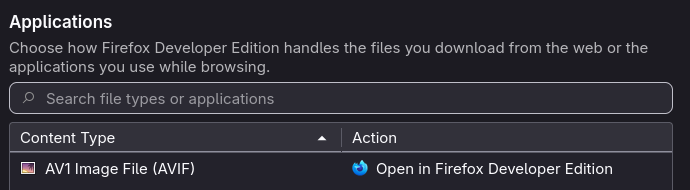
activity+json could be opened in an activity viewer. see firefox for example in pic 1:

@trwnh @evan @julian @rimu while this is true now, it was an evolution. As you probably know, the ht in html and http stands for HyperText, the fundamental concept that enabled websites in the early 90s

The question is what is more realistic for wide adoption… that all browsers start recognizing activities and decide if rendering in a viewer inside the browser or redirecting outside to an app makes sense.

@ricferrer @evan @julian @rimu any browser right now can recognize, or should be able to recognize, that the http response it got is "content-type: application/activity+json" and then open it in your system's configured activity+json processor, like a PDF or PNG or anything else.

i think it's not realistic to fork the entire namespace of http resources based on content-type. it was bad enough that https: was different from http: and we are still dealing with the repercussions of that move today

@ricferrer @evan @julian @rimu if we say that every resource needs *two* identifiers, one to open in a "https" browser and one to open in a "fedi" browser, then why? what happens if someone copies the "fedi" uri outside of the "fedi" context, and the other person doesn't have a "fedi" uri handler on their system? that link becomes useless. not everyone is going to know to copy the "correct" link, or that the "incorrect" link can be rewritten.
@ricferrer @evan @julian @rimu which is more realistic: that literally every application in the world need to start recognizing "fedi" links, or that existing fedi applications start opening https: links locally ("in-app") where possible?

@trwnh @evan @julian @rimu imho this is unrealistic and wishful thinking. I don’t think all major browsers will agree to do it this way anytime soon. Specially on mobile where most people get their content.

if that doesn’t happen the fediverse will continue to be difficult for ppl accustomed to one app that offers a unified social experience

Before 2015 universal/app links didn’t exist, a URI scheme was the best solution FB, Twitter, Instagram found

@ricferrer @evan @julian @rimu fb twitter instagram etc are also centralized single entities, so there's no contention on who gets to open the link.

@trwnh @evan @julian @rimu it already works well for mailto: the average user doesn’t have 10 mail clients. For the advanced and technical savvy users that want a bunch of fedi clients they can find other solutions on how deal with it.

Btw Android lets you choose your the app.

Before 2015 you would uninstall twitter and install tweetbot which responded to twitter:

Fallbacks to http/html for people without apps was handled through JavaScript

@trwnh @evan @julian @rimu

I think the biggest difference with pdfs, mp4 in your example and an activity is that I most likely want to interact with an activitypub object: either follow, repost/announce, etc for this to work I need to be logged in. So is the solution to include an activitypub client in the browser? Use an external viewer that intercepts through browser extensions?

Now even the experience inside mastodon sometimes opens a webview šŸ¤·šŸ»ā€ā™‚ļø

@ricferrer @evan @julian @rimu

acceptable solutions imo:

- a browser extension that lets you POST to your outbox (to publish activities) or proxyUrl (to view activity streams 2.0 resources)
- in-app rewriting like https://browser.pub/ that keeps all links as "internal links" with the ability to open an "external link" that takes you out of the app
- a system app that handles activity streams 2.0 resources which your default browser can dispatch to (and this may be a PWA!)

https://bolha.one/@cadusilva Ā· BrowserPub Ā· A browser for exploring ActivityPub and the fediverse

Explore the open social web through the lens of ActivityPub and the fediverse.

I think the right solution is to use a combination of FedCM (making progress in the W3C) plus Activity Intents (FEP-3b86) to link you back to the web page for your home server.

FedCM will let you ā€œsign inā€ to your browser, and make that information available (with consent) to the pages you visit online.

Activity Intents publish the operations your home server supports, then give links to complete the intent.

We already have the tools we need.

@ricferrer @trwnh @evan @julian @rimu

@benpate @ricferrer @evan @julian @rimu should be possible even without necessarily those specific tools -- although fedcm can make it "friendlier" ux-wise

- authenticate your id ("i am this person")
- get the linked claims from the id ("this is my proxy url")
- submit the request ("fetch me this thing")

i mean, you could write a web extension right now that does it in a very minimal way, i'm pretty sure? "POST the current URL to this proxyUrl" is not exactly a difficult thing to do...

@benpate @ricferrer @evan @julian @rimu there's a shortcoming where mobile browsers don't let you install web extensions as easily but that can also be overcome i think.
@benpate @ricferrer @evan @julian @rimu native apps can also expose share targets so you can "share" the current web URL to those apps and it opens in those apps.

@trwnh @benpate @evan @julian @rimu share targets opens a new post, which is expected behavior

I think waiting for all browsers to allow extensions and then waiting for extensions to exist and then expecting the user to know which to use is not very realistic or short term.

@ricferrer to repeat: you don't need the extensions. they are just one option to making things simpler. i described at least 2 other options that are all complementary:

- rewrite links to keep you in-app
- content-type handlers to get you in the right app
- extensions to also get you in the right app
- share targets to get you in the right app (on mobile)

you can use one, some, all, or none of these. the first one is the most important; the others should also be easy to do right now.

@ricferrer browser support would be the icing on the cake, but i think that extensions are actually not as unrealistic as you are saying. many people end up with extensions installed almost by accident. at the end of the day, if you open an app like mastodon, you have to be prompted to do certain things like enabling notifications and registering stuff like that.
@trwnh staying in app is the simplest solution. But the challenge is getting me from the browser to the app without me having to install anything or use the share intent workaround, which doesn’t work because it opens a ā€œnew postā€ as expected by the user when they select ā€œshareā€
@ricferrer you have to at minimum register a handler, no? how is that any different than "installing"?

@trwnh @benpate @evan @julian @rimu
I am focused on what can we do pragmatically and realistically as a community to fix the broken experience to help get more people into the fediverse.

A mix of

1) JavaScript for websites that want to link to the fediverse that trigger ap: and offer http fallback (just like fb: before 2015)

2) adding support for ap: on fedi clients

It’s something we can do now. It works and we don’t have to wait for big tech

@ricferrer @benpate @evan @julian @rimu doing ap: will fail for anyone who doesn't understand ap: which by default is everyone
@trwnh @benpate @evan @julian @rimu it worked before 2015 for twitter:, fb:, instagram: in the time of highest growth. Nobody needed to understand anything. It just worked because it was implemented with JavaScript and used http as a fallback which always worked even if the uri scheme failed

Yes. I agree with just moving forward with the tech we have.

What would the JavaScript do, exactly?

What parts of this would require a new ap:// protocol, or could we accomplish this with regular https:// links?

Also: thanks for starting this conversation. I think it’s very helpful and timely!

@ricferrer @trwnh @evan @julian @rimu

@benpate @trwnh @evan @julian @rimu
Maybe I did not explain it well. Fb, twitter, instagram used JavaScript to try to open their uri. If it failed, they opened the http equivalent

The user did not notice much. If they had the app, it jumped. Sometimes if you returned to the browser the http was opened anyways. But that’s wasn’t very annoying

I think I follow. Instead of ā€œlook before you leapā€ it’s more like ā€œjust jump anyway, then recover errors gracefully.ā€

On my iPhone, websites themselves can declare a preferred app to use instead of the site. That’s another way around this problem, yes? But I don’t know if that’s available in desktops or not.

I care mostly that we don’t break things for regular people who haven’t installed an app, and haven’t installed a browser plugin.

@ricferrer @trwnh @evan @julian @rimu

@benpate @ricferrer @evan @julian @rimu you can already do this with http and as early as 2013 there was an android app for handling links before they reached your default browser. i'm trying to remember what it was called :(

@benpate @trwnh @evan @julian @rimu that was the beauty of the approach. At the time desktop only said ā€œapp not availableā€ but still had the destination open below the alert. I don’t know if macOS and other desktop handles it the same way now. I tried this in 2009 the last time šŸ˜‚ but it might be worth a try

On you iPhone it uses the newer approach of registering the domain for universal links (released in 2015). Which won’t work in the fediverse

@[email protected] @[email protected] yes, that's correct and what the current state of affairs is.

You can write links pointing to an interstitial page that says something like "opening in app", and use js to fire off the web+ap protocol handler.

If the user is still on the page after some time has passed, the handler failed and you redirect to the https version.

@[email protected] and yes it will work fine with users without an app or extension installed. Agreed that this is a no-go for wide adoption. It has to be done with stuff everybody already has.

cc @[email protected] @[email protected] @[email protected]

@julian @benpate @rimu @ricferrer most people don't have fedi
@[email protected] exactly, that's why when you open the interstitial page, it tries the protocol handler, and if there's no response, sends the user to the https target as fallback.

@julian yup

you could in theory do web+activity to mean "http get with accept header for activity+json" but what mastodon does is i think just intercept the click with js

This is unfortunately true. But I believe good content (plus those little like and share buttons) would give people a reason to join.

I yammered about this for 30 minutes at FOSDEM. I can link the presentation video once it’s posted.

@trwnh @julian @rimu @ricferrer

@julian

just some historical context,

 since at least 2010 (16 years ago) registerProtocolHandler is specified and worked for mailto: then for tel: (cause nice for gooles android)


 back in 2015 (11 years ago) we (w3c SocialCG) had talked to all the browser makers about making ActivityPub and webmention trusted protocols.

In 2016 (T-10 years) I demoed the existing practical problems at Jeremy Keiths indiewebcamp in Brighton see the demo https://www.youtube.com/live/W70wd56i0Bg?si=DJgm9WsGpwzaLdGJ&t=2030 (indiewebcamp demos are written in incredible short time …)

Anyway - nothing changed at the browser makers except the browser makers switched their positions from company to company. @jaffathecake :)

[edit; well: Mozilla did BrowserId, renamed it to Persona and directly trashed it cause then gaming and AI [where the parts of the teams went to] was more important …

@ricferrer @benpate

Demos - IndieWebCamp Brighton 2016

YouTube

@sl007 @julian @jaffathecake @benpate but you don’t need approval or the blessing from the browsers to implement a uri scheme right? iTunes used it with itms: , zoom does it.

It works of people have the app. You would only need their support if you want the browser to do something with the uri out of the box when there is no app other than showing an error. Right?

@[email protected] yes and no. I think standalone apps can listen for their own protocol handlers (like julian:// what a great protocol)

But PWAs must use the web+ prefix. The OS (or maybe just the browser) won't allow registration otherwise

@[email protected] @[email protected] @[email protected]

@julian @sl007 @benpate @trwnh oh ok. I was talking only about native standalone apps and forgot about PWAs… that makes it a bit more complex, but still solvable. Do you use lots of ā€œinstalledā€ PWAs?

@julian

That’s really helpful. Thanks, Julian://

One follow up question? Is it possible for regular apps to use the web+ prefix, too? Otherwise we’d have to pick one over the other, which might be problematic.

@ricferrer @trwnh @sl007

@julian

well, the difference is what I demoed at IWC:
Apple itself (itms) or zoom https://www.visualcapitalist.com/zoom-boom-biggest-airlines/ can do anything.
You will not be asked for consent.
Same with mailto …

But as shown the consent mechanism is not standardized and when I see the nearly white icon in the white browser bar I wanted to hit the person who made it cause at least 30% will not even realize it …

@ricferrer @benpate @trwnh

Zoom is Now Worth More Than the World’s 7 Biggest Airlines

Zoom benefits from the COVID-19 virtual transition—but other industries aren't as lucky. The app is now more valuable than the world's seven largest airlines.

Visual Capitalist

You’re correct.

FedCM is a bonus, but not required.

And Activity Intents just normalize the mess of ā€œremote followsā€ and ā€œshare intentsā€ that many apps already support. I currently ā€œpolyfillā€ intents for servers (like Mastodon) that don’t publish explicitly.

It should, however, start with a GET to my home server (not a POST) so I can see what I’m about to do. There’s so much variation between servers; we’re asking for bugs if we skip this step.

@trwnh @ricferrer @evan @julian @rimu

@benpate @ricferrer @evan @julian @rimu i'm not entirely sure why it's POST proxyUrl instead of GET proxyUrl but i think it has to do with leaking metadata iirc

In the end, we need real ā€œshareā€ and ā€œlikeā€ buttons for the Fediverse - with as few clicks as possible - wrapped up as easily installable widgets that go next to Twitter and Facebook on every site online.

(That’s step 1)

Once we do this, step 2 is to lobby sites to JUST use Fediverse buttons, and drop the ones for hateful platforms.

@trwnh @ricferrer @evan @julian @rimu

@benpate @trwnh @ricferrer @evan @julian @rimu I’m actually working on implementing your Activity Intents FEP in Loops right now, using autocomplete from FediDB it’s quite powerful!

This is AMAZING, Dan, and it would be a huge win. #ThankYouThankYouThankYou!!!

@dansup @trwnh @ricferrer @evan @julian @rimu

https://bolha.one/@cadusilva Ā· BrowserPub Ā· A browser for exploring ActivityPub and the fediverse

Explore the open social web through the lens of ActivityPub and the fediverse.

@benpate @trwnh @ricferrer @evan @julian @rimu So I have a working proof of concept, using the Activity Intents FEP and a polyfill for software not yet supported.

Want to work on this together?

I will be getting the webintents.net website up shortly šŸ˜‰

https://mastodon.social/@webintents/116028982466167234

Yes. I'm in.

I've built similar buttons for Emissary, but they require too much server-side logic. I've been wanting to migrate the whole thing to client-side JS for some time, and make an easy widget that "webmasters" can drop on their pages.

If you're interested, you're more than welcome to take the lead on this (I'm sooo full rn) and I'll do whatever you need to help out.

And if you want to chat, let's jump on a video call :)

@dansup @trwnh @ricferrer @evan @julian @rimu @webintents

@benpate @trwnh @ricferrer @evan @julian @rimu @webintents

Yes, for sure! I've already built a proof of concept, that I will get setup and ready to test on a video call.

I even got the project website up: https://webintents.net

WebIntents - Universal Follow Button for the Fediverse

Simple, beautiful follow buttons for ActivityPub. Works with Mastodon, Pixelfed, Loops, and all fediverse platforms. Less than 10KB, zero dependencies.

@benpate @trwnh @evan @julian @rimu I agree. That’s I like the uri scheme solution, which takes inspiration from the approach twitter, fb, instagram used before universal/app like in 2015 to achieve massive growth

Here’s a question: do browsers let JavaScript introspect what custom protocol handlers are available/installed?

I’m planning a Franken-widget that works with whatever tools are available.

Activity Intents? Sure

Custom protocol? Okay, we’ll use that too.

None of the above? Sniff the server and polyfill.

We could certainly try an ā€œANDā€ approach, if JavaScript will let us.

@ricferrer @trwnh @evan @julian @rimu

@benpate @trwnh @evan @julian @rimu I know I implemented it at some point by analyzing what Facebook and co were doing. I think it was kind of a hack, but it worked. It didn’t let you know what was available. It just assumed it worked if you left the page and if you were still there it opened http. Like I said sometimes you had the page open when you came back to the browser (so it effectively opened both) but it wasn’t that annoying
@ricferrer @benpate @trwnh @julian @rimu so, maybe we should have a group working on this problem.
@evan @benpate @trwnh @julian @rimu is there a matrix room we could joint? šŸ¤” or should I make one?
@[email protected] I feel keeping this on fedi is easier, but that's also because I don't have a matrix account šŸ˜…
@julian @ricferrer I meant, taking it to a Task Force. It's a really important question.

@[email protected] yep! I was responding to using a matrix chat room.

I'm all for a task force on this.