Did it ever occur to you why your computer has a fan, and why that fan usually stays quiet until the machine actually starts doing something?

When your laptop sits idle, very little is happening electrically. Modern processors are extremely aggressive about not working unless they have to. Large parts of the chip are clock-gated or power-gated entirely. No clock edges means no switching. No switching means almost no dynamic power use. At idle, a modern CPU is mostly just maintaining state, sipping energy to keep memory alive and respond to interrupts.

The moment real work starts, that changes.

Every clock tick forces millions or billions of transistors to switch, charge and discharge tiny capacitors, and move electrons through resistive paths. That switching energy turns directly into heat. More clock cycles per second means more switching. More switching means more heat. Clock equals work, and work equals heat.

This is why performance and temperature rise together. When you compile code, render video, or train a model, the clock ramps up, voltage often increases, and the chip suddenly dissipates tens or hundreds of watts instead of one or two watts.

The fan turns on not because the computer is panicking, but because physics is being obeyed.

Even when transistors are not switching, hot silicon still consumes power. As temperature increases, leakage currents increase exponentially. Electrons start slipping through transistors that are supposed to be off. This leakage does no useful work. It simply generates more heat, which increases temperature further, which increases leakage again. This feedback loop is one of the reasons temperature limits exist at all, and ultimately why we have fans – to keep the system under load below this critical temperature.

Above roughly 100 C, this leakage becomes a serious design concern for modern chips. Not because silicon melts (that's above 1400ºC) or stops working, but because efficiency collapses.

You spend more and more energy just keeping the circuit alive, not computing. To compensate, designers must lower clock speeds, increase timing margins, or raise voltage, all of which reduce performance per watt.

Reliability also suffers. High temperature accelerates wear mechanisms inside the chip. Metal atoms in interconnects slowly migrate. Insulating layers degrade. Transistors age faster. A chip running hot all the time will not live as long as one kept cooler, even if it technically functions.

This is why cooling exists, and why it scales with workload: It exists to keep the chip in a temperature range where switching dominates over leakage, where clocks can run fast without excessive voltage, and where the hardware will still be alive years from now.

In space, where you cannot rely on air or liquid to carry heat away, this tradeoff becomes unavoidable and very visible.

  • Run hotter, and you can radiate heat more easily.
  • Run hotter, and your electronics become slower, leakier, and shorter-lived.

@isotopp Heat dissipation issues alone would fill its very own thread 😏

The good @nyrath has a very nice webpage on that topic: https://projectrho.com/public_html/rocket/heatrad.php

@thilo @isotopp

Heat Radiators - Atomic Rockets

@wonka @nyrath @thilo @isotopp Considering how much radiator panel even our primitive International Space Station uses, it occurs to me that virtually all classic depictions of space stations and other large constructs with huge volume to surface ratios are unrealistic. The Death Star should melt just from having the crewed sections have lighting.
@60sRefugee @wonka @nyrath @thilo @isotopp there was a great article on ecumenopoli I read a while back about how having a city that large turns into a heat dissipation problem.
Coruscant, Heat Dissipation, and Basic Worldbuilding

Continuing along the lines of world-building for science fiction settings, I had planned a post on just how much heat Coruscant (of Star Wars universe fame) would generate and the fact that the pla…

M. Q. Allen

@cinebox @60sRefugee @wonka @nyrath @thilo @isotopp

I do love fandom nitpicking.

I'll add a few things in case someone is interested:

I believe the "city the size of planet" trope was originally introduced by Asimov in The Foundation. It was later used by at least Harrison in in the
"Bill, The Galactic Hero" -series. In Star Wars, Coruscant was invented by Timothy Zahn for Thrawn -series.

To certain extend these should all be seen as the "same place" (capital of a galactic polity). ½

@cinebox @60sRefugee @wonka @nyrath @thilo @isotopp

2/2

I recall Harrison addressing the population by pointing that there're completely abandoned ruins in his capital (something akin to Detroit). So while the capital had high population, it wasn't evenly distributed. There were also buried seas etc.

In the books, Coruscant had somewhat of a morlock-problem, and the sublevels are outside Republic-control. The polities didn't even've maps! So the "1..3 trillion" was just the known subjects.

@cinebox @60sRefugee @wonka @nyrath @thilo @isotopp

I'll add a personal assumption to the "each planet has only one type of fauna" -problem that Star Wars has.

I believe that when space travel is as cheap as it seems to be in SW, then there's no need to populate the more harsh climates of the planet (or they were outside the galactic polity control). So for example Tatooine's Mos Eisley is probably closer to one of the poles, and Alderaan's poles were used just for cold storage.

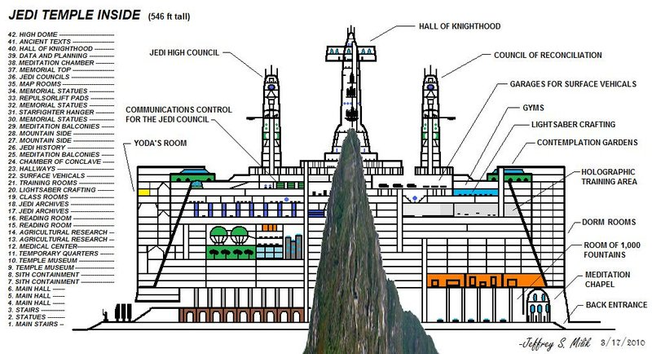
@iju @60sRefugee @wonka @nyrath @thilo @isotopp you know, “not evenly distributed” reminds me that I don’t think Coruscant is ever portrayed outside the sight-lines of the senate building or jedi temple. Maybe it genuinely is mostly ruins

@cinebox @60sRefugee @wonka @nyrath @thilo @isotopp

The last season of Clone Wars (which ends in a very epic manner!) starts with an arch where Ahsoka spends time in the lower levels, finding out that the Jedi are not well-thought of. Clone Wars also has shorter periods where Anakin (or someone else) visits the lower levels for one reason or another.

But in general, Coruscant was created for the books, so its existence outside senate and the temple tends to not be very visually interesting.

@iju @60sRefugee @wonka @nyrath @thilo @isotopp of course theyre the same place, Star Wars is just Foundation fanfic :P

Now that is some first grade rage bait! 😉

@cinebox @iju @60sRefugee @nyrath @thilo @isotopp

@60sRefugee @wonka @nyrath @thilo @isotopp you know the original Death Star managed to get all the heat out through a little hole and you know how that worked out for them in the end -- reminds me of a Dorling Kindersley about 𝑆𝑡𝑎𝑟 𝑊𝑎𝑟𝑠 spacecraft that had detailed cutout drawings and not a single fuel tank!
@UP8 @60sRefugee @wonka @nyrath @thilo @isotopp Yeah, as long as you don't mind dumping physical material (some sort of "exhaust port") you can load that up with heat and dump it. In *principle* you could also dump heat radiatively in large amounts using a laser or similar, but I don't think it's been done in practice. Laser cooling does exist, but on a different basis for very small systems.

@_thegeoff

The exhaust keeps things under control, but every now and then you get some heat build up and have to destroy a nearby planet

@_thegeoff @60sRefugee @wonka @nyrath @thilo @isotopp when i run numbers for space-based cooling systems I am not bothered by the required area of the cooling fins because if your operating temperatures are close to temperatures on Earth the scale of the radiator is about the same as the scale of your solar panels...
@_thegeoff @60sRefugee @wonka @nyrath @thilo @isotopp ... 𝐁𝐔𝐓 with thin film and membrane construction solar panels could be even lighter weight than they are now whereas you need some kind of cooling loop that doesn't get stuck in zero gravity and won't freeze up if something goes wrong; i can see why heat pipes are so popular in that business and they do OK in terms of power density but not as good as state-of-the-art or future solar panels ...
@_thegeoff @60sRefugee @wonka @nyrath @thilo @isotopp ... I think one way or another weight kills any plan for off-planet data centers even if some kind of Starship-class vehicle gets perfected; there is also the "wireless chauvinism" that makes people all too easily not see the huge advantage a data center with fiber running all over the place has over "modern" and "clean" wireless systems that Apple fanbois would approve of.
@60sRefugee @wonka @nyrath @thilo @isotopp @cinebox I’d assume the power source that can explode a planet with a laser has an equally magical heat deletion mechanic.
@robert_cassidy @60sRefugee @wonka @nyrath @thilo @isotopp @cinebox It's the same system. They just pump excess heat into Other People's Planets until the problem goes away.
@robert_cassidy @wonka @nyrath @thilo @isotopp @cinebox See Nyrath's Boom Table for how much energy it takes to explode a planet like Alderaan and then calculate the _mass_ of that much energy. Like the equivalent of cubic kilometers of matter and anti-matter.
Useful Tables - Atomic Rockets

@nyrath @robert_cassidy @wonka @thilo @isotopp @cinebox So much energy in fact that if we're not to take Star Wars as pure science fantasy we'd need to postulate that the Death Star's main weapon is actually some sort of conversion beam, rather than supplying all the energy needed.
@60sRefugee @wonka @nyrath @thilo @isotopp IIRC the deathstar was not full of people space, mostly a star destroyer worth of decking wrapped around a giant reactor and beam weapon.