 Jason Beets
Next, let’s examine the overlaps between genderfluid and bigender in 2024, the last time bigender appeared in the Gender Census.
51/x
Next, let’s examine the overlaps between genderfluid and bigender in 2024, the last time bigender appeared in the Gender Census.
51/x
In 2024, 50.5% of bigender respondents identified as genderfluid.
For comparison, only 24.7% of Gender Census respondents, as a whole, identified as genderfluid.
52/x
Conversely, 11.7% of Genderfluid respondents identified as bigender.
53/x
Therefore, in 2024, a slight majority of bigender respondents identified as genderfluid.
54/x
Both genderflux and bigender have had a majority of respondents who have identified as genderfluid in the Gender Census.
Therefore, I consider both genderflux and bigender to be terms that are closely related to genderfluid.
Taking these majority overlaps into account, I consider both genderflux and bigender to be part of the genderfluid family tree.
55/x
Section: Genderfluid Pairing Analysis
57/x
Now, let’s examine the relationships genderfluid, genderflux, and bigender have with other terms in the Gender Census.
We’ll begin this wider pairing analysis by examining genderfluid in the 2025 Gender Census.
58/x
A total of 10,519 people selected genderfluid in 2025, representing 24.4% of Gender Census respondents.
59/x
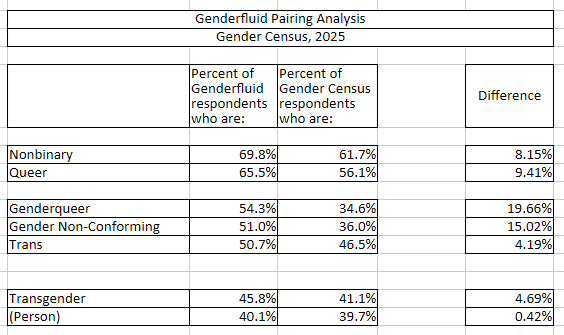
69.8% of genderfluid respondents identified as nonbinary.
65.5% of genderfluid respondents identified as queer.
60/x
54.3% of genderfluid respondents identified as genderqueer.
51% of genderfluid respondents identified as gender non-conforming.
50.7% of genderfluid respondents identified as trans.
61/x
Therefore, in 2025, majorities of genderfluid respondents identified as nonbinary, queer, genderqueer, gender non-conforming, and trans.
62/x
45.8% of genderfluid respondents identified as transgender.
40.1% of genderfluid respondents selected, “a person / human / [my name] / ‘I’m just me.’ ”
Therefore, large minorities of genderfluid respondents identified as transgender and “a person…”
63/x
This ongoing thread can be read as an article on my blog, Meticulous Musings.
https://jasonbeets.blogspot.com/2025/12/genderfluid-genderflux-and-bigender.html
64/x
#Genderfluid #Genderflux #Bigender #Nonbinary #LGBT #Queer #Trans #Transgender
Section: Genderflux Pairing Analysis
65/x
Next, let’s examine genderflux in the 2022 Gender Census, the most recent survey where it appeared as a checkbox.
66/x
A total of 3,018 participants identified as genderflux in 2022, representing 7.6% of Gender Census respondents.
67/x
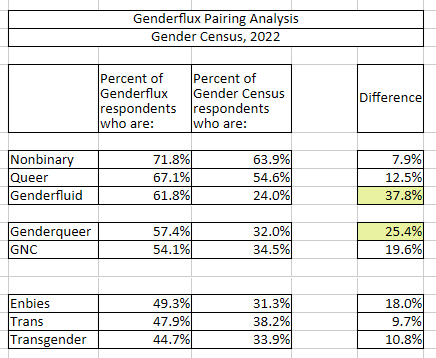
71.8% of genderflux respondents identified as nonbinary.
67.1% of genderflux respondents identified as queer.
61.8% of genderflux respondents identified as genderfluid.
57.4% of genderflux respondents identified as genderqueer.
54.1% of genderflux respondents identified as gender non-conforming.
Therefore, majorities of genderflux respondents identified as nonbinary, queer, genderfluid, genderqueer, and gender non-conforming.
68/x
Genderflux respondents were significantly more likely to identify as genderfluid and genderqueer, than Gender Census respondents as a whole, as you can see in the table above.
69/x
49.3% of genderflux respondents identified as enbies.
47.9% of genderflux respondents identified as trans.
44.7% of genderflux respondents identified as transgender.
Therefore, large minorities of genderflux respondents identified as enbies, trans, and transgender.
70/x
Section: Bigender Pairing Analysis
71/x
Now, let’s turn to bigender in the 2024 Gender Census, the last time bigender appeared as a checkbox.
72/x
A total of 2,781 participants selected bigender in 2024, representing 5.7% of Gender Census respondents.
73/x
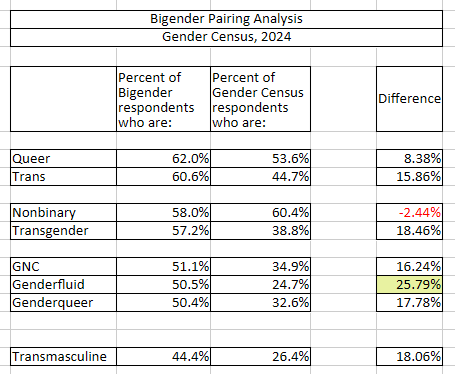
62% of bigender respondents identified as queer.
60.6% of bigender respondents identified as trans.
58% of bigender respondents identified as nonbinary.
57.2% of bigender respondents identified as transgender.
74/x
51.1% of bigender respondents identified as gender non-conforming.
50.5% of bigender respondents identified as genderfluid.
50.4% of bigender respondents identified as genderqueer.
75/x
Therefore, majorities of bigender respondents identified as queer, trans, nonbinary, transgender, gender non-conforming, genderfluid, and genderqueer.
76/x
44.4% of bigender respondents identified as transmasculine.
Therefore, a large minority of bigender respondents identified as transmasculine.
77/x
Bigender respondents were slightly less likely to identify as nonbinary, than Gender Census respondents as a whole.
Bigender respondents were significantly more likely to identify as genderfluid, than Gender Census respondents as a whole.
78/x
This ongoing thread can be read as an article on my blog, Meticulous Musings.
https://jasonbeets.blogspot.com/2025/12/genderfluid-genderflux-and-bigender.html
79/x
Section: Discussion
80/x
Let's imagine someone asks, "Are you male or female?"
Remember, someone's gender and biological sex aren't the same thing, and they don't always align.
81/x
If someone believes they can't honestly and accurately describe their gender with only one of these two options, they are nonbinary.
Genderfluid and bigender are identities held by people who would reply to the question by answering, “both.”
82/x
Although, some genderfluid people are fluid between genders other than male and female.
And some bigender people identify with another set of two genders, other than male and female.
83/x
Genderfluid has consistently received more than 20% in the Gender Census. It is currently the most common specific nonbinary identity, and the tenth most common term overall.
84/x
Neither genderflux nor bigender has ever received more than 10% in the Gender Census.
Both of these terms are relatively rare, and fairly niche.
85/x
Without data from the Gender Census, it might not be apparent just how much more common it is for people to identify as genderfluid than bigender.
86/x
The Pairing Analysis results for genderflux are particularly interesting.
In 2022, 61.8% of genderflux respondents identified as genderfluid.
I consider any majority overlap greater than 60% to be particularly significant.
87/x
Online, genderflux is often discussed alongside genderfluid, as well as binary gender terms such as boy, girl, man, and woman.
Boy, girl, man, and woman, each appeared as separate checkbox options in the 2022 Gender Census.
88/x
There is quite a gap between how likely genderflux respondents are to identify as genderfluid, than as any of the binary terms, mentioned above, as we can see from a pairing analysis of the 2022 survey.
89/x
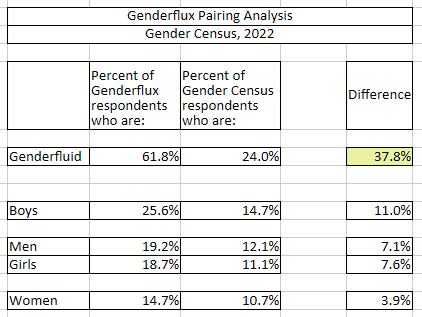
Of the binary gender terms listed above, genderflux respondents were most likely to identify as boys.
In 2022, 25.6% of genderflux respondents selected “boy” in the Gender Census.
90/x
That’s far less than the 61.8% of genderflux respondents who selected genderfluid.
91/x
The comparatively large percent of genderflux respondents who identify as genderfluid, relative to any of the binary gender terms, is unlikely to be explained simply by the fact that genderfluid performs better than any of the binary gender terms in the Gender Census as a whole, because of just how much larger that overlap is.
92/x
This would suggest that genderflux might be best understood as a term most likely to be used by a genderfluid person to signify that both their gender, and the intensity of their gender, changes over time.
93/x
That being said, someone who is female and genderflux, or male and genderflux, might not be the kind of person who is most likely to be motivated to take part in the Gender Census, in the first place.
94/x
Also, there might be many people, who identify with their birth gender, who would describe themselves as genderflux, if they were familiar with the term, but who haven’t explored specialized gender terms, because they haven’t felt the need to closely examine their gender, in the way many transgender and nonbinary people have.
95/x
Results from the Gender Census suggest genderflux may be most commonly used alongside genderfluid, rather than alongside binary gender terms.
But it’s still useful to know that genderflux can be paired with those genders as well.
96/x
I will also add that if a genderfluid person doesn’t specify that they are genderflux, that doesn’t necessarily mean that they don’t experience variations in the intensity of how strongly they experience their genders.
It simply means they aren’t specifying whether or not they experience variation in how strongly they experience their genders.
97/x
If you are enjoying this ongoing thread, consider supporting my work on Patreon.
https://www.patreon.com/cw/MeticulousMusings
98/x
Genderflux is also interesting because it’s a term that, by itself, doesn’t specify what someone’s underlying gender is.
Instead, it specifies an aspect of how they experience that underlying gender.
99/x
In a way, that makes it somewhat similar to trans or transgender, in that these terms, by themselves, also don’t specify what someone’s underlying gender is.
Instead, these terms represent that someone’s gender is different than the gender they were assigned at birth.
100/x
Likewise, autigender, a term we discussed in a previous article, doesn’t specify what someone’s underlying gender is, either.
Autigender simply means that someone’s autism influences their gender, or how they experience their gender.
https://jasonbeets.blogspot.com/2025/12/autigender.html
101/x
Section: Conclusion
102/x
Genderfluid describes someone whose gender changes over time.
Genderfluid people will often, but not always, be fluid between male and female.
103/x

