 "Wish the sun to stand still.." 🌞
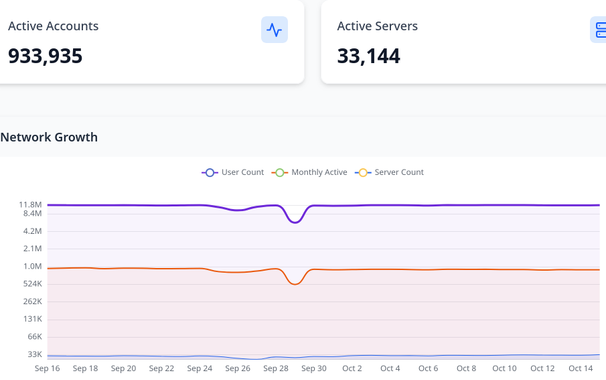
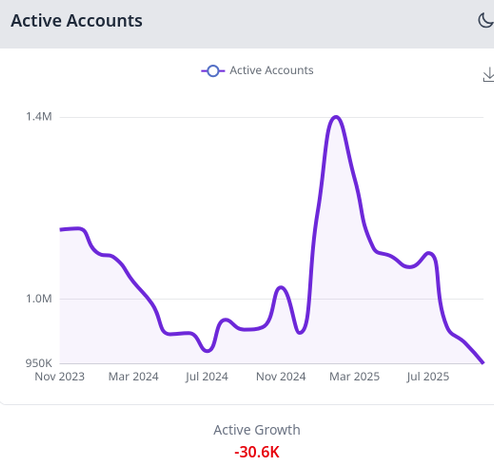
📉 #Fediverse is looking stagnant... Newcomers tolerate the bad UX for a while and then leave.
📉 #Fediverse is looking stagnant... Newcomers tolerate the bad UX for a while and then leave.
@tasket
> Newcomers tolerate the bad UX for a while and then leave
Just as likely, people set up Mastodon accounts in a fit of pique, and never really use them.
There's also the possibility of people quitting social media (apps for public posting) in general, in favour of social networking using chat groups etc;
https://nymag.com/intelligencer/article/7-reasons-to-think-social-media-has-peaked.html
But active account numbers in the fediverse, and more importantly overall server numbers, continue to be much higher than pre-2024.
"That you shouldn’t post too freely on social media has become — or returned to — conventional wisdom: If you’re posting publicly, your family might see it, your boss might see it, and, every once in a while, a few million strangers might see it as well."
#JohnHerrman, 2025
https://nymag.com/intelligencer/article/7-reasons-to-think-social-media-has-peaked.html
It shouldn't surprise anyone that "Danyl Strype" isn't my birth name, and I've always been cautious about sharing info online that would make me too easy to identify.
(1/2)
My current avatar is a photo of me (a very old one), but I'm pretty cautious about posting images of myself that could be used to identify me (one reason I'm sceptical of dating sites).
I started using the net in the late 1990s, mainly as an activist tool, and it's always blown my mind that people have been routinely living their private lives in public since about the mid-noughties. Clearly they haven't seen;
https://weliveinpublicthemovie.com/
(2/2)
"One of Törnberg’s most interesting findings in the ANES data... is that 'most platforms have moved toward Republican users', with Twitter’s swing being the most pronounced, leading to a partisan 'reconfiguraton' with 'Republican users shifting from ideologically homogeneous venues such as TruthSocial into mainstream platforms such as Twitter/X' while 'Democrats have retreated toward emerging, smaller networks such as Bluesky, Mastodon, and Threads'.”
#JohnHerrman, 2025
https://nymag.com/intelligencer/article/7-reasons-to-think-social-media-has-peaked.html
If BlueSky, Mastodon, and Threads were just platforms competing with the existing platforms, this could be interpreted simply as a reversal of the preexisting situation. But it's a bit more complicated than that.
(1/2)
Mastodon isn't a platform at all (it's software), and BlueSky and Threads are both explicitly pitching themselves as participants in larger networks (the fediverse and ATmosphere respectively). So what's really happening here is Republicans are doubling down on centralisation, while Democrats are following the left (as they generally do) into strategically embracing decentralisation.
Which makes for a far more intriguing story, if political scientists can be bothered understanding it.
(2/2)
"... but in terms of engagement, TikTok’s competitors did pretty well by copying it. Previously social feeds filled with video made by strangers, resulting directly in the scenario described above by Mark Zuckerberg: Formerly social networks now filled with, basically, little shows and marketing, content from influencers, and random recommendation slop, an increasingly amount generated by AI."
#JohnHerrman, 2025
https://nymag.com/intelligencer/article/7-reasons-to-think-social-media-has-peaked.html
(1/2)
I've commented before on how "social media" has become an umbrella term for a wide range of online experiences; web forums, social networks, social bookmarking/ link-sharing, media-sharing, even code forging (GritHub is in many ways a "social media" platform for geeks). It's become the NewSpeak phrase I suspect Web 2.0 was trying to be; a way of eliding the important differences between these different styles of interaction, so they can all be absorbalophed into centralised "portals".
(2/?)
What gets lost when all these online experiences are fudged together under the power of One Ring, is the one thing I suspect most people really want from "social" platforms. Not "content", but relationships. Either an extension of our ability to maintain in-person relationships in the fact of the tyranny of distance, or opportunities to create new ones with people we'd likely never meet in person.
If the fediverse has a future, I think it lies in serving those needs well.
(3/3)
 Strypey
