
I've got a new #KiCad plugin out in the KiCad plugin manager:

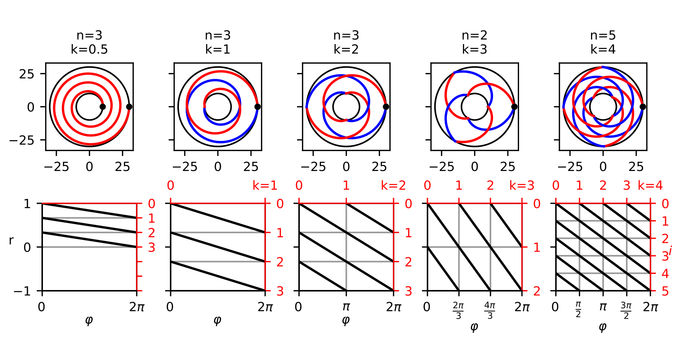
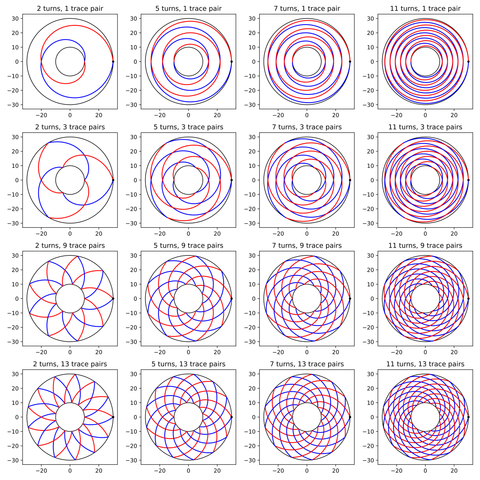
KiCoil generates "twisted" planar inductors. You can make it do one- or two-layer spiral inductors, toroid inductors, and many intermediate, hybrid variants in between spiral and toroid inductors.

These hybrid types have wider traces than a single-layer spiral, and have better high-frequency behavior (parasitic capacitance and self-resonant frequency) compared to two-layer spiral inductors. And they look really pretty!
#electronics

You can install the plugin on KiCad 9.0+, or you can try out the GUI and the command line interface from the accompanying PyPI package even without KiCad installed. The CLI can also export gerber and SVG in addition to KiCad footprints.

Here's how you run the GUI using uvx:

uvx --with cairosvg,pillow --from kicoil kicoil-gui

Here's how to install it as a python package using pip:

pip install kicoil cairosvg pillow

In normal modern PCB processes where vias are possible, I'd expect that a planar inductor with 3-7 twists should usually outperform a standard two-layer spiral inductor at least a little bit.

If anyone with an ansys or CST license is bored over the christmas holidays, I'd love to see some simulations of the magnetostatic field and the RF performance of these. I can contribute code for geometry export, and I also have a working mesher based on gmsh.

#electronics

@gsuberland @jaseg I can do Sonnet simulations and extract S-parameters if that would be useful?
@azonenberg @gsuberland I think it would be possible to do this kind of simulation in sonnet, I just have to find out at which frequency at the low end their models break down. I'll have a look at their manuals. Thank you!

@jaseg @gsuberland It's just method of moments, it should run down to arbitrarily low frequencies but it's still inherently an AC technique so you won't get a 0Hz point at the edge of the curve.

The curve fitting for s-parameter interpolation doesn't like running over toooo many decades though. You might need a ton of sim points if you tried to do like 1 Hz to 10 GHz.

@azonenberg @gsuberland The SRFs of most reasonable coils of this type that have PCB-scale dimensions (millimeters to centimeters, not RF IC-size micrometers) are in the tens-to-hundreds of megahertz range anyway, so e.g. 10 kHz to 1 GHz would already be plenty.

The DC resistance of these I can calculate during generation pretty accurately. The magnetostatic field would be interesting, but that should be close enough at say 10 kHz.

@jaseg @gsuberland I don't think I can get you field renders in Sonnet since it's a frequency domain current solver. I could get you far field radiation pattern at a given frequency but that's probably not useful.

(Sonnet actually is *mostly* meant for RFIC/MMIC work and excels there, using it for PCB stuff is the stretch not the other way around)

@jaseg @gsuberland What I can easily get you is current in any conductor layer at a given frequency
@azonenberg @gsuberland Yeah, I see. I figured it would mostly be used for IC design, not for PCB stuff at such low frequencies. I'll have a look around the doc and see what I find.

@jaseg @gsuberland I've been seeing some interesting line blurring though.

Wurth actually has made silicon planar magnetics (sorry, birdsite link but it's all I've found publicly https://x.com/QVHenkel/status/1875721779710455888) for PCB applications.

Lukas Henkel (@QVHenkel) on X

The production of the custom silicon-based inductors from Würth Elektronik for the open-source SiP is nearing completion. Looking forward to testing the new design 🙌

X (formerly Twitter)
@azonenberg @gsuberland Oh neat, I guess using silicon you can stack a lot more turns in a smaller area compared to a PCB.
@azonenberg @jaseg AMD and Intel have some presentation slides and patents on this topic too.
@azonenberg @jaseg also lots of substrate integrated inductors in their chip carriers using very similar techniques.
@gsuberland @azonenberg @jaseg their substrates even use vias filled with ferromagnetic material, a liner, then Cu. Make a bunch into a solenoid can you can run a FIVR with it. This way you avoid DCR of long planar inductors.
@craigjb @gsuberland @azonenberg Slihtly related, I saw a bunch of planar PCB coils used with discrete clipped-on ferrite cores as flyback transformer windings in compact power supplies at last year's electronica trade fair. They used separate, high layer count PCBs for the transformer, and the windings were not integrated into the PCB containing the rest of the circuit since that was thinner and usually only 2-4 layers.