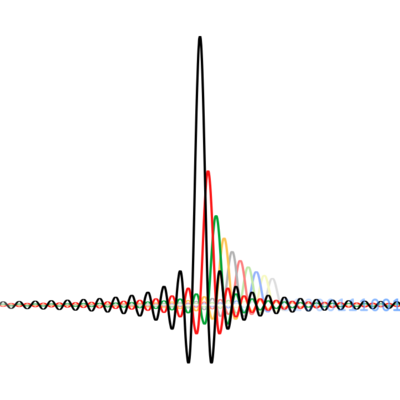
I've got a new #KiCad plugin out in the KiCad plugin manager:

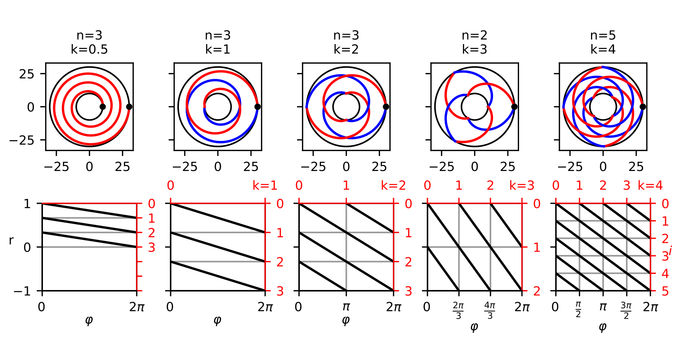
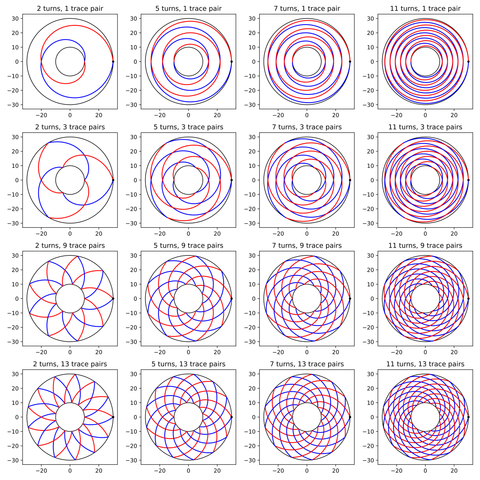
KiCoil generates "twisted" planar inductors. You can make it do one- or two-layer spiral inductors, toroid inductors, and many intermediate, hybrid variants in between spiral and toroid inductors.

These hybrid types have wider traces than a single-layer spiral, and have better high-frequency behavior (parasitic capacitance and self-resonant frequency) compared to two-layer spiral inductors. And they look really pretty!
#electronics

@jaseg Have you given any thought to how this could be adapted to use more PCB layers? I’m interested in making a PCB loop antenna that I think would benefit from maximizing the number of turns by using more layers.
@mossmann @jaseg I'd think in that case you're mostly aiming for "tightest possible packing of windings". If you have blind vias (and buried vias at >= 6 layers), you could simply stack identical 2-layer solutions, which would optimize overall.
Without partial vias, you'd always be limited by the space that the layers on the innermost "ring" on which vias lay take up, and then I could see how a nesting of "quasi toroids" could work out in your favor, but unless my spatial imagination betrays me
@mossmann @jaseg … for traces to not cross on the same layer, the layers would need identical winding counts (at different "girths" of the toroid "core"), and an angular offset.
@funkylab @mossmann The generator as is supports offsetting and also staggering the interior and exterior vias and automatically adds small connecting traces. As long as you have enough space for the holes, you could use that to fit more vias on the inside considering their annular rings.
@funkylab @mossmann For large OD, large ID coils, a configuration that has both large turn count and large twist count has a (measured!) inductance that is greater than the sum of either a plain spiral and toroidal coil of the same dimensions. I'm not sure that translates to better performance as a magloop antenna though, because I think the mechanism this works like is that this layout tilts the effective cross-sectional area of each coil turn a little bit.
@funkylab @mossmann Since these tilted cross-sectional areas don't quite align anymore, I can imagine that this increase in inductance is only a near-field effect, and far-field coupling will be pretty much the same as a simple spiral.

@mossmann If you want to try it out, I have a few samples of large-ish ID/OD inductors that I could share. I'm at 39C3 this year, but I can also just post something as they're flat and not heavy.

@funkylab

@jaseg @funkylab Thank you for the offer, but I’d rather make a new PCB anyway as I would like to add some active components to it. And, yeah, the amount of inductance doesn’t much matter for my application.