 Brian Bình
In an attempt to break up the constant doom scrolling, I'm going to post random little snippets of information I've picked up over the years. Stuff that is not at all topical because I need a little break from the present horrors.
If you buy a bottle of 3 year old Scotch and put it in your cupboard for twenty years until you bring it out for a special occasion, you don't have a bottle of 23 year old Scotch. You have a twenty year old bottle of 3 year old Scotch. Liquor ages in the barrel and picks up flavor from the wood. It doesn't pick up anything from the inert and nonporous glass bottle.
Wine ages in the bottle because it isn't distilled. It is more than just alcohol. It has sugars, tannins, & other stuff that continue to react chemically to change the flavor profile. This change isn't always for the better. Depending on a huge variety of factors (temperature, light, type of grapes, etc.) wine quality generally follows a bell curve: it improves, peaks, then degrades. Most wine peaks between 6 months & 5 years old. Very old wine is bad but costly because people think it's linear.
Saccharomyces cerevisiae & S. pastorianus are the two species of yeast used to make beer. S. pastorianus makes lager. S. cerevisiae makes ale, but also wine, liquor, mead, & bread. "Winemaking yeast", "champagne yeast", "baker's yeast", and "distiller's yeast" are all breeds of the same species: S. cerevisiae. S. pastorianus is a hybrid species that appeared when S. cerevisiae crossbred with another species of wild yeast in a brewery in Munich in the 1600s. There was no lager in the Middle Ages!
Speaking of the Middle Ages, you've probably heard that "ye" was actually "the" and was never pronounced with a Y sound because they used the Y to represent the letter thorn, Þ. You may wonder why they picked Y as a substitute for a letter that looked more like a b superimposed on a p. It's because in a lot of handwriting, it looked like a Y. The runic form was a stick with a triangle on the side. Later forms were rounder. Some miniscule forms were much curvier like a fancy Y.

Serifs were not extra bits added to letters as decoration. They were a natural consequence of writing with a quill. The tip of a quill has a little split through which ink flows by capillary action. When you press the quill to a page, the end spreads open on contact then narrows as you ease up on the pressure when you draw it across the page. That initial spread meant each stroke started with a serif "flare" (and sometimes ended with one if you pressed hard at the end, like in capital legs).
You've heard how "uppercase" & "lowercase" letters are called that because typesetters literally stored them in cases with the majuscules on top. Did you know that majuscule & miniscule letters are two different versions of the Latin alphabet? The ancients wrote in majuscule letters. That's right. THE ROMANS WROTE IN ALL CAPS LIKE AN ANGRY INTERNET COMMENT (when they weren't using Greek to look fancy and dignified). Miniscule letters came much later around the start of the Middle Ages.
When scribes started using miniscule, they only used miniscule. it was its own alphabet.they wrote completely in lowercase letters.they also didn't space out their sentences much.parchment was expensive so they didn't want to waste space.
It wasn't until Charlemagne's time that scribes invented "mixed case": using capital letters to start paragraphs and mark proper nouns while using miniscule for everything else. Capital letters helped break up the wall of text so it was easier to read.
Upper and lowercase letters were two different alphabets stuck together to give us capitalization. If they had chosen a different majuscule alphabet, we could have had sentences like this:
"Тhe Лord of the Рings" was a sequel to "Тhe Хobbit", both of which were written by Д'.Р.Р. Тolkien. Иt tells the story of the Оne Рing after Бilbo gives it to his nephew Фrodo and Гandalf tells him to destroy it.
Michael J. Fox's real middle name is Andrew, but he didn't like "Michael A. Fox" as a stage name. By SAG rules, he had to use a name other than "Michael Fox" because there was already an actor with that name, so he just stuck a J in the middle.
In his hit movie "Back to the Future", his character's father, George, says he has to get home so he doesn't miss his favorite TV program, "Science Fiction Theatre". "Science Fiction Theatre" had only 8 episodes. Four starred the original Michael Fox!
The Vietnamese language has *many* pronouns for 1st, 2nd, and 3rd person. I can think of dozens off the top of my head and I suspect it's actually hundreds. They vary based on both relative and absolute age, social standing, incredibly complex family trees, profession, politeness, marital status, and more. Vietnamese people tend to ask a lot of personal questions when first meeting someone, which foreigners think is kind of rude, but they need that information to know how to refer to you.
Because of the complexity of its pronouns, the Vietnamese translation adds an extra layer of depth to the otherwise shallow dialogue of the Star Wars original trilogy, which I watched on TV in Vietnam.
People speak to droids with the pronouns used to speak to pets or farm animals. Droids address people as professional superiors.
Droids speak to each other like they are siblings.
Vader speaks to everyone (except the emperor and Tarkin) as an arrogant superior addressing an underling.
Everyone addresses Vader as if he were a high ranking imperial mandarin, which he kind of is.
Leia is addressed as a princess. Han constantly butchers it and mixes up her rank constantly until the Carbonite/"I know" scene when they start addressing each other as lovers.
Vader speaks formally to Luke as an arrogant superior addressing an unknown young man. When he says "I am your father", he suddenly switches to the pronouns used by a father to his child. He continues addressing Luke as father to child until he dies. Luke continues speaking as a humble peasant addressing a mandarin until the next film when he finally tells Leia "he's my father". Then he speaks to Vader as a child to his father.
When I say Vietnamese has a lot of pronouns, I'm not exaggerating. There are pronouns for almost every specific family relationship. Not just "aunt" or "uncle" but "the aunt who is my father's younger brother's wife". For some reason "parent's older sibling" is just one term though. Also "cousin" isn't really a thing: they're just "surname siblings" that are addressed like siblings.
Vietnamese has pronouns that are only used in fiction, because they describe relationships that don't exist in the real world. Some are for feudal relationships that no longer exist in the modern world, but are still used in historical settings. Some are relationships that only exist in fiction.
There's a 2nd person ("you") pronoun for addressing talking animals in folktales or cartoons. This is different than the word used to talk to pets and farm animals that aren't expected to talk back.
I watched the movie "300" in a cinema in Saigon with Vietnamese subtitles. They kept translating "you" as "khanh", but only when Leonidas spoke to his captain. I'd never encountered the word before, so I looked it up in my big unabridged dictionary when I got home. That's how a king says "you" when speaking to his favorite subject. It's a word for "you" which is only spoken by kings and only when speaking to one particular guy!
"Electricity" comes from the Greek word "elektron", which means "amber". They discovered that if you rub a piece of amber on fur, it will attract small, lightweight objects. Many centuries later, scientists figured out it was static electricity. The world was forever changed by the knowledge of how to drag your feet on the carpet to shock your friends (among other applications).
This means electrons and women named Elektra are also named for amber.
Speaking of the Greeks, Aristocles of Athens laid the foundation of Western philosophy. It's been said that all European philosophy is just a series of footnotes to his work, which has been consistently studied for 2,400 years. He is mostly known by the nickname he got as a wrestler with a massive chest and shoulders: Plato, meaning "broad or wide"*. Some busts show him as a bald guy. The father of philosophy was basically "The Rock" with a beard.
*This is the same "plat" in "platypus", btw.
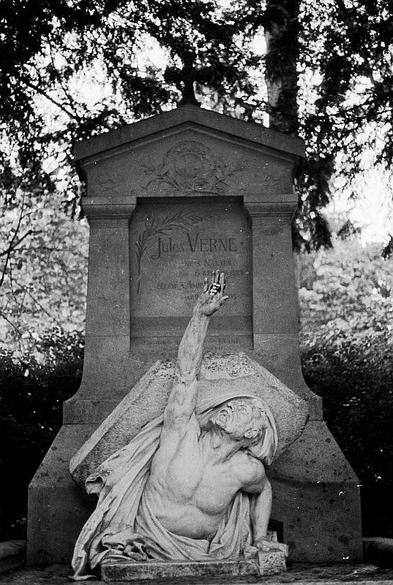
The grave of Jules Verne features a statue of a man breaking out of the grave and reaching towards the sky. It's metal as hell.
 CaptMorgan
@BrianBinh Jules Verne invented metal in 1865
 Benjamin Geer
@BrianBinh In one of the parallel universes in Philip Pullman's His Dark Materials series of novels, electricity is called ‘anbaricity’, from the Arabic word for amber.
 EllenInEdmonton
@BrianBinh
I gradually learned that it was impolite for me to say "toi" to mean me, since who "I" am is always relevant to the relationship that I have with the listener. Since I was older than most people and also a teacher, I could generally just use "co". It's a really difficult language for the English-speaking brain to grasp.
I gradually learned that it was impolite for me to say "toi" to mean me, since who "I" am is always relevant to the relationship that I have with the listener. Since I was older than most people and also a teacher, I could generally just use "co". It's a really difficult language for the English-speaking brain to grasp.
 Null
Null@BrianBinh I can only imagine how much the translator nerded out when they had this chance to use this word.
 Marc Trius
@BrianBinh this is very cool. Now I don't know how European languages get by with only two sets of pronouns! Not too mention contemporary English, with just one!!!
At least Russian and Yiddish have a couple of sets of diminutives that can be used with names, for children and friends. But nothing like this extravagant wealth that you're describing
 Jeff Smith
@alter_kaker @BrianBinh this is somewhat similar to keigo in Japanese. Interesting that Vietnamese has this also. Implies a society with highly developed (and traditional strict/rigid) social layers I suppose.
 kouhai, of the health issues
@BrianBinh oooh, translation threads are always cool! thanks for posting
 King Naga Calyo Lucere-Delphi
@BrianBinh This tangent in your long thread just gave me some deeper respect for a former Vietnamese colleague whom I'd taken to calling "Chú Phi Lòng" ("Uncle Flying Dragon") during our time together (I still do the few occasions we call each other up and chit chat 💙)
I really loved working with him, too. We complemented each other really well. He has a dogged detail-oriented persistence that my ADHD often lacks, whereas I had a more immediate competence with some of the tech we worked with.
 Gordon Fawks
@BrianBinh That is a level of specificity beyond.
 Joyce Leskinen
 smeg
smeg@BrianBinh what about parrots
 elilla&, autostopowiczka
@BrianBinh oh this is cool, Japanese has that too, I didn't know any other language that does that!
it has a fair amount of pronouns only used in fiction, though I think not in the hundreds, more like a few dozen. but also specific grammar inflections, verb endings, particle and whatnot that make you sound like, say, a wizened old grampa, a megalomaniac monarch, a cosmic deity, a spoiled young lady, a ninja, or a rough blue-collar worker—but not how any of these people would talk in real life, more as sort of, trope talk. like in the novel I'm currently reading, there's a scene in which a little girl answers to a question with "sayō de gozaru" where normal people would say "sō desu", and immediately the main character goes, "oh Naomi-chan, you like ninjas then?"—because these are the same words meaning the same thing, but inflected in a "ninja from TV shows" kind of way.
in jp this is called yakuwari-go, or "role speech" http://skinsui.cocolog-nifty.com/sklab/index.html . I have an entire role speech dictionary and it's one of my favourite dictionaries ever.

 Owlor 🦋
@elilla @BrianBinh I've definitely been tripped up in anime where they've been playing with this in a way that's really hard to translate, like when the badass talking weapon randomly switches between sounding like a cool entity and sounding like a little girl as a bit.
@Owlor @BrianBinh yeah I did manga scanlation for a few years and the hardest part for me was to convey character colour, which is expressed grammatically by trope conventions, in English where the same thing would be expressed purely by intonation, body language and vocabulary choice, and only one of those are represented in writing.
@elilla @BrianBinh The only real example of "grammar that's only ever really used in fiction to convey a sense of character" I can think of in English is mangled ren-faire speak, which might be why it shows up a lot in translations 🤔
@Owlor @BrianBinh I actually experimented with that myself when translating Vinland Saga, but I wasn't very good at it, and my success varied. it's hard not to make it corny; look at how the first Dragon Quest or the original Thor comics went heavy on the thou art's, but the modern versions just gave up trying.
I know one author who does this really well: Sarah Monette in "The Goblin Emperor". she uses "you" for formal and "thou" for informal in a court setting and magically makes it sound natural somehow—the first time a character thous another you actually do feel like suddenly intimacy has been raised, finally a friendly chat between friends, which is amazing given that "thou" sounds like exactly the opposite to modern ears—along with a few other uses of archaic grammar that aren't so common in the average fantasyspeak, with a stylistic masterfulness I struggle to convey in one toot. probably has to do with her being both an English PhD and already established as a fantasy author by that point.
did I mention Goblin Emperor has a #conlang? Ethuverazin is very underrated as a conlang! it sounds really pretty while being much simpler and more approachable than Sindarin. when I first read the novel I had to carry a little notepad with the book everywhere because I kept being distracted by spotting a suffix here or recognising a morpheme in a court title over there. my only complaint about Ethuveraz is that we only get tantalising hints of the orc dialects and by the time we reach the second novel the author's enthusiasm for her own language seems to have waned, but I still enjoyed the heck out of it.
 Alex, the Hearth Fire
@BrianBinh okay, what pronoun would you use for a pet parrot?
 FediThing
Thank you for this, it shows really vividly why translation is an artform all of its own. People who've never experienced two languages often think it's some utilitarian thing that can be automated away, but to do it properly requires artistic judgement from the translator.
 FoolishOwl
@BrianBinh This is interesting. I'm wondering if there's a convention for how outlaws talk and that's what they did with Solo.
I'm also imagining there must be some history of radicals trying to change the structure of the language.
I also was just reading someone talking about how in English, "respect" means two contradictory things, and I wonder if there's a pattern of English appearing egalitarian but having hidden status markers.
 James Bartlett
@foolishowl @BrianBinh
All right, now I'm curious. I know "respect" means something like "reverance or deference to [someone or something]," and that it also can be used as a synonym of "regard" in both the opinion sense ("holding high regard/respect for [someone or something]") and in the "in consideration of" sense ("with regards/respect to [someone or something]"). But I don't think I've heard the word "respect" used to convey the opposite of either of those meanings. What did I miss?
All right, now I'm curious. I know "respect" means something like "reverance or deference to [someone or something]," and that it also can be used as a synonym of "regard" in both the opinion sense ("holding high regard/respect for [someone or something]") and in the "in consideration of" sense ("with regards/respect to [someone or something]"). But I don't think I've heard the word "respect" used to convey the opposite of either of those meanings. What did I miss?
 Karl T.
@JamesDBartlett3 @foolishowl @BrianBinh https://kottke.org/18/05/the-respect-of-personhood-vs-the-respect-of-authority has a short summary of two of the connotations of "respect."
@dubious_dragon
OK, yeah, I've seen this. I guess I just didn't think of those two meanings as being contradictory, per se (one can be treated as an authority AND as a person, after all). However, they are definitely two very different meanings, and anyone deliberately conflating the two (as in the scenarios mentioned in the article) is engaging in psychological manipulation, and should be called out on it.
@foolishowl @BrianBinh
OK, yeah, I've seen this. I guess I just didn't think of those two meanings as being contradictory, per se (one can be treated as an authority AND as a person, after all). However, they are definitely two very different meanings, and anyone deliberately conflating the two (as in the scenarios mentioned in the article) is engaging in psychological manipulation, and should be called out on it.
@foolishowl @BrianBinh
@JamesDBartlett3 @BrianBinh I can't find the link, but the general idea I've seen expressed a few times. A man was describing his experience with an authoritarian and abusive band instructor, who said, "If you respect me, I will respect you."
The first means accepting his authority. The second means treating children as autonomous beings with agency and rights. The second part should never be conditional, but authority figures often resent assertion of human rights as a constraint on authority.
 Nentuaby
@foolishowl @JamesDBartlett3 @BrianBinh This is a commonly quoted formulation of the idea you might be thinking of: https://flyingpurplepizzaeater.tumblr.com/post/115216522824/sometimes-people-use-respect-to-mean-treating
@Nentuaby @foolishowl @BrianBinh
Another reply in the thread:
https://mastodon.social/@dubious_dragon/115476506628969646
Another reply in the thread:
https://mastodon.social/@dubious_dragon/115476506628969646
 Token Sane Person
@JamesDBartlett3 @foolishowl @BrianBinh In British English, "With the greatest respect..." means "Boss, you are an idiot."
 In Search of a Better World
@JamesDBartlett3 @tokensane @foolishowl @BrianBinh
"very good, sir"
From a sergeant, means: pack your bags, kid, we're getting a new officer tomorrow.
and
"That is something to consider." in general means "I will stop this with my dying breath if I have to".
 Damon L. Wakes
@tokensane @JamesDBartlett3 @foolishowl @BrianBinh "With all due respect..." has a neat loophole in that the amount due may be "none whatsoever."
 Virginicus
@BrianBinh The translators must have had fun with this.
 tibia bone
@BrianBinh this is super fascinating, thank you for sharing!
 Inanna🇵🇸

@BrianBinh fascinating!
 Daniel Brotherston
@BrianBinh Cool! There is so much diversity in language.
 Estarriol, Terrorist Dragon
@BrianBinh but do they still have to bleep out every word the foul mouthed R2 D2 says?
 JoeJoeTom (aka Eerie Tom)
@BrianBinh This sounds like a conversation @AnthoDerv needs to read. 👍
 Kim Possible
@BrianBinh this is fascinating.
 sayrer
@BrianBinh yes, this is all in the English version too. That is why there are no dogs in Star Wars. :)
Darth Vader sounds, well, "imperious", even in English.
@BrianBinh and since you haven't mentioned it, you must read "Daniel Immerwahr - The Galactic Vietnam: Technology, Modernization, and Empire in George Lucas’s Star Wars"
Star Wars was a Vietnam script rewritten as a space opera, and strangely co-written by John Milius, faithfully portrayed by John Goodman in "The Big Lebowski". Apocalypse Now is close to the initial intended movie, but it has more Joseph Conrad - Heart of Darkness in it.
 Arturo Serrano 🇨🇴🤖👽🧙🦄
@BrianBinh Do you know where one can find a TXT file of the Vietnamese subtitles for Star Wars?
 Juho Mäntysalo
Not having seen, nor understanding, Vietnamese, doesn't that come up in the original dialogue as well?
Luke Skywalker calls R2-D2 as "Artoo", which is clearly a petname. C3PO calls Luke "Master", which is also the title Luke gives Yoda.
The hierarchial nature of the society shows in how titles are used more than is common even in US culture: Obi-Wan is "General Kenobi" and Leia is Princess, while lacking an army and a fiefdom.
½
@BrianBinh
2/2
That being said, translations usually aren't word-to-word, as languages aren't ciphers, but ways of thinking. The closest aproximate to original meaning is thus based on context, and may at times need additional clarification.
This being said, Disney (and anglophones in general) aren't very good with this, and the translations are often poor as a result. I've seen translations of Star Wars that miss the cues in the previous post due to lack of time and material.
"Vader speaks to everyone (except the emperor and Tarkin) as an arrogant superior addressing an underling."
Accurate.
 👻™ supreme goblin 🐊
@BrianBinh Oh I love this