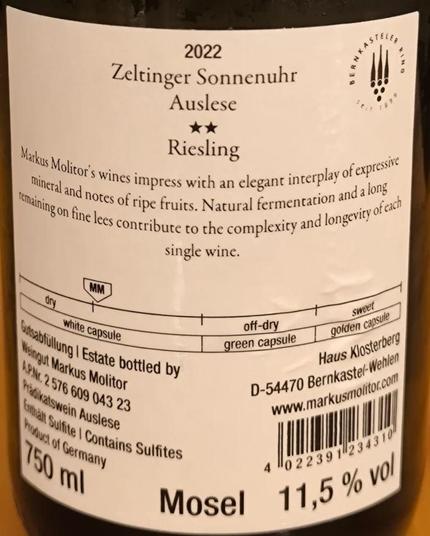
En las etiquetas de los vinos de Markus Molitor podemos encontrar indicadores propios de calidad en forma de asteriscos (*). Por ej. **
indican un nivel específico de calidad debajo del máximo *** y encima del "básico" *. La idea es clasificar sus vinos según su calidad, con mayores niveles de madurez y de intensidad asociados a el número de asteriscos. #Mosel . El color de las capsulas también cambian según el nivel de dulzor (blanco, verde o dorado) de menos a más. #vino #wine #wein #vi
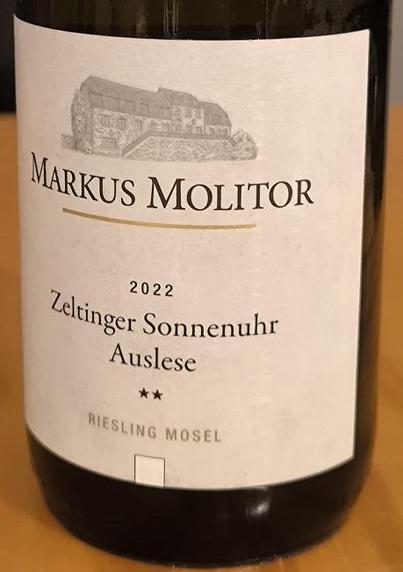

@Paco_Higon "higher levels of maturity and intensity associated with the number of asterisks."

I have a lot of star wines (not from him). I would say, higher levels of maturity, absolutely. They tend to be more concentrated, denser, richer. That, to be sure, is not always the best answer. I know folks who think it is often too much at the higher levels, that they lack some intensity, harder to find a backbone.

I have no hard-and-fast rule. It depends on the wine and the year.

@MarkSquiresWine That's quite an interesting topic. German Auslese wines usually have some degree of sweetness. In the past, Auslese Trocken was rather uncommon, but nowadays export markets tend to prefer dry wines, so producers have developed systems to communicate this "dry" character to consumers.
In the case of Molitor, more than the asterisks, the key is the color of the capsules: white for dry, green for off-dry, and golden for sweet. #wine #germanwines #auslese #auslesetrocken

@Paco_Higon "German Auslese wines usually have some degree of sweetness"

Absolutely, in that off-dry style. The Pradikat system is not per se about sweetness, though. It measures ripeness at harvest not sugar. Of course, these can be related issues. In that off-dry style, Auslesen can be over 60 g/l of sugar, often a lot more. Even Spatlesen can be over 30 g/l. They often don't seem that sweet because of balancing acidity.

The dry styles are quite another matter.