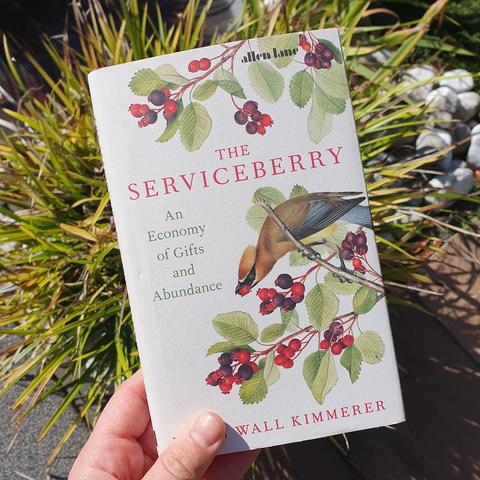
I made notes on Robin Wall Kimmerer's "The Serviceberry - An Economy of Gifts and Abundance", which was one of the first #books this year. But somehow never came around to make posts - perhaps because it did not feel right in the middle of winter.

Now, with the fall upon us, it seems the right time.

A biologist's and Native American's thoughts on economy - and alternatives and gifts. Hugely relevant but in a quiet way, one that makes you make small changes in everyday life.

1/7
#VicisBooks

Enumerating the gifts you've received creates a sense of abundance, the knowing that you already have what you need. Recognizing "enoughness" is a radical act in an economy that is always urging us to consume more.

-- Robin Wall Kimmerer "The Serviceberry"

2/7

Gratitude and reciprocity are the currency of a gift economy, and they have the remarkable property of multiplying with every exchange, their energy concentrating as they pass from hand to hand, a truly renewable resource.

-- Robin Wall Kimmerer "The Serviceberry"

3/7

When I speak about reciprocity as a relationship, let me be clear. I don't mean bilateral exchange in which an obligation is incurred, and can then be discharged with a reciprocal "payment". I mean keeping the gift in motion, in a way that is open and diffuse, so that the gift does not accumulate and stagnate, but keeps moving [...].

-- Robin Wall Kimmerer "The Serviceberry"

4/7

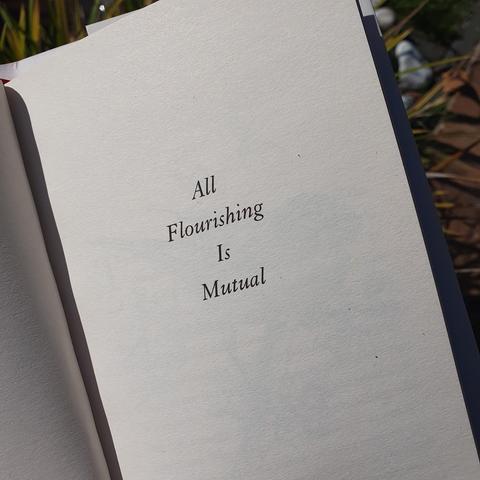
In a gift economy, wealth is understood as having enough to share, and the practice for dealing with abundance is to give it away: In fact, status is determined not by how much one accumulates, but by how much one gives away. The currency in a gift economy is relationship, which is expressed as gratitude, as interdependence and the ongoing cycles of reciprocity. [...] the economic unit is "we" rather than "I", as all flourishing is mutual.

-- Robin Wall Kimmerer "The Serviceberry"

5/7

What if scarcity is just a cultural construct, a fiction that fences us off from a better way of life?

-- Robin Wall Kimmerer "The Serviceberry"

6/7

I want to live in a society where the currency of exchange is gratitude and the infinitely renewable resource of kindness, which multiplies every time it is shared rather than depreciating with use.

-- Robin Wall Kimmerer "The Serviceberry"

7/7

@vicgrinberg Reading Robin Wall Kimmerer is like having someone wrap you in a warm blanket in winter. Putting this one on my list.
@kritischelezer I really enjoyed her books - thought provoking but in a quiet, comforting way...
@vicgrinberg @ShaulaEvans I'd never seen it put so well before, but it's interesting to note how many people (including me) want more than we currently have so that we can help others by giving them things, whether that be physical things like food or less tangible things like our time 
@vicgrinberg my mother is so good at that 😅
@vicgrinberg Yes, this book is a great read. Thanks for spotlighting it. The more people that understand the concept of a gift economy, the better the chance that humans can survive self extinction. Her other book, Braiding Sweetgrass, is also excellent.
@keithwolcott I haven't read that one, but I really enjoyed her "Gathering Moss" (fittingly read onna trip with lots of hiking...).
@vicgrinberg Braiding Sweetgrass is beautifully written and well worth reading. It covers some of the same topics as The Serviceberry, such as a gift economy, but includes other beautiful ideas too. Thank you for the recommendation of "Gathering Moss". I have not read it, but will add it to my reading list.

@vicgrinberg

Good timing, though there's no berries on my this year, due to drought (I'm guessing). Same with my wild plum

Fortunately, the wildlife have eaten all my gooseberries and some are enjoying my high-bush cranberry.

@bonaventuresoft

@vicgrinberg @geneforanarchy

This looks lovely.

This year I moved into a trailer on my sister's land in north Idaho, partly off-grid, with a new attitude. She doesn't have many edible plants, but her house is surrounded by serviceberries, or we call them Saskatoon berries. I filled several cloth bags with them over 6 weeks, putting them in pancakes and eating them straight. Saved a lot of buying fruit, and there were more than enough left for the wildlife — the rest shriveled into raisins.

It took a bit to get used to their taste and seedy texture. They have a bit of a "freezer burnt" overtone. But it felt really good to get my food from my surroundings.

@vicgrinberg this is on my list of books to get to. Braiding Sweetgrass was excellent.

I'm wondering, does she cover reciprocity not just between individuals but between groups as well? It's ok if she didn't, no book can cover everything. How we can scale gift economies up to larger scales is just a personal interest of mine and if she covers it I'll want to read the book sooner.

@UnicycleSam I don't remember that she does - it's not a book about economics per se, it's a (not too long) personal essay thinking about meaning, implications and community.