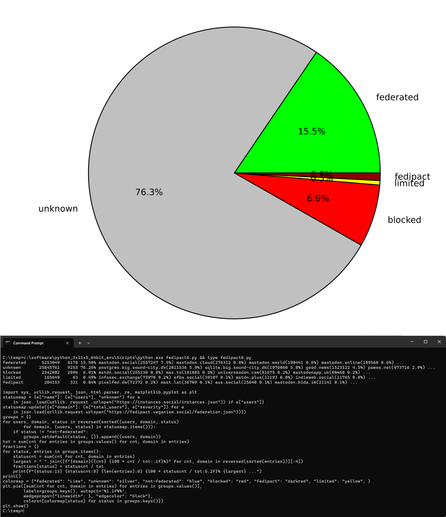
That's a deflection again. Nobody doubts that technically both #activitypub and #atproto support decentralization.
But the point is that *in practice* basically all #bluesky users are concentrated on infrastructure of a single company under US jurisdiction, while #mastodon users are distributed over many servers in many jurisdictions all over the world.
The consequences can be seen with Mississippi.
https://mastodon.social/@ikuturso/115124768664434731
https://mastodon.social/@mastodonmigra[email protected]/115125132980066617
@folkerschamel @mmasnick.bsky.social
The technique Mike Masnick employs is to ignore the substance of the critique. #Bluesky may technically be capable of decentralization, but in practice it is still highly centralized. Instead, he repeats the mantra there are some examples of decentralization.
Stipulated Mike.
Now move on to addressing the reality that for all intents and purposes, which is what matters for these censorship issues, it is centralized.
@mmasnick @folkerschamel @mmasnick.bsky.social
This is a specious argument, and does not deserve a serious response. Please stop misrepresenting the current degree of centralized concentration of Bluesky PBC on AT Protocol. You are in a perfect position to advocate for actual meaningful decentralization, but instead continue to misrepresent the current overwhelming dominance of Bluesky PBC.
1/
@mmasnick @folkerschamel @mmasnick.bsky.social
Rather than making false and misleading arguments you could instead stipulate that the overwhelming dominance Bluesky PBC does currently make AT Protocol a defacto centralized network, but the company recognizes this and are taking specific steps to address it. AT Protocol is designed to facilitate decentralization and list what steps are being taken, against what metrics to achieve real decentralization.
2/
@mmasnick @folkerschamel @mmasnick.bsky.social
Specifically, what is the company doing to enable independent instances and provide the type of choice your marketing ballyhoos? What are your goals for achieving a meaningful percentage of the AT Protocol network users NOT being Bluesky PBC users? What programs are you sponsoring to achieve these ends? Are you serious about these goals?
3/
@mastodonmigration @folkerschamel @[email protected] the only one misrepresenting stuff is you, unfortunately. Bluesky has done a ton of stuff to enable actual decentralization, all of which we're starting to see come into effect as we speak and all you guys do is lie about it.
But you still ignore my point. If we (properly) counted Threads as part of the fediverse, would that make the fediverse less decentralized?
Answer please.
@mmasnick @folkerschamel @mmasnick.bsky.social
@ricci did answer your question very specifically here:
https://discuss.systems/@ricci/115171236116610436
There was also more in depth discussion of the issue. It may be that you are not seeing the entire thread across the bridge.
Hi, creator of the chart here. I'm disappointed to see people using it as a way to try to dunk on or bully various protocols. @[email protected] and @[email protected] if you're going to share the screenshot I'd appreciate if you'd update it to the latest version, which is slightly clearer that the gauge is showing the HHI, a measure from economics that captures market concentration - not just users on the biggest servers, as are in the table. It also now has git forges as well to show that the point is to compare many forms of decentralized networks (I'm working on getting data for more); it's not just there to dunk on atproto. The heading that you cut off also (tries) to make it clear that it's showing user data, eg. it's not attempting to show things like moderation or feeds, where Bluesky likely has more diversity. @[email protected] I'm working on getting Threads data in here; Meta doesn't make that data available via the standard APIs so it's not in my data sources. The most recent estimate I can find for the number of Threads users who have opted in to the fediverse is around 25k-50k as of Dec 2024: https://fediversereport.com/why-is-meta-adding-fediverse-interoperability-to-threads/ . So while I do want to get it in here for completeness, Threads doesn't really move the needle. I do want criticism of this data, the way that it's presented, and other ways I can show the decentralization that does exist in the deployment of the AT Protocol ecosystem. I've made several changes in response to feedback, some of it from Bluesky team members - in fact creating this dashboard in the first place and the way I'm getting ATProto data was the idea of a Bluesky team member. (He didn't suggest the specific use of HHI, however) But that said, this specific criticism is off-base: if we add the number of Threads users who are actually fediverse users, nothing changes. If we were to add in the 400M MAU that Threads claims to have, but who are not fediverse users, that would be kind of like asking why we didn't put Facebook on the AT Protocol side: not a meaningful thing to do. And, if, hypothetically, all those 400M Threads users *were* fediverse users, that would, in fact, centralize a *lot* of power in Meta's hands - not all of it, but a ton. We all know how networks work. This is one reason (the other being the, you know, everything, about Meta) that fediverse folks were quite worried about Thread's entrance. My goal in building this thing is so that we can watch the deployments, nothing more nothing less. Hopefully, blacksky grows and we see that reflected in the Atmosphere side. I've seen your recent post about a bunch of AT Protocol development that is not from Bluesky. Great. The point of this chart is to watch that grow. There are plenty of anecdotes, those are good and necessary. Data is part of the story too, and that's what I'm trying to provide here. Speaking of which, I would very much like to get data from Bluesky regarding the use of third-party feeds and moderation tools. As far as I can tell, I can only get this from the Appview, and I can't find any indication it's exposed yet. I hope that you understand that I'm trying to provide a valuable data source here, and if you do, I'd appreciate if you could put me in touch with the right person to ask about this. And finally, thanks for One Billion Users, I had a great game with my spouse last night :)
@mastodonmigration @folkerschamel @[email protected] @ricci No @ricci is making a different (totally valid!) point. I am saying IF he included Threads, would you then say that Mastodon is less decentralized?
That's the only question I am asking. If your answer is yes, I would be confused. If your answer is no, you are admitting that this is not a measure of decentralization.
Which is it?
@mmasnick @mastodonmigration @folkerschamel @mmasnick.bsky.social I think a better question here, Mike is *if* Threads had 400M users who were active on the fediverse, would the fediverse be more centralized?
I would say yes.
@ricci @mmasnick @mastodonmigration @[email protected]
But even if all of #threads would be part of the #fediverse and make the fediverse practically centralized, it wouldn't change the the factual situation that
a) #mastodon is #decentralized,
b) #bluesky as being controlled by a single company is completely centralized, and
c) #atmosphere as being dominated by #bluesky is practically centralized.
@folkerschamel @mmasnick @mastodonmigration @mmasnick.bsky.social
Centralization is not binary the way you're presenting it here.
Let's say we have a 400M-user Threads and a 1M-user Mastodon. If they defederate or Threads dies, Mastodon users loose access to 99.8% of the people they could communicate with. Ouch. But Mastodonians still have 1M people in their network so maybe it'll survive. Definitely not certain, though, that's a big cut. That's why I say a version of the Fediverse with 400M actual federated Threads users would be quite centralized.
Now, people on one side may not actually give a shit about communicating with people on the other side. Fine, the people in both networks are not gaining a lot from federation. This seems to be more or less the status of most of the Fediverse and Threads, and why I think the correct thing to do is count the number of Threads users who have actually turned on federation, not the rest of them. If they defederate (as a lot of the Fediverse has done already), not a lot of connections are cut. This is why the existence of Threads does not increase the centralization the Fediverse today. This could, of course, change. This is why one should *keep* counting the number of Threads users who federate.
Now, let's do this for Bluesky and Blacksky (in its role as a PDS, appview, and maybe soon relay). If, today, they split (say, the Bluesky relay stops talking to the Blacksky PDS and appview) or Bluesky dies, the 718 people on the BlackSky PDS lose access to the 38M people on the Bluesky PDSes: 99.999% of the people in the network. Again, maybe people on Blacksky could care less about people on Bluesky. But, given the even vaster difference in size, I'd wager that Blacksky users are pretty strongly interconnected with Bluesky users. And again, maybe this changes; in the week I've been watching, the number of users on the Blacksky PDS has gone up by about 200. Maybe it continues to grow and gets a lot bigger, that would change the dynamic. So again, this is why it's worth measuring and watching.

@ricci @folkerschamel @mmasnick @mmasnick.bsky.social
Exactly. Let's keep in mind that one of the big reasons why decentralization matters is the 'fork off' test that Bluesky CEO Jay Graber memorialized in her 'No Caesars' marketing blitz. Simply stated, what is the impact on the overall network should any one node be lost, become evil or otherwise corrupted? Any analytic should inform this risk assessment as this one seems to do very well.
@mastodonmigration @folkerschamel @mmasnick @mmasnick.bsky.social
In fact, I have a proposal for a metric that attempts to measure this exactly. I'm calling it the B-Index (B for Block) but maybe I should call it C-Index for Caesar.
@ricci @folkerschamel @mmasnick @mmasnick.bsky.social
Very interesting. Thank you for pulling this all together and for such an in depth description. Looking forward to digging into it further.
@ricci @mastodonmigration @mmasnick @[email protected]
Some special cases of your B-Index: If only a single entity has a large number of users, then B_p = p >= sqrt(HHI) ? 1 : 0. If having only entities of the same size, then B_p = ceil(p / HHI).
Also: While your B-Index expresses control X by the *most powerful* B_X entities, HHI expresses the weighted average *control of each entity*, since HHI is the expectation value of the control of the entity of a random user.
@folkerschamel @mastodonmigration @mmasnick @mmasnick.bsky.social
Yep.
This is why I'm considering this thing as a different kind of index from HHI - it tells a different story and you would want both.
It originally came from a thought experiment from someone who wondered if we could answer the question "how many people does a fascist need to threaten to erase a marginalized group from the network". So it's intentionally pessimistic, assuming that censors would go after the biggest players first, and/or that those players might be the most likely to comply.
@ricci @mmasnick @mastodonmigration @[email protected]
I didn't present it binary - I deliberately chose the words "completely centralized" versus "practically centralized" versus "decentralized".
And while of course centralization is not binary, and there are many discussions about details and about the future, we should not muddle the water and forget the overall big picture that for all practical purposes today bluesky is centralized and mastodon is decentralized.
@folkerschamel @mmasnick @mastodonmigration @mmasnick.bsky.social
Here's an illustration of the difference (in agreement with your basic point).
Threads is currently blocked by servers representing 31% of Fediverse MAU and muted by another 2.5%. (Data from https://fedipact.veganism.social/ )
That's the independent decisions of 3,280 instances. Several thousand others chose to federate.
Let's say the atmosphere had the same decision to make. One organization's decision re: whether or not Thread's PDSes on their relay would affect >99% of atmosphere users.
Mike will probably say that Bluesky might fragment, with people who don't like its decision, whichever way it goes, moving to services that make a different decision. Yes, it might. And they would get to take their data with them, which is great, and they can still communicate with the people who stay behind.
But I gotta say, these seem to me like very different decision making processes with respect to whether power is held centrally or distributed to independent actors.
@ricci @mmasnick @mastodonmigration @[email protected]
To add, I think the credible exit argument falls apart in reality anyway. See reality check Mississippi blocking: Many people on bluesky seem to not like the decision, but at the same time I have seen nobody acting on it and moving to services that make a different decision.
BTW, using a different analysis only 7% of the fediverse seem to be known to block #threads, down from 9% last year, see also https://mastodon.social/@folkerschamel/111612927848322776.
@folkerschamel @mmasnick @mastodonmigration @mmasnick.bsky.social
Interesting post, thanks. I didn't cross-check the fedipact data against another source, that's probably part of our discrepancy, but the data from them does add up to about 900k MAU, so I don't know why it's such a big discrepancy. Anyway, we agree that this represents highly-decentralized decision making in action, right?
I think I'm more optimistic about credible exit than you are, part of the goal is not just that people will move, but that it will discourage individual platforms from taking actions that will piss users off. That said, I think it absolutely does not *guarantee* decentralization or user-positive behavior. The web search market has great credible exit, yet Google is staying around 90% (depending on source) even while making a lot of people quite angry about various things.
@ricci @mmasnick @mastodonmigration @[email protected]
Yes, agreed that fediblock is a text book example how decentralization works well in practice.
Well, then #bluesky credible exit is the same as decentralization support of #atproto: cool tech, nice theory, clever marketing trick, but largely irrelevant in reality. Btw, #twitter has a credible exit too: just export your data and import it into something new.😉
PS: any chance of an explanation of
https://mastodon.social/@folkerschamel/115184281756139935 ?
@folkerschamel @mmasnick @mastodonmigration @mmasnick.bsky.social
I think the contention here is that Mastodon GMBH is to the Fediverse as Bluesky PBC is to the Atmosphere: both individual companies develop software, run services with users, and participate in a larger ecosystem that they don't control[*]. Each company can be called a "central" entity, and the whole can be said to contain parts that are outside that center. This is the point that I understand Mike to be making that he thinks you are missing or confused about.
At some level, this is correct. But I think this is a very shallow reading. If you look at the actual structure of these networks, they are very different. A large majority of the Fediverse is not subject to Mastodon GMBH's operational decisions (TOS, federation decisions, etc. ). There are other projects that rival the software produced by Mastodon GMBH in both scope and userbase. The pressures that shape the Fediverse are much larger *outside* of Mastodon GMBH that the ones that come from the company. There are tens of thousands of people in the Fediverse who, for better or worse, are social network administrators. Decisions are made by a huge set of people. atproto envisions a world where these things *could* happen - but so far as I know none of them are true of it today.
I think it is a major mistake to gloss over these differences.
[*] I think we will all concede that Bluesky does currently have significant control over the larger ecosystem through its control over atproto, but I am willing to give them the assumption of good faith in terms of handing off that control; they've started, and I assume they will complete the process.
@folkerschamel @mmasnick @mastodonmigration @mmasnick.bsky.social
In terms of "credible exit" Bluesky has made some moderation decisions in the last day that have made a set of people mad and (anecdotally) as I result I just saw a of people move to the fediverse from there, so maybe that is the future of credible exit. :)
They can still bridge, and fed.brid.gy currently hosts more than half of the accounts on the Atmosphere that are on non-Bluesky PDSes.
[Edit: Some hard data shows that Blacksky users shot up by 300 that day, which is more compelling than my anecdote.]
@ricci @mmasnick @mastodonmigration @[email protected]
But what exactly are you explicitly agreeing with that *I* am "either extremely confused or [...] deliberately misleading" about?
@folkerschamel @ricci @mmasnick @mmasnick.bsky.social
Do not think that Rob is saying you are confused. Rather, he's suggesting Mike thinks you are not understanding his point that Mastodon GmbH dominates the Fediverse just as Bluesky OBC dominates AT Protocol. Rob goes on to explain why this analogy is flawed since Mastodon GmbH does not control the Fediverse to the same extent Bluesky PBC controls AT Protocol. So, seems Rob is being diplomatic, but not agreeing with Mike.
@mastodonmigration @ricci @mmasnick @[email protected]
Well, after complaining about style of engagement, he is literally explicitely agreeing with a wrong direct personal attack without ever retracting it. Well, this seems to be the kind of "diplomacy" some people seem to use in social networks.😉
@folkerschamel @ricci @mmasnick @mmasnick.bsky.social
Again, that is not what he's saying. It is a somewhat convoluted construction, but what he is saying is the thing that Mike accuses you of is incorrect. Not that he agrees with it.
@mastodonmigration @folkerschamel @mmasnick @mmasnick.bsky.social
I didn't retract my statement that I disagree with your engagement style because I still believe it. I wanted to make a distinction between agreeing with the basics of what you are saying and the way you are saying it, that's all. People online have lots of different ways of interacting, and some of them work better in some situations and with some folks than others. I am not calling the way you've engaged in this "wrong." I'm happy to be having this conversation with you, as I hope I've demonstrated, I am just taking a different strategy.
@ricci @mastodonmigration @mmasnick @[email protected]
My note about not retracting was obviously not about engagement style, but about agreement with a wrong personal attack.
Of course you are free to disagree with my "engagement style". I just think social media would benefit a lot from refraining from personal attacks and focus more on good faith substantial discussions, and it seems to me that this whole discussion is unfortunately not a good example for that.
Thanks for clarifying this! I appreciate that.
@folkerschamel @mastodonmigration
My intention was to present Mike's argument, as I understood it, in the strongest form that I could, and in a form that I thought he'd agree with. So that I could (I hope) show that even that strong form does not hold up.
@mastodonmigration @ricci @mmasnick @[email protected]
I didn't claim that "he's saying" it. But he explicitely said "Agreed".
@folkerschamel @mmasnick @mastodonmigration @mmasnick.bsky.social
I just wanted to update this, Blacksky added 300 users since this post, fueled by some unpopular moderation decisions on Bluesky. That's a win for credible exit.
@mmasnick @folkerschamel @mastodonmigration @mmasnick.bsky.social
I am not a fan of this guy's style of engagement but I do feel the need to point out that his point b literally does not say what your reply says it does.
@ricci @mmasnick @folkerschamel @mmasnick.bsky.social
Concur. His point b specifically references Bluesky not AT Protocol.
@mastodonmigration @mmasnick @folkerschamel @mmasnick.bsky.social
Okay to play devil's advocate for my own point :) there are things you could plausibly say are part of bluesky but not the atmosphere that are not controlled by the company, namely third party labelers and feed generators.
@ricci @mmasnick @folkerschamel @mmasnick.bsky.social
Not endorsing point b, just pointing out it references Bluesky and not AT Protocol. In general the conflation of the two leads to a lot of confusion and ambiguous statements. Think that it is much more useful to look at the overall networks and the relative percentage ownership of the various distributed components, as the Rob Ricci analysis does.
1/
@ricci @mmasnick @folkerschamel @mmasnick.bsky.social
Mike Masnick seems to suggest that it is not the current state of distributed ownership, but some measure of the ease of people moving to other independent nodes on the network. It is hard to see how any metrics could capture this, since it would necessarily involve the creation and rapid expansion of very significant server resources that do not currently exist. This just doesn't seem feasible.
2/
@ricci @mmasnick @folkerschamel @mmasnick.bsky.social
So, returning to Rob Ricci's point that the current measure, while not dispositive on the subject of potential decentralizability is a useful thing to know. And further, that it can give insight into the ability of the independent network resources to respond to a 'mass migration' event.
3/
@ricci @mmasnick @folkerschamel @mmasnick.bsky.social
Question for Rob... Thinking about this a little more, and wondering what the sensitivity of the metrics is to changes in the distribution. For example, let's hypothesized Bluesky PBC shrinks on a percentage basis to 70% of total AT Protocol users, and 10 other independent options evolve to handle 25% with 5% spread across another 100. What would the needle look like?
4/
@ricci @mmasnick @folkerschamel @mmasnick.bsky.social
The reason for asking is this might capture the decentralizability capability that Mike is talking about. Sure the user are still predominantly on Bluesky PBC, but viable options exist that could scale if need be.
5/
@mastodonmigration @mmasnick @folkerschamel @mmasnick.bsky.social
Interesting question, it might be cool to build a little tool that makes it easy for people to explore questions like this for themselves. Could be fun. For some kinds of people (I am that kinds of people)
The HHI for such a configuration would come out to 4963, so in terms of the needle, just about halfway.
@ricci @mmasnick @folkerschamel @mmasnick.bsky.social
This seems important. The conclusion being, consistent with Mike's thesis, that in order for a network to be meaningfully decentralized, it does not have to be broadly distributed. However, the potential needs to be demonstrated in statistically meaningful real world deployments.
It will be interesting to track the needle as things evolve. Seems establishing an initial decentralized goal of "about halfway" is a good target.
@mastodonmigration @ricci @mmasnick @[email protected]
Personally I think decentralization is not enough. I I'm more interested in full interoperability.
I would prefer a world where #fediverse, #mastodon, #bluesky, #threads etc. seamlessly interoperate instead of being isolated islands.
I don't see a technical reason why this is not possible. #activitypub support of #threads and @bsky.brid.gy are a good start, but far from real interoperability in practice.
@mastodonmigration @ricci @mmasnick @[email protected] @bsky.brid.gy
We could be closer to that world if #bluesky would have been build on top of #activitypub, e.g. #atproto as backward compatible #activitypub 2.0. I full understand the desire of developers for creating a new clean slate, but the price is islands. Imagine what would have happened if email providers would have created their own perfect email protocol better than SMTP ... but water under the bridge.
@mastodonmigration @mmasnick @folkerschamel @mmasnick.bsky.social
I'm not too worried about *potential* for *infrastructure* to scale: at a technical level we've been putting a lot of engineering resources into that sort of thing for a long time now, and what I've seen of the various atproto implementations suggests to me that it's reasonable to believe they can be operated at scale by groups other than bluesky-the-company.
Money I'm not super worried about either. Sure anyone wanting to absorb a mass migration would need to get a bunch of money quickly, but we have existence proof that the "please donate to your server" model, while it has its flaws, is remarkably stable.
But the human capital, that's the hard part. If all of the knowledge and hard-won experience about how to actually run a social network is locked up in one organization, or a few, that takes a long time to build up. The distribution across *some* measure of independent services is a proxy for how centralized or distributed that human capital is. This is why I really wish I could get data re: labelers and feed generators, as that's one place where I do think Bluesky is probably building up some distributed expertise.
@ricci @mmasnick @folkerschamel @mmasnick.bsky.social
Agree with all this. We don't really need to isolate the different components of what basically comes down to inertia.
Edit: Which is also why getting things spun up from rest is very different from accelerating them once they are up and spinning.
@mastodonmigration @mmasnick @folkerschamel @mmasnick.bsky.social
To continue to try to make the strongest argument I can think of on the Bluesky side here: Bluesky itself scaled up successfully and fairly rapidly; it did a good job absorbing the waves of people moving off Twitter in the wave of some of the particularly grievous conduct there.
But I think to resist measuring and to place actual exercise of user control in the future is to sleepwalk into monopoly. Yes, right now, there are indeed some notable exercises of that control going on, with Blacksky being particularly notable. This is exactly why this is a good time to start tracking data. Stories are powerful (Mike's conversation with Rudy on the Techdirt podcast is great if you haven't heard it) and they're best when *also* backed up with qualitative data.
@ricci @mastodonmigration @mmasnick @[email protected]
A third party labeler or feed generator is not part of bluesky. That's the literal definition of the word "third party" after all.
And of course #bluesky and #atmosphere are obviously not synonyms. In the same way as gmail and e-mail are not synonyms. Or #fediverse and #mastodon. Or mastodon and mastodon gmbh.
@mmasnick @folkerschamel @mastodonmigration @mmasnick.bsky.social
Agreed. But, they are very differently-sized parts of those ecosystems, and I think that matters.
@ricci @mmasnick @folkerschamel @mmasnick.bsky.social
Glad we're able to nail down some terms. Think that differentiating between Bluesky, which is kind of nebulous and Bluesky PBC is useful, as is the distinction between Mastodon and Mastodon GmbH. Likewise, AT Protocol ATmospher and ActivityPub Fediverse.
@mastodonmigration @ricci @mmasnick @[email protected]
Important to note that #bluesky is not the equivalence of #mastodon in practice: People deploying #mastodon are using the same software from Mastodon GmbH, but are operating completely independent of Mastodon GmbH. But basically all users deploying bluesky software, e.g. PDSs, are still using bluesky infrastructure, e.g. their relay. People oft cite #blacksky for real independence, but they are not using Bluesky software.
@ricci @mmasnick @mastodonmigration @[email protected]
What am I confused or misleading about?
@mmasnick @ricci @mastodonmigration @[email protected]
It's more than "fair enough" - you were spreading untrue things about other people's posts and wrongly attacking them of misleading or lying to your followers multiple times now, not only about my posts but also posts of others like @Gargron, without ever sending out a correction.
Yes, of course "mastodon gmbh" is centralized. But this doesn't invalidate anything I said in my post or make it misleading.