
If trains are the greener option, why are we basically being punished for choosing them?

The difference in trains vs planes ticket prices isn’t a coincidence, it’s the result of a transport system that rewards pollution.

Learn more: https://act.gp/460kBvh
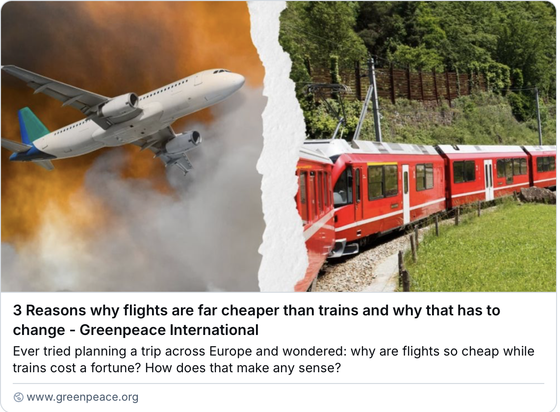
@greenpeace trains are expensive because NGOs like Greenpeace fight against railways.
That makes them extremely expensive.
I mean, as long as rail and road builders insist on passing their lines through natural reserves, Greenpeace is ethically required to protest, unfortunately for everyone involved.

@csolisr

the #nimby factor plays a huge role in #infrastructure dev, that much is very true.

airports have a huge global effect, energy-wise, but for people/miles a relatively small footprint outside of carbon.

rail travel is principally the opposite.

@greenpeace Who runs the airlines, and who runs the trains?

@greenpeace

I agree that trains are too expensive and flights too cheap, but the article lists as penalties for rail operators:

* High infrastructure fees
* Track access fees

Do air carriers not have to pay airport fees as well? And who pays for building airports? Maybe it would be appropriate to expand on these points a bit more in the article.

@greenpeace @mhoye A plane from Toronto to Vancouver will take me hours. A train will take me days and eat up most of my vacation traveling.
@lo_fye @greenpeace @mhoye If you want to go from Libon, Portugal to Chișinău, Moldova it would also make sense to take a plane for time saving sake. Lots of options for shorter travel in Europe though.
@lo_fye @greenpeace @mhoye That's a sad effect of the low speeds imposed on trains. A Japanese bullet train could get you there in 19 hours. There were trains in the early 20th century running 100 mph on steam with no streamlining. There's no reason that couldn't be done today.
@jhavok @greenpeace @mhoye It costs like $175 to go from London Ontario to Toronto Ontario on a train, and it takes 3 hours versus 2.5 hours and $40 in gas in a car. Canadian rail sucks.

@lo_fye @greenpeace @mhoye American rail is similar. It's pathetic. I take it for the pleasure of the ride.

I was trying to put together a trip from Vancouver to Prince Rupert, one leg by rail and one by ferry, and no matter what I would have been stranded overnight in the middle of nowhere.

@lo_fye @greenpeace @mhoye Yeah, I'm not sure we all need to go so far for our holidays. I realise some trips are essential, but people go vast distances with quite poor motivation other than vague marketing.
@chiffchaff @greenpeace @mhoye No we don’t all need to, but some do. A third of my family is in Vancouver. A third in London England. And a third (including me) near Toronto.
@greenpeace Greener doesn't mean cheaper.
@wayubi @greenpeace More energy efficient should mean cheaper.
@jhavok @greenpeace Energy efficient on the energy consumption side should mean cheaper, yes, but on the energy production side, energy dense / energy efficient means cheaper. Green energy, generally speaking, is not dense energy.
@wayubi @greenpeace Trains are energy efficient even if they use fossil fuels.
@jhavok @greenpeace Trains are energy efficient because of energy usage / cargo/passengers. Trains are actually extremely energy inefficient to move by themselves, but because they carry so much cargo, energy usage / cargo/passengers works makes them efficient.
@wayubi @greenpeace Wow, you're really struggling. Defending the indefensible is a real challenge.

@jhavok @greenpeace I haven't defended anything. I've pointed out that the efficiency of trains is dependent on load.

Yes, in this instance, trains are more efficient thus cheaper than planes, but as I said in my original post, greener doesn't mean cheaper, because greener doesn't always mean more efficient.

Trains are cheaper because they're more efficient, not because they're greener.

@wayubi @greenpeace Trains are greener because they are more efficient which means they produce less pollution per unit of cargo. That also makes them less expensive, since producing that pollution consumes a resource which has a cost.
@jhavok @greenpeace Pollution is not the only cost of transportation (or any industry, good, or service) and you can have a situation where opting for less pollution results in more non-pollution costs, making it less efficient and more expensive overall while being greener.
@greenpeace where are those cheap airlines? In Europe, even the low-cost airline tickets are more expensive than train tickets if you as much as take a cabin luggage with you 😕
Except when you travel all across the continent, in which case there is just no train option.

@greenpeace Also, in Britain at least, one can fly directly from point A to point Z. If you're going by train, you ride from A to B, get off and wait half an hour for the next train. Then ride an hour to point C. Then a 15 minute platform wait for a train run by a second company. It's late but eventually shows up and takes you to point D. But because your train was late, you have to wait an hour and 45 minutes for the next train that can take you to point E. That train is operated by a third company. Eventually you arrive where you want to get to. L a t e.

Do trains in the EU operate the same way?

@Bodling @greenpeace it varies from country to country. UK makes zero effort in harmonising train timetables - and makes the usual accounting mistake of subsidising car roads ar expense of railways, which somehow must turn a profit to be allowed to exist.

@greenpeace Europe has a broken train system that is really why.

Apart from the price. So hopefully that can change first.

@melroy @greenpeace Europe has no tax on aviation fuel. No wonder flying is often cheaper than taking a train.
@greenpeace Follow the money, punish those responsible.
@greenpeace the problem is not taxes. The airlines are just better at marketting, and at taking care of their passengers.
And they are faster. Nobody is going to travel Zagreb - Oslo by train, even if it was trivially easy to get a ticket, and cheap.
@greenpeace that railways pay taxes on their energy, and airlines don't is not entirely correct. Quite a few countries excempt their railways from taxes on energy.
@greenpeace I think it'd be more helpful to give a tual numbers of how much the fees and taxes compounds to for the specific route compound to. There's nothing wrong with it, but I'd be interested in a cost breakdown