
If trains are the greener option, why are we basically being punished for choosing them?

The difference in trains vs planes ticket prices isn’t a coincidence, it’s the result of a transport system that rewards pollution.

Learn more: https://act.gp/460kBvh
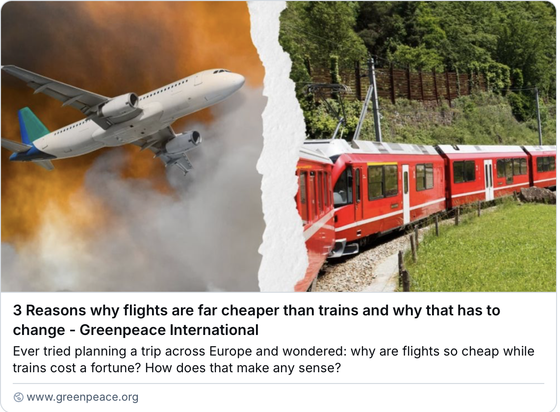
@greenpeace Greener doesn't mean cheaper.
@wayubi @greenpeace More energy efficient should mean cheaper.
@jhavok @greenpeace Energy efficient on the energy consumption side should mean cheaper, yes, but on the energy production side, energy dense / energy efficient means cheaper. Green energy, generally speaking, is not dense energy.
@wayubi @greenpeace Trains are energy efficient even if they use fossil fuels.
@jhavok @greenpeace Trains are energy efficient because of energy usage / cargo/passengers. Trains are actually extremely energy inefficient to move by themselves, but because they carry so much cargo, energy usage / cargo/passengers works makes them efficient.
@wayubi @greenpeace Wow, you're really struggling. Defending the indefensible is a real challenge.

@jhavok @greenpeace I haven't defended anything. I've pointed out that the efficiency of trains is dependent on load.

Yes, in this instance, trains are more efficient thus cheaper than planes, but as I said in my original post, greener doesn't mean cheaper, because greener doesn't always mean more efficient.

Trains are cheaper because they're more efficient, not because they're greener.

@wayubi @greenpeace Trains are greener because they are more efficient which means they produce less pollution per unit of cargo. That also makes them less expensive, since producing that pollution consumes a resource which has a cost.
@jhavok @greenpeace Pollution is not the only cost of transportation (or any industry, good, or service) and you can have a situation where opting for less pollution results in more non-pollution costs, making it less efficient and more expensive overall while being greener.