
When a Paper Has 1000 Authors: Citation Metrics in LLM papers. Identify standout researchers among many co-authors by balancing contributions across large-scale & small-scale pubs; Scale-Balanced Citation Index (SBCI)

https://arxiv.org/pdf/2508.06004

Some key insights below:

1/8
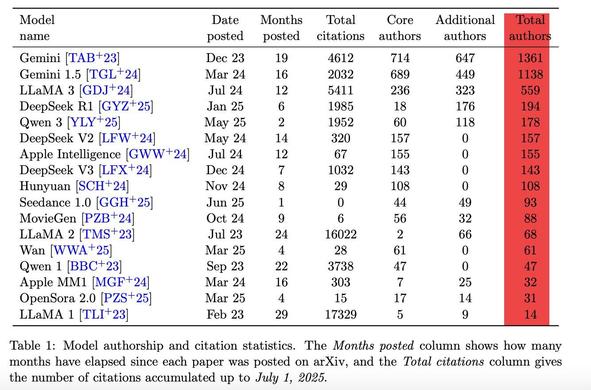
1. New research tackles a critical problem: How do we evaluate researchers when papers have 1000+ authors? The Gemini paper has 1,361 authors & 4,600 citations. Traditional metrics like h-index completely fail here. #AcademicTwitter #CitationMetrics

2/8

2. The Scale-Balanced Citation Index (SBCI) offers a solution: It separates large-scale papers (≥26 authors) from small-scale ones, then balances credit between massive collaborations & traditional research. Finally, fair evaluation! #Research #Academia
3/8
3. Why this matters: In foundation model research, compute requirements have pushed papers from academia to industry. Result? Papers with 100s-1000s of authors are now common. We need new ways to assess individual contributions. #AI #MachineLearning
4/8
4. SBCI's key insight: Balance is crucial. Researchers contributing to BOTH large consortiums AND small-team papers should be recognized differently than those doing only one type. Traditional metrics can't capture this nuance. #ResearchMetrics
5/8
5. The math: SBCI penalises for more co-authors while rewarding citations, creating a fairer system that works across collaboration scales. Recommended: α=0.6 #DataScience #Bibliometrics
6/8
6. Real impact: In case studies, h-index ranked a 2-paper author with 31K citations (1000+ co-authors each) same as a 7-paper author with 446 citations (small teams). SBCI properly distinguished their contributions. #ResearchEvaluation #FairMetrics
7/8
7. Key takeaway: As AI research evolves with massive collaborations, our evaluation metrics must evolve too. SBCI offers a practical, tunable solution for hiring committees & funding agencies to fairly assess researchers in the LLM era. #FutureOfResearch
8/8