 Thilo
ThiloIf every product had an infinite warranty, waste would vanish, markets would focus on real needs, and UBI would become cheap enough to fund easily.
I call this the The Infinite Warranty Principle / The Warranty Abundance Theorem.
If every product had an infinite warranty, waste would vanish, markets would focus on real needs, and UBI would become cheap enough to fund easily.
I call this the The Infinite Warranty Principle / The Warranty Abundance Theorem.
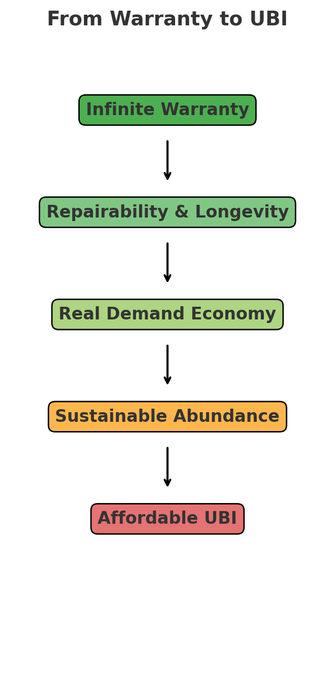
How it works in 4 steps:
1️⃣ Warranty lengths double until they reach “forever”
2️⃣ Planned obsolescence dies, products become repairable/adaptable
3️⃣ Markets shift to serving real demand, not manufacturing it
4️⃣ Social safety nets (like UBI) become affordable, because artificial scarcity vanishes
@murdoc Another flaw in Energy Accounting is the claim that “Energy is the only common denominator.”
Even if we achieved material abundance, there’s still no abundance of human attention. It remains constraint, so value doesn’t simply collapse — we’d still make choices and trade-offs based on what we care about.
That’s why money works as a proxy for value: it reflects scarcity across all those dimensions, not just energy. It overlooks that attention scarcity alone is enough to keep value alive.
@thilosch
It is not an ideal, it is a very real thing. That's one of the things I like about Technocracy is that is only deals in physical reality, not philosophical concepts and ideals.
For a conceptual example, think of ordinary air. You can't sell air because it is very abundant. People won't buy it from you because they can get all they want anytime. It thus has no economic value. This is despite the fact that people not only want air, but need it to survive.But there is no reason to buy it. Now if for instance there is ever a scarcity of air, say due to too much pollution or you're stuck in a bank vault, then there is scarcity, and hence economic value. You will then be willing to buy air.
For a historical example, this is what happened to cause the Great Depression. Goods and services were produced in such great quantities that companies couldn't sell enough of things to stay in business. The price of things fell too much. That is abundance. We only seemed to get out of it with the introduction of artificial scarcity, which is necessary to maintain economic value.This is described more here: https://www.technate.org/tiki-index.php?page=IB28
Also, there is a lot more to Technocracy than just Energy Accounting. A greater understanding of the overall design should help clear up a lot of things.
https://www.technate.org/tiki-index.php?page=Begin
@murdoc Your arguments are intriguing and raise important points. I’d like to explore a few areas further:
1/
How does Energy Accounting address innovation—especially emerging needs not met by current production? A rigid, static system risks the “made by committee” flaw, where consensus slows or blocks creative breakthroughs. Innovation needs flexibility and risk-taking. How is that ensured here?
@thilosch
Yes, many people to prefer the incremental reform path to the changing everything path. I can understand why, it's usually the safer option. However, there are important reasons why a big change like Technocracy is necessary:
1) Technocracy requires a minimum of natural resources to be able to produce an abundance. We are rapidly over-consuming and outright destroying those resources. So there will come a time when Technocracy will not longer even be a physical possibility for us to choose.
2) Our current system, like any Price System, is cyclic in nature and due for collapse. It is also requires continuous, exponential growth, which is a big part of the reason why it has to collapse, it is not sustainable. No amount of incremental changes will change that fact. All they can do is help stave it off for a while. This is why I am not opposed to changing the current system for as long as we are also working toward a permanent solution like Technocracy. But if such a collapse were to happen, adopting Technocracy would become far more difficult, probably even impossible.
These are just conclusions. They are further explained in various places in Technocracy literature. I'm happy to help you find what you are looking for.
@murdoc While climate change and resource limits pose serious challenges, it’s important to be clear: this is definitely not species-ending. I sense that for some, the hope of systemic collapse is a quiet wish born of disenfranchisement or argument for more autocracy - humanity is way more resilient than most giveit credit.
Also, the belief that we owe the biosphere a debt is a kind of religious hubris that has contributed to our crisis. The biosphere will endure far longer than we ever can.
@thilosch
There is no need for a universal metric across all economic dimensions. Energy is chosen because it is a universal metric for all goods and services.
So I'm afraid that I don't see why EA is an ideal. It's really a simple and elegant system. The system records all consumption and then uses that information, along with statistical trends and fluctuations, to determine how much of each product and service to produce in the next production cycle. Being a single organization means that this is done easily and rapidly, and with today's technology consumption rates could be recorded in real time. It's not really that different in that way from what is currently done, except that EA would be unburdened by: 1) having to deal with millions of separate and competing organizations, 2) the fluctuating value of currency making it hard to compare products and resources, and 3) the drive for profit seeking to artificially manipulate consumer demand.
@thilosch
There's no need to worry there, Technocracy is all for scientific and technological advancement. It would progress far more quickly under Technocracy than under any scarcity based system, with all of the problems of those out of the way. Just think of the improvement the lack of "trade secrets" would be alone.
In the proposed organizational structure of Technocracy, there is a high-level department called the Sequence of Continental Research. It is the aim of this body to help coordinate and execute all research and development in the country. Everything from basic scientific research, to technological development, product design and improvement, and social research. Even the system's own processes and procedures would be regularly analyzed and updated for improvements.
You can read more about the organizational structure in chapter 4 of this book: https://www.technate.org/pdf/eTTCD-1.1_Final.pdf
 Murdoc Addams 🧛🏻
 🇨🇦
🇨🇦