 Thilo
ThiloIf every product had an infinite warranty, waste would vanish, markets would focus on real needs, and UBI would become cheap enough to fund easily.
I call this the The Infinite Warranty Principle / The Warranty Abundance Theorem.
If every product had an infinite warranty, waste would vanish, markets would focus on real needs, and UBI would become cheap enough to fund easily.
I call this the The Infinite Warranty Principle / The Warranty Abundance Theorem.
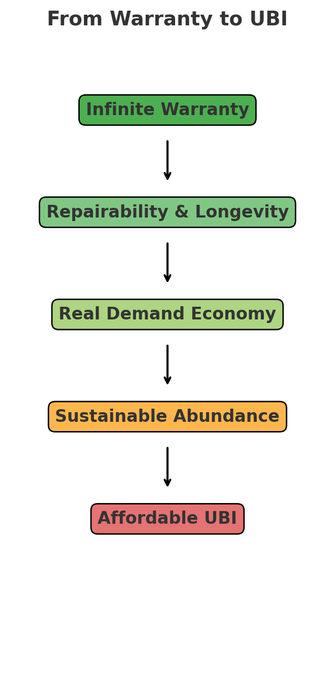
How it works in 4 steps:
1️⃣ Warranty lengths double until they reach “forever”
2️⃣ Planned obsolescence dies, products become repairable/adaptable
3️⃣ Markets shift to serving real demand, not manufacturing it
4️⃣ Social safety nets (like UBI) become affordable, because artificial scarcity vanishes
@thilosch
I'm certain that you must have misread something, because it is a key point of Technocracy that energy is chosen specifically because it is a unit of measure and not one of subjective value. For example: "Thus, money in any form whatsoever is completely inadequate as a medium of distribution in an economy of abundance with a Price System control. Any social system employing commodity evaluation (commodity valuations are the basis of all money) is a Price System."
So it is not conflating the two at all. It's point is exactly as you describe. You can find this elsewhere in Technocracy literature as well.
as I argued already, you wont get rid of valuation, by declaring there is no need for it.
@thilosch
The argument is not that there is no need for it, but that it is not a good way to measure things. Sure, people can still assign their individual opinions on how much they "value" any particular good or service, but the point here is that doing so is not a good way to run the back-end of the economy precisely because it is not a true measure of anything.
It is still accounted for in the front end however, in the fact that how much is produced is matched to how much is consumed. That is the point of Energy Accounting (and the meaning of Technocracy's symbol of the Monad, representing the dynamic balance between production and consumption). It is designed to reduce as much as possible any shortages and overages (waste). It is a flaw of all current systems that they use subjective value for both the back end and front end of their economy.
 Murdoc Addams 🧛🏻
 🇨🇦
🇨🇦