TOPIC>
Milkyway From Earth

2025 July 2

Milky Way Through Otago Spires
* Image Credit & Copyright: Kavan Chay
https://www.instagram.com/kchayphotos/;
* Text: Ogetay Kayali (Michigan Tech U.)
https://www.ogetay.com/
https://www.mtu.edu/physics/

Explanation:
Does the Milky Way always rise between these two rocks? No. Capturing this stunning alignment took careful planning: being in the right place at the right time. In the featured image taken in June 2024 from Otago, New Zealand, the bright central core of our Milky Way Galaxy, home to the many of our Galaxy's 400 billion stars, can be seen between two picturesque rocks spires. For observers in Earth's Northern Hemisphere, the core is only visible throughout the summer. As Earth orbits the Sun, different parts of the Milky Way become visible at different angles at different times of the night. As Earth rotates, the orientation of the Milky Way in the sky also shifts -- sometimes standing vertically as seen in the featured image, and other times stretching parallel to the horizon, making it harder to see. In early June, observers can watch it emerge low on the horizon after sunset and gradually arc upward to reveal its full grandeur.
https://www.instagram.com/p/C8qW2gMJcaF/

https://apod.nasa.gov/apod/ap250702.html

#space #milkyway #astrophotography #photography #nature #NewZealand #NASA

A Milky Road to the Rubin Observatory
* Image Credit: NSF, DOE, Rubin Obs., Paulo Assunção Lago (Rubin Obs.)
https://www.instagram.com/passuncao.ph/
https://rubinobservatory.org/
https://www.energy.gov/
https://www.nsf.gov/

Explanation:
Is the sky the same every night? No -- the night sky changes every night in many ways. To better explore how the night sky changes, the USA's NSF and DOE commissioned the Vera C. Rubin Observatory in Cerro Pachón, Chile. In final testing before routine operations, Rubin will begin to explore these nightly changes -- slight differences that can tell us much about our amazing universe and its surprising zoo of objects. With a mirror over 8 meters across, Rubin will continually reimage the entire visible sky every few nights to discover new supernovas, potentially dangerous asteroids, faint comets, and variable stars -- as well as mapping out the visible universe's large-scale structure. Pictured, the distant central band of our Milky Way Galaxy appears to flow out from the newly operational observatory. Taken last month, the featured picture is a composite of 21 images across the night sky, capturing airglow on the horizon and the Small Magellanic Cloud galaxy on the lower left.
https://www.nsf.gov/
https://ui.adsabs.harvard.edu/abs/1999PASP..111..886N/abstract
https://ui.adsabs.harvard.edu/abs/2003AJ....125.2740N/abstract

https://apod.nasa.gov/apod/ap250604.html

#space #earth #observatory #milkyway #astrophotography #photography #science #nature #NASA

2011 September 24

Mangaia's Milky Way
* Image Credit & Copyright: Tunç Tezel (TWAN)
https://twanight.org/profile/tunc-tezel/

Explanation:
From Sagittarius to Carina, the Milky Way Galaxy shines in this dark night sky above planet Earth's lush island paradise of Mangaia. Familiar to denizens of the southern hemisphere, the gorgeous skyscape includes the bulging galactic center at the upper left and bright stars Alpha and Beta Centauri just right of center. About 10 kilometers wide, volcanic Mangaia is the southernmost of the Cook Islands. Geologists estimate that at 18 million years old it is the oldest island in the Pacific Ocean. Of course, the Milky Way is somewhat older, with the galaxy's oldest stars estimated to be over 13 billion years old. (Editor's note: This image holds the distinction of being selected as winner in the Royal Observatory, Greenwich, Astronomy Photographer of the Year competition in the Earth and Space category.)

https://apod.nasa.gov/apod/ap110924.html

#space #milkyway #astrophotography #photography #nature #science #astronomy #NASA

2025 May 20

Milky Way over Maunakea
* Image Credit & Copyright: Marzena Rogozinska
https://www.instagram.com/marzena_astrophotography/

Explanation:
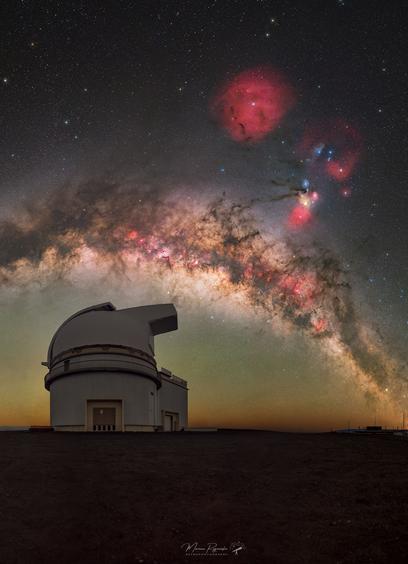
Have you ever seen the band of our Milky Way Galaxy? In a clear sky from a dark location at the right time, a faint band of light becomes visible across the sky. Soon after your eyes become dark adapted, you might spot the band for the first time. It may then become obvious. Then spectacular. One reason for your growing astonishment might be the realization that this fuzzy swath, the Milky Way, contains billions of stars. Visible in the featured image, high above in the night sky, the band of the Milky Way Galaxy arcs. Also visible are the colorful clouds of Rho Ophiuchi on the right, and the red and circular Zeta Ophiuchi nebula near the top center. Taken in late February from Maunakea, Hawaii, USA, the foreground telescope is the University of Hawaii's 2.2-Meter Telescope. Fortunately, you don’t need to be near the top of a Hawaiian volcano to see the Milky Way.

https://apod.nasa.gov/apod/ap250520.html

#space #milkyway #astrophotography #photography #science #astronomy #nature #NASA

2025 February 9

Milky Way over the Australian Pinnacles
* Image Credit & Copyright: Michael Goh
https://astrophotobear.com/about/

Explanation:
What strange world is this? Earth. In the foreground of the featured image are the Pinnacles, unusual rock spires in Nambung National Park in Western Australia. Made of ancient sea shells (limestone), how these human-sized picturesque spires formed remains unknown. In the background, just past the end of the central Pinnacle, is a bright crescent Moon. The eerie glow around the Moon is mostly zodiacal light, sunlight reflected by dust grains orbiting between the planets in the Solar System. Arching across the top is the central band of our Milky Way Galaxy. Many famous stars and nebulas are also visible in the background night sky. The featured 29-panel panorama was taken and composed in 2015 September after detailed planning that involved the Moon, the rock spires, and their corresponding shadows. Even so, the strong zodiacal light was a pleasant surprise.

https://apod.nasa.gov/apod/ap250209.html

#space #milkyway #astrophotography #photography #science #astronomy #nature #NASA

2024 November 5

Milky Way over Easter Island
* Credit & Copyright: Josh Dury
https://www.instagram.com/josh_dury_photomedia/

Explanation:
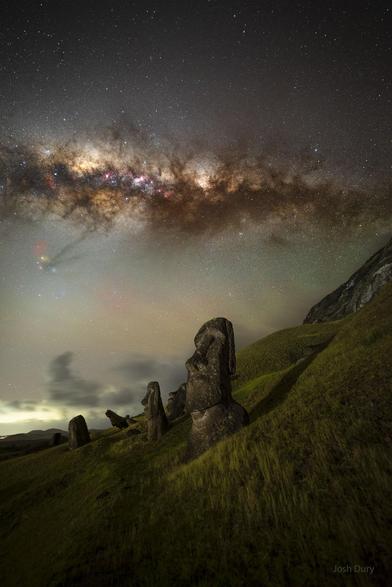
Why were the statues on Easter Island built? No one is sure. What is sure is that over 900 large stone statues called moais exist there. The Rapa Nui (Easter Island) moais stand, on average, over twice as tall as a person and have over 200 times as much mass. It is thought that the unusual statues were created about 600 years ago in the images of local leaders of a vibrant and ancient civilization. Rapa Nui has been declared by UNESCO to a World Heritage Site. Pictured here, some of the stone giants were imaged last month under the central band of our Milky Way galaxy. Previously unknown moais are still being discovered.
https://www.theguardian.com/world/2023/mar/02/new-easter-island-moai-statue-discovered-in-volcano-crater

https://apod.nasa.gov/apod/ap241105.html

#space #milkyway #astrophotography #photography #science #astronomy #nature #NASA

2024 August 7

Milky Way Behind Three Merlons
* Image Credit & Copyright: Donato Lioce; Text: Natalia Lewandowska (SUNY Oswego)
https://www.instagram.com/donamour_photography/
https://ww1.oswego.edu/physics/profile/natalia-lewandowska

Explanation:
To some, they look like battlements, here protecting us against the center of the Milky Way. The Three Merlons, also called the Three Peaks of Lavaredo, stand tall today because they are made of dense dolomite rock which has better resisted erosion than surrounding softer rock. They formed about 250 million years ago and so are comparable in age with one of the great extinctions of life on Earth. A leading hypothesis is that this great extinction was triggered by an asteroid about 10-km across, larger in size than Mount Everest, impacting the Earth. Humans have gazed up at the stars in the Milky Way and beyond for centuries, making these battlefield-like formations, based in the Sexten Dolomites, a popular place for current and ancient astronomers.

https://apod.nasa.gov/apod/ap240807.html

#space #milkyway #astrophotography #photography #science #astronomy #nature #NASA

2024 August 5

Milky Way Over Tunisia
* Image Credit & Copyright: Makrem Larnaout
https://app.astrobin.com/u/Makrem_Larnaout#gallery

Explanation:
That's no moon. On the ground, that's the Lars Homestead in Tunisia. And that's not just any galaxy. That's the central band of our own Milky Way galaxy. Last, that's not just any meteor. It is a bright fireball likely from last year's Perseids meteor shower. The featured image composite combines consecutive exposures taken by the same camera from the same location. This year's Perseids peak during the coming weekend is expected to show the most meteors after the first quarter moon sets, near midnight. To best experience a meteor shower, you should have clear and dark skies, a comfortable seat, and patience.
https://www.atlasobscura.com/places/lars-homestead

https://apod.nasa.gov/apod/ap240805.html

#space #milkyway #astrophotography #photography #science #astronomy #nature #NASA #starwars

Epic photo!