—Ivan Illich
There is currently considerable concern with limiting the growth of transport demand, the use of resources and related pollution. This book makes a major contribution to the debate on transport and the environment and is likely to become a benchmark against which new research will be developed. Transport Policy and the Environment presents for the first time the results of extensive research: *quantifying the contribution of transport to environmental problems. *assessing the options for resolvi
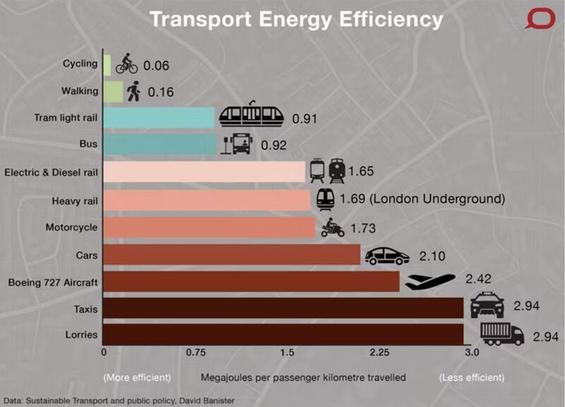
@kim_harding @aburgerabz it seems that his graph is slightly off, but the general picture is right.
Anyway, here is another comparison of busses and trams.
https://bathtrams.uk/the-most-energy-efficient-mode-of-public-transport/
For total life cycle comparisions see here: https://bathtrams.uk/relative-life-time-co2-enissions-of-tramways-compared-to-buses-and-busways-taking-into-account-co2-during-construction-ie-steel-and-concrete-etc/ Info from Professor Lewis Lesley: Above: A bombardier tram in the 10th district of Vienna, Austria 2. Alternative calculation. Trams are a seemingly expensive outlay for a city. They require permanent tracks and overhead wires. At least that’s how the figures can often initially appear, but there
@johnelalamo Time we got rid of them, if we want a liveable planet...
I know some people don't like to face reality, but they can't break the laws of physics with wishful thinking, not matter how much neoclassical school economic likes to pretend otherwise...
This is the comment I was looking for.
Walking can happen anywhere.
Bicycling and motorbikes are presumed to occur on well-trafficed footpaths at the very least.
Cars and taxis and busses and trucks move on roads, without exception.
Trains move on one or more rails.
The megajoules per passenger mile measure is incomplete without the energy costs of building the supporting medium. Biking and walking turn out even better after you count in these full costs.
@seachanged @kim_harding I recently heard that just sealing a m² of natural land causes about 34 kg CO2 / m² just for sealing.
1000 Cyclists per day using a 2 meter wide cycle way for one kilometer would thus cause 2 * 1000 * 34 = 68000 kg CO2 / Year.
Or 0,2 kg CO2 per kilometer cycled.
That would be 0,75 ton of CO2 for me cycling 4000 km per year? A significant contribution.
Value is from this scientific video:
https://youtu.be/k4DHFk3ccgY?feature=shared&t=365
@muvlon Yeah, everyone should really be riding a M5 Carbon High Racer... 😉 😂
http://www.m5-ligfietsen.nl/site/EN/Models/Carbon_High_Racer/
I'm quite surprised that the difference between rail and flying isn't greater.
I know there are other factors that make rail travel better for the environment, but that rail is less than 50% more energy efficient than flying is a surprise.
I get this but I have a question.
Which is more efficient, single parcels being delivered to individual doors, or a 53' semi delivering hundreds of items to a store?
@kim_harding I'm surprised by the large gap between cars and taxis.
Also by the choice of a 727 for plane. It was already quite outdated in 1999