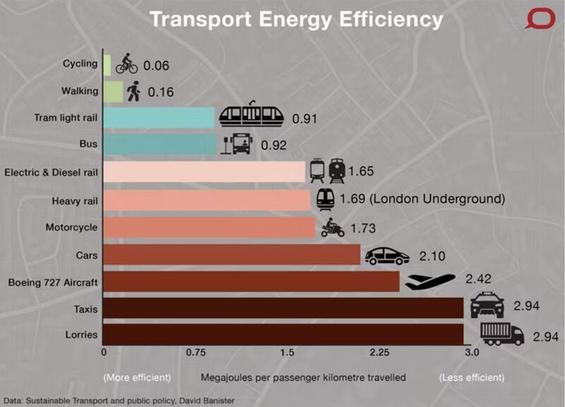
"A cyclist can go 3 or 4 times faster than a pedestrian, but uses 5 times less energy. The bicycle is the perfect transducer to match metabolic energy to impedance of locomotion. Equipped with this tool, man outstrips efficiency of not only all machines, but all other animals as well."
—Ivan Illich
@kim_harding I wonder if the high efficiency of the bicycle compared to walking would be reduced when including the energy to maintain a paved road for cycling with an unpaved track for walking?

@herdsoft @kim_harding

This is the comment I was looking for.

Walking can happen anywhere.

Bicycling and motorbikes are presumed to occur on well-trafficed footpaths at the very least.

Cars and taxis and busses and trucks move on roads, without exception.

Trains move on one or more rails.

The megajoules per passenger mile measure is incomplete without the energy costs of building the supporting medium. Biking and walking turn out even better after you count in these full costs.

@seachanged @kim_harding I recently heard that just sealing a m² of natural land causes about 34 kg CO2 / m² just for sealing.

1000 Cyclists per day using a 2 meter wide cycle way for one kilometer would thus cause 2 * 1000 * 34 = 68000 kg CO2 / Year.

Or 0,2 kg CO2 per kilometer cycled.

That would be 0,75 ton of CO2 for me cycling 4000 km per year? A significant contribution.

Value is from this scientific video:
https://youtu.be/k4DHFk3ccgY?feature=shared&t=365

Prof. Dr. Karsten Tichelmann, TU Darmstadt: Wohnraum ohne Bauland.

YouTube