 aeva
aevawhat if I made a little visual programming language for my synthesizer 🤔
I'm considering replacing the register machine I wrote with an evaluator graph as a convenience for polyphony, but this would also open up the possibility of live editing patches. My register machine allows for no flow control, and each operation has at most two inputs and exactly one output. This is geometrically very convenient, so I'm thinking maybe something grid based to hopefully keep it simple.
Another thing that would be nice is being able to make patch-specific touch interfaces.
I'm thinking something like this for the visual language frontend. The nodes are grid aligned with space between for connections to run. Placing a new node in that space would insert a new row or column into the grid. Wire paths will probably be automatic, and the whole thing would ideally have a deterministic textual representation to make revision control easier.
Also important: graph cycles are allowed. If there's a feedback loop, the value is pulled from the previous frame's computation or is zero if there is no previous frame.
Commutative instructions get to be variadic. I'm not sure what to do about non-commutative instructions syntaxwise. I'll probably have it make you select which parameter your connecting when you draw a connection, and then display information about the connection when you touch wires, and draw the name along the wire where possible. Color coding and ordering where the inputs connect also would make sense to supplement that.
I'm really tempted to just not have division or subtraction, and provide rcp and sign flip as instructions instead. Likewise who needs clamp when you've got min(max(v, low_bound), high_bound), right? I think I'd want lerp and some other functions that don't really fit this syntax well though so idk I'll have to think about that.
One of the fun things about designing a visual programming language is "how can I put less work making this" and "what if it wasn't super annoying" can coincide on the same solutions! Like what if instead of trying to drag and drop a noodle between two nodes on opposite sides of the world, what if you just select both and enter noodle mode that temporarily puts them side by side so you can draw the connections you want.
also graph travel mode. zoom in on one thing and just see what's connected to it and travel to neighbors
i have no share holders! no KPIs! no customers! the ux only has to be awesome for meeeee! bweeehehehe!
playing around with the rules for automatic wire placement tonight and i got a marvelous idea. normally i'd want to avoid parallel runs of wires when it improves readability to do so, but the exception to this rule is if the destination is the same then its better to consolidate. here's a mock up
my current wire placement rule set is this:
1. groups of wires that all connect to the same parameter on one node are evaluated to see if a wire wrap path makes sense. if so, these are placed first, and the cost of the path is raised arbitrarily high for other wires.
2. wires that travel the farthest go second and search for the shortest path with the fewest bends
3. wires that have the shortest path go last, avoid parallel runs, but favor perpendicular crossings
ideally things will be color coded by destination and wires will have different colors and textures to make it easier to tell them apart, as well as UV animation. Also highlighting / isolating connections when you select things.
another thing I want is a mode for isolating parts of the patch. stuff like selecting a node and having it highlight it's connections is common place, but I'd also like to have a mode for isolating the entire expression tree that roots on that node. dunno if anything does that.
I figure the eagle eye view of a patch can be a little obtuse if I have reasonable tools for examining, navigating, and organizing what I have.
also I am delighted that people keep thinking of examples of games instead of other visual programming languages in response to this thread. it's one of the ways I know I'm on the golden path.
I put it to the test by translating my test patch from my python fronted to a hypothetical equivalent node based representation without regard for wire placement and then stepped through my wire placement rules by hand. I'm very pleased with the results, it's a lot clearer to me what it does than the python version is at a glance.
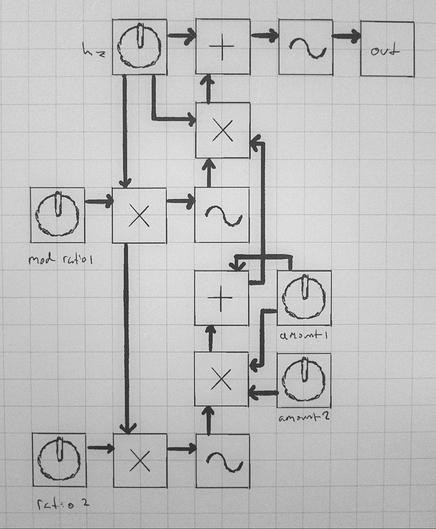
I want this to be real so bad XD
Test grid background and placeholder tiles. I wasn't quite aiming for windows 9x buttons but it sorta veered that way. dunno if I'll keep them
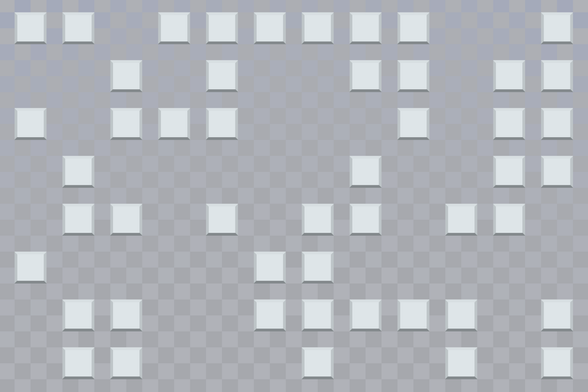
now, this may seem like I'm just fussing around on trivial details, but i assure you this is all going according to plan
I made some forward progress on my visual programming language project. Mind you, not any progress on the actual language yet, but I've established a makeshift gui quasi-framework that will hopefully make it easier to write the editor gui
I believe this was a worthwhile yak shaving detour because I was able to write the select mode in less than an hour.
The "framework" works such that there's some global state for the working data and theme elements, and there's a set of "screens" which are responsible for implementing drawing the gui and processing input events. Similar screens (as demonstrated here) share a base class to reduce code duplication. Each screen has its own event loop, and so the call stack essentially becomes an implicit stack of UI mode changes that can be unwound.
The side bar consists of "targets" which are just hyper link boxes that trigger screen changes on mouse-down. There's no mouse-over logic anymore since this meant for a touch screen anyway, and removing mouse-over button appearance changes simplifies things a bit. Each screen just define what it wants in the sidebar.
Select mode tests to see if a mouse-down happened on any boxes in the graph bay, and toggles their select state. The toggle function implements all the select and deselect logic. When select mode is active, the graph bay tiles check their select state to see which sprite they should use. When a toggle is issued, the select mode also rewrites its sidebar based on what you have selected. The "magic" button that appears will eventually go to the wire connection mode, but that doesn't exist yet.
I don't think the connection mode will take long to write, but I need to wander away to do other things now.
connection mode update: connection mode indeed did not take long to write
This version of connection mode is just a short term solution for managing parameter connections. I'm going to have it work such that the different sides of the screen correspond to one of the two selected nodes, but I think later on when I get all the other parts in place I'll probably rip it out and replace it with something else.
ok I'm at the point where I need to establish a base class representing the synthesizer instructions, which in this thread I've been calling "nodes" but I want to stop calling them "nodes" because the word "node" makes me think of pimples but they're full of javascript instead which is worse. I don't want to call them "instructions" because I'm going to be writing that word over and over and also because the nodes can represent registers and constants too. (there is no js in this project)
ok I'm just gonna call these "tiles" since in my mind they're just weird scrabble tiles anyway
an aside on naming things: I tend to substitute the word "user" with the word "player" or "operator" depending on context. So like, if I'm writing documentation on a tool I wrote, odds are I'm going to call you The Operator instead of "user" because I want you to feel cool.
in this particular project, I'm tempted to use the word "musician" instead, but I'm probably going to default to "player" for the person operating and programming the machine.
Getting to the fun part. There are now different types of tiles, and they can be programmatically connected. Tile positions are explicit. The wire positions are implicit, but I haven't implemented the procgen rules for them yet so they're just shortest path lines right now.
I implemented this part today because I realize that working out the data structures stuff here was a prerequisite to being able to complete the connection editing screen. Lots of options for where to go from here.
Incremental progress tonight while waiting for dinner. I've updated connect mode to now show the parameters of the selected items, as well as which side corresponds to which selected tile. Still lots of room for improvement.
I'm planning on having little detached wires hanging off of the outputs to hint at their polarity when they're disconnected. When they're connected my intention is to have an arrow indicating the directionality of the connection.
Also I'm annoyed that math words are all verbose. "term" and "sum" fit as alternatives for the inputs and outputs of the add node, but the vibes are off. "result" reads better than "sum" for the output. I don't like "term" because it's ambiguous. "summand" is too long. "addend" both is too long and it looks like it says "add end" which what. In the end I went with "+" for the operand end of the tile and "=" for the result end. (operand is also too long)
"input" and "output" could work, but I'm intentionally avoiding them so the output tile doesn't have an input named "output"
idk what I'm going to do for the "min" and "max" tiles lol
also I'm considering making the add tile effectively just a pass through and having the system add all wires connecting to the same input when the input doesn't have a special arithmetic meaning. eg draw two wires to the line out and it just adds them. or draw two hz values into a sine wave and it adds them. draw two values into a mul tile and it multiplies them instead.
 Tom Forsyth
@aeva arg1 arg2 arg3 res?
 d@nny disc@ mc²
@aeva i definitely try vvv hard to avoid overloaded terms unless they are exactly equivalent to my intent
 Kojack 🦎
@aeva I've now got the image of this in the style of Satisfactory stuck in my head. 2s and 440s on conveyor belts being processed into 880s.
 Tacitus 🇮🇪

Neat. I think arrows on the lines would be helpful, or some way of telling directionality. On larger formulae it could be difficult to tell if it's doing add(sin(mul(...))) or mul(sin(add(...))).
@tacitus that's coming soon for sure
@aeva also very important to distinguish the classes of interacting users served by package managers
@hipsterelectron which user archetype is sudo sh -c "$(curl blah blah blah)"?
@aeva the problem with that is that it conflates all the classes of user together instead of letting them breathe
 ideaPDish
 🇺🇦 haxadecimal 🚫👑
@aeva
Operator, get me anexit!
Operator, get me anexit!
 Jonathan
@aeva I damn, I had a suggestion: sertexes - sound vertices, as in the bits in a graph between edges.
 mcc
mcc Josh Simmons
 Oblomov
 Stefan Eissing
 Gawain(DarkGriffin)
@aeva Might I suggest simply "Bee". So bees. So busy. So buzzy. Cause they make noise as a swarm of them?
@darkgriffin it's got potential. maybe a good "drone" pun in here
 Celes 🌙
@aeva last time I was in this conundrum I just called the thing an "egg" 
not suggesting you do that, but sometimes just picking an unrelated word like that helps
 cassie
@aeva “blocks” or even “boxes” ?
@porglezomp I was thinking "tiles" but there's also a lot of visual elements in this program that could be reasonably described as tiles even though they all have their own names.
 halcy @
@aeva wait AHHH i missed this entire thread somehow this is so fucking cool!!!
@hipsterelectron :D :D :D
 Efi (nap pet) 🦊💤
@aeva I don't understand, but I believe in u 🐾🐾🐾💕💕💕
 ferunando
@aeva well. i do love the texture.
@aeva as a placeholder it's fine, keep going
 Ronflaix
 Asta [AMP]
@aeva ME TOO. I already wanna hack on it.
@aeva embrace the homies and make it real! 
it looks really cool, I love visual programming languages and I never thought about making a grid-based one :3