 mhoye
mhoyeTurns out that scientific consensus and public policy matter a lot.
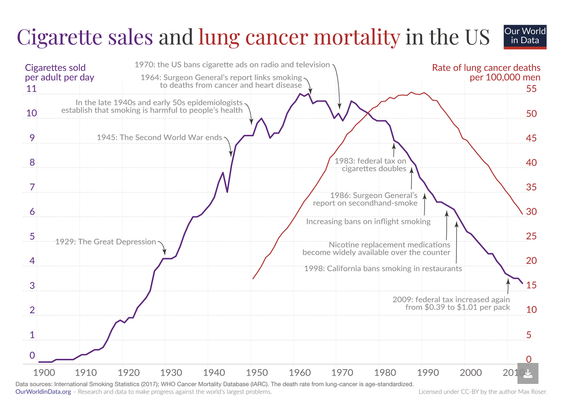
Turns out that scientific consensus and public policy matter a lot.
The incredulity of kids, flying on old enough airplanes, when they ask "what is this weird panel on the armrest" and you say, that's where the ashtrays used to be.
They don't believe me when I say, until I was in my late teens basically everything smelled and food often tasted kinda like cigarettes.
By 11 PM the air in most bars was blue.
@mhoye Never mind the pub, even "family" restaurants like Perkins were pretty rank.
I remember the pleasant surprise when traveling, and asking for the non-smoking section in a restaurant. "Oh, we don't have smoking in restaurants here."
@mhoye my 25-year-old sister-in-law is trying to quit vaping after seeing a video on the physical effects of long-term vape use on the lungs. Vaping is so rampant among Gen Z—I wonder if we're going to have another reckoning in the future?
I actually think vaping might be *worse*. With cigarettes if you finish one you have to light another, which at least makes you recognize that you're chain-smoking. Vape carts are good for hundreds or thousands of puffs.
@mhoye @etchedpixels Not sure that I should be proud of myself for the act I did.
Context:
I smoked regularly and heavily for 26 long years and enjoyed every single puff.
One fine morning,(without any motivational speech or act) in 2019, I just GAVE IT UP for good, that silly pleasurable habit.
And damn! It's been six years now, and I haven't smoked one!!! Tempted many times...by sheer luck avoided the urge.
Not sure what stuck me...probably age 😜
Can someone explain why the distance between the two lines seems to get closer: from more than 20 years to about 15? It can't be all placed upon lengthening lifespan, surely?
I'm not altogether convinced on that explanation, but thank you for trying it for the size!
If it were just less people dying, then yes, the line would be lower. But it wouldn't affect the distance from cigarette-sales.
Further, we might think that better treatments would extend life even if leading to death, so if anything the line should be FURTHER to the right.
There has to be some other factor. Something that doesn't affect correlation with tobacco-sales.
@iju @mhoye that's maybe a flaw of the diagram, that it creates the impression, that you can see how long people lived afterwards when that's actually not the case.
Take the year 2000 as example. 45 of 100'000 people died. If medicine would have been worse, maybe it would have been 50. Imagine the line the same amount higher for all years following, and you will see, that also the distance to the cigarette selling gets bigger.

 Flounder Mode
 Aaron
Aaron Tim Lavoie
 bjb
bjb 

 fleaz
fleaz Glacies delenda est
 Ted Mielczarek
 Eric R. Smith
 unixbhaskar
 poleguy looking for lost tools
 Juho Mäntysalo
 Duco
Duco