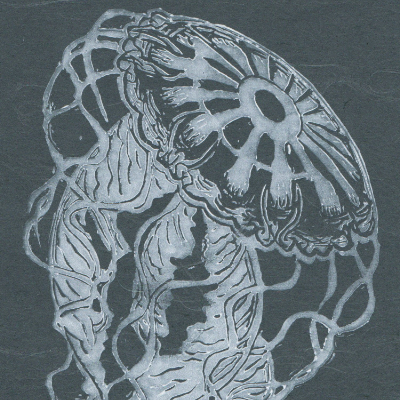
Happy birthday to #neurologist Santiago Ramón y Cajal (1852 - 1934), here in front of Purkinje and granule cells from a pigeon, based on one of his own drawings! Cajal &Golgi won the Nobel in 1906, “in recognition of their work on the structure of the nervous system”. He was as much of an artist as he was a scientist & his 100s of drawings are still used for teaching purposes.⁠

Born in 1852, in Petilla de Aragón, Spain, 🧵1/n
#sciart #linocut #printmaking #histsci #mastoart #neuroscience
the son of an #anatomy teacher, he was a precocious & rebellious child, imprisoned at 11 for destroying his neighbor’s yard gate with a homemade cannon. He loved art, but his father apprenticed him to a shoemaker & barber in an attempt to teach him some discipline. During the summer of 1868, his father tried to interest him in medicine by touring graveyards & getting him to sketch bones. This was successful & he graduated med school of the U of Zaragoza in 1873. He served as a 🧵2/
medical officer in the Spanish Army & went on expedition to Cuba in 1874–75. Returning to Spain, he pursued a doctorate in medicine in Madrid, graduating in 1877. ⁠

2 years later he became director of the Zaragoza Museum, & married & eventually had 12 kids. He worked at the U of Zaragoza until 1883, when he was hired as an anatomy professor at the U of Valencia. He studied pathology of inflammation, the microbiology of cholera, & the structure of epithelial cells and tissues.⁠
⁠🧵3/
After moving to Barcelona, he learned Golgi’s method, which employed potassium dichromate & silver nitrate to randomly stain a few #neurons a dark black color, while the other cells remain transparent. He improved upon the method, & used it to investigate the central nervous system, which would otherwise be too densely intertwined for standard microscopic inspection. He made many extensive, detailed & beautiful illustrations of neural material for many species & 🧵4/5

regions of the brain& many discoveries in #neuroanatomy.⁠

In 1922 he founded the Laboratorio de Investigaciones Biológicas, which has since become Instituto Cajal, or the Cajal Institute, in his honour. He worked until his death at age 82, in Madrid.⁠

🧵5/5

https://minouette.etsy.com/listing/642707290