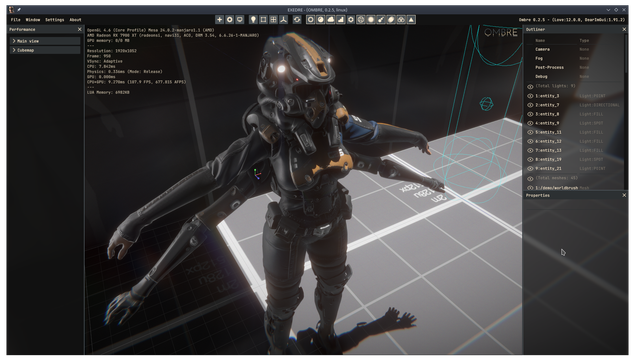
So Ombre development enters its third year this month, so let's start a new thread to track the progress !

I spent the past few days reworking my Depth of Field, which started off the GPU Zen method and then evolved a bit.
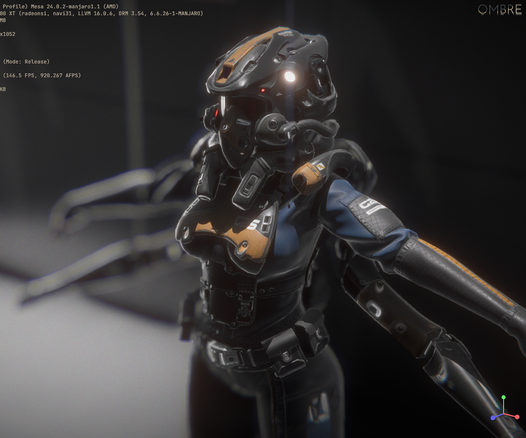
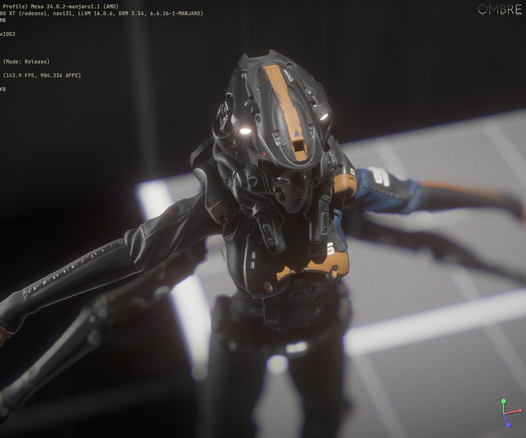
The part I'm currently trying to figure out is how to make the effect "scale-up", aka resolution independent.
Since the kernel is computed on the fly from a function, I should be able to find a formula to adjust it based on a resolution reference (so via a ratio or something). 🤔
My bokeh pass shader on Linux has a little issue it seems. For some reason it result in my pass taking 0.7ms, but if I increase the number of samples it actually goes down !
Switching to Vulkan or another shader compiler fix the problem. That was a fun one to investigate. :p
While trying some different bokeh radius, I thought of scaling up/down the render targets resolution and it worked without changing anything... this means I could have dynamic resolution scaling !
Here is 1080p x 2, aka 4K.
That's basically SSAA(2x) ? :D
Still hitting 80 FPS, but the post-process stack and shadow volumes are getting quite expensive at that resolution.
(Some stuff is broken obviously, like the tiny and wrongly placed viewport axis.)

I made an in-editor tweak to change the resolution, this way I could try out different bokeh sizes and sample count.

That made it easier to figure out how to make the bokeh stable across different resolutions. (My bloom isn't it however, so I will have to look into it.)

So the past few weeks I have been working on my refraction implementation and I'm finally starting to get some good results. I also added absorption which is going to be nice for liquids and colored glass.
I'm struggling with a specific point however. I have read that glass IOR should be around 1.5 for example, but when I use such value then I get this kind of double layering:
I tried looking around, to see if I was missing some notion, but even with a simple shadertoy I get the same result: https://www.shadertoy.com/view/ttBBWz
Same with this one, IOR of 1.5 gives the same warping/duplicated result: https://www.shadertoy.com/view/4lB3D1

@froyok The refraction function takes a ratio of IOR with source IOR over destination IOR. So for air to something that has IOR 1.5 it would be 1/1.5.

What you are seeing in your examples is the Snell's window (typically seen underwater).

@fclem Okay, you made me check my code again and I just noticed I had the Air/Material IOR flipped around. 😅