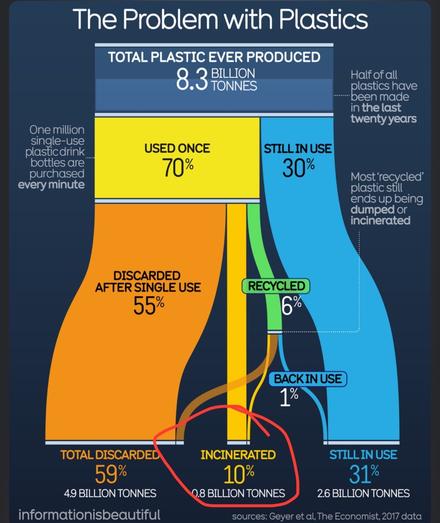
Guess what % of plastics have been #recycled? No prizes :(
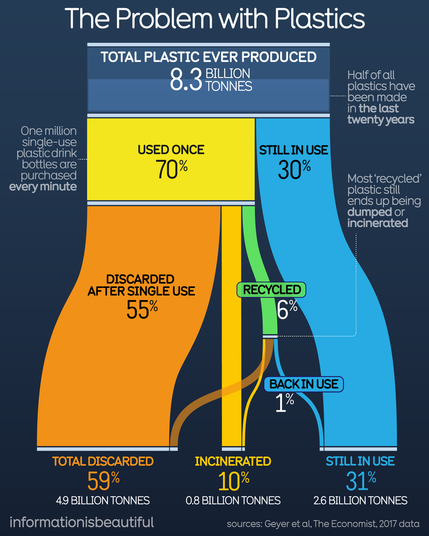
@infobeautiful

Plastic: yet another of civilization's countless Faustian bargains.

@infobeautiful Most people think, reducing plastics trash is like a hangover from consuming too much alcohol. The hangover is away the next day, but plastics trash accumulates, i.e. to the "too much plastics in the environment" adds "another but smaller bit too much plastic in the environment". Oh, just one more for the team, Earth!

And that stuff is micro accumulating already in German beer and digesting systems! Ugh!

@claus_schoenleber

@infobeautiful

Not just packaging. Plenty of people buy and discard plastic clothing again and again. All that acrylic, nylon, padding, goretex,....

@infobeautiful but what about not using plastic straws anymore?
@infobeautiful ok. Where is the Problem. As long at it is burned.
@N3r0 @infobeautiful there's this thing called global warming, yknow. you'll never guess what causes it
@umbu @infobeautiful in what World Has plastics anything to Do with global warming?
@N3r0 @infobeautiful incinerating plastics produces greenhouse gasses
@infobeautiful Can we (me and my students) translate some of your graphics into Galician and publish them in the school magazine? I don't see your rights policy on the website...

@infobeautiful

I think there's an issue...
(Used once) + (Still in use) ≠ 100%

What about used more than once and then disposed?

@simmer @infobeautiful i think those are plastics in appliances and such
@infobeautiful I think a much more informative panel is this: new plastic is being created at a much higher rate than it's being recycled, or... recycling % is going DOWN while the public thinks it's going up so we tend to buy MORE plastic.
@zabow @infobeautiful
So it's around 30% (16/6) and not 6% as in OP figure?
@tyx The second picture is data from the EU. The first is data from ?
@danstowell
That's what I'm talking about. OP pushes averaged data on people for which they're just irrelevant (and even then outdated).
If you live in EU - you should consider recycling a significant part of plastic cycle. If you live elsewhere you should know that recycling can be brought to at least 30%.
But reader will rather think "phew, even EU can't do better than 6%", why bother.
@infobeautiful ye gods, but that is a distressing graphic. And 7 year old #data to boot.
@infobeautiful > just had a discussion about these exact statistics over thankgiving holiday at my in-laws. Thank you for a proper visual to help show the details. Could not have come at a better time for me.
@infobeautiful I remember when all soft drinks came in glass bottles and people drank tap water. I don't remember anyone complaining about it.
@SordidAmok @infobeautiful the people that like to make a lot of money were the ones complaining.
@infobeautiful @carrieberry There's simply no excuse for this. All plastics can be recycled and reused. It's not a limitation of the material. It is a limitation of the process and effort required to do it. Of care. Of desire to do better. ☹️
@infobeautiful i hate to say it, but take away plastics entirely, keep the scenarios plastics covers, work out what will replace plastics, and do the calculation again. is plastic worse? using a pragmatic and realistic comparison. wrap every plastic wrapped product in the "something else". how does it all stack up?
@infobeautiful the other problem is that recyclers will only accept "unadulterated" plastic. basically removes all food packaging from recycling. my steak today has a security tag on the back that i can't easily remove. landfill or incinerated, just so i can't run out of the store with it.
@infobeautiful Plastic is a cancer to our planet.
@infobeautiful @smeg nobody wins... except big oil who have been successfully pushing the lie of plastic recycling for 40 years and counting. 😖
@infobeautiful Its had NO funding thrown at it, rather like Fusion. Remember when EVs were impractical?

@infobeautiful

Fake news!

This is not beautiful, this sucks :(

@infobeautiful I have a closet full of recyclables bc my sister is an idiot. Has a truck, but taking the stuff to the nearby facility is too much work, apparently.

@infobeautiful Until we (i.e. scientists) can develop plastics that can actually easily and efficiently be recycled, the best solution is to burn as much as possible of that waste stream, and turn it into electricity and heat.

The reason that’s not happening is because oil and gas (and lately solar and wind) are just way too cheap. It’s just not economical. Just like recycling of polymers isn’t.

@xerge @infobeautiful Asking from almost complete ignorance: what about dioxines and PFCs? Burning it all to turn it into energy sounds great... but.
@bixardune @infobeautiful for almost all polymers that really isn’t a concern. That only means you can’t indiscriminately throw everything into a furnace. There has to be some sorting, removing things like PVC or PTFE. Luckily they are generally used in specific products. For most commodity polymers (PE, PP, PS, PET, PC), unless they have weird additives used in specific applications, burning should be fine.

@xerge @infobeautiful Burning is the predominant way in Germany. As of last year, 35% of plastics is recycled, 64% is burned for energy and less than 1% is dumped. For packaging recycling is at 51%.

Source (in German): https://www.bkv-gmbh.de/files/bkv/studien/Kurzfassung_Stoffstrombild_2023.pdf

@infobeautiful is this US data or worldwide? I could imagine the recycling quota in Germanic countries (Germany, Austria, Switzerland) and Scandinavia is higher.
@infobeautiful @kathrinpassig In Switzerland more than 80% of plastic bottles are recycled. Why can‘t other countries do this?
@dgavin @infobeautiful @kathrinpassig because not all places in the world live from speculating with money to buy drugs and weapons. 
@ecosurrealism @infobeautiful @kathrinpassig You misread : Switzerland, not Columbia
@dgavin @infobeautiful @kathrinpassig no. i meant switzerland.  and we all known that most of columbian traffickers have houses and bank accounts in swiss. 

@ecosurrealism @infobeautiful @kathrinpassig OK, then I don‘t see the context to my post. At all. Because I live here and I never, not for a moment thought "Oh hey, someone in my country is doing something immoral, let‘s recycle PET for my karma."
@dgavin @infobeautiful @kathrinpassig hahahhahaha. i meant the wealth of swiss to be able to do that is stolen from the global south. plastic is unsustainable. and something like that makes it look as something sustainable, do you really believe what you are saying? how much do you trust your government? arent they just getting rid of plastic through dark routes? its all suppositions, we never studied this about swiss.
@ecosurrealism @infobeautiful @kathrinpassig I don‘t know where you are coming from, but if there is one country in the world where such things work it‘s Switzerland. There is no such thing as "our government". We *are* our government. I was 10 years in the local parliament and the amount of democratic control over anything the state does is probably unimaginable for most other countries.
@ecosurrealism @infobeautiful @kathrinpassig And it‘s not Switzerland that is stealing wealth from the global south, it‘s US companies making business here because of low taxes. We have many laws for fair trade and sustainability:
- Wood Trade Act
- Anti-Money Laundering Act
- Public Procurement Act
- Environmental Protection Act
- Fair Trade Town Movement
- Responsible Business Initiative
Of course laws are broken, but they are also enforced. These are head and shoulders above US regulation.

@dgavin @infobeautiful @kathrinpassig

"Credit Suisse has been found guilty and fined for involvement in money laundering related to a Bulgarian drugs ring.

Swiss criminal court found that the bank did not do enough to prevent members of the crime syndicate from profiting off the trafficking of cocaine in to Europe."
https://www.bbc.com/news/business-61957774

Credit Suisse bank found guilty over money-laundering charges

The bank is fined by a Swiss court for involvement in money-laundering linked to a Bulgarian drugs ring.

@dgavin @infobeautiful @kathrinpassig
"Swiss largest financial institutions invest billions of dollars in the global weapons industry. In the US alone, Swiss central bank has invested more than $2 billion"
https://www.swissinfo.ch/eng/politics/major-swiss-banks-invest-billions-in-weapons-manufacturers/46158438
Major Swiss banks invest billions in weapons manufacturers

The major Swiss investment institutions invest millions in the global arms trade. An initiative wants to put an end to it.

www.swissinfo.ch
@infobeautiful Situation where I live (a place in Germany):
A friend of mine works in the waste industry. A few years ago, I asked him where the different waste types go.
- Paper (blue bin) goes to a sorting facility and gets mostly recycled (i think there's a quota of about 75%, i don't have a source for that number).
- General waste (black bin) goes straight to an incineration power plant.
- Plastic waste (yellow bin) goes straight to the same incineration power plant.
- Returnable bottles ("Pfandflaschen") are compacted, collected and ultimately sent abroad. What happens then is a well-kept secret, but afaik they usually end up in open-air landfills in poor countries.

One big problem he stated was that paper nowadays is often combined with plastic in some way which makes recycling paper a lot more difficult. Recycling plastic is possible, but with current technology is very inefficient and a lot more expensive (financially) than producing new plastic. Is only really feasible if all plastics are the same type - you can't just throw it all together, because the resulting plastic doesn't have consistent properties, which is important for manufacturers. Why would a manufacturer buy expensive plastic with unknown properties if they can keep using the cheap stuff that's also reliably the same quality all the time? Yes, some companies are mixing recycled plastics into their stuff, but that's mostly for marketing reasons, that stuff ultimately also ends up in incinerators or african landfills anyway.

I'm not saying recycling plastic is bad, it should absolutely been done - what I'm saying is that waste management is part of a product's life-cycle and manufacturers are responsible for that. But they don't get their shit together and don't care where it ends up (side-eye especially to the biggest criminals like Nestle).
In Germany we have laws for that ("Erweiterte Herstellerverantwortung" with the "Verpackungsgesetz" and other laws like the "Elektro- und Elektronikgerätegesetz", and also the "Kreislaufwirtschaftsgesetz") but they're too weak and aren't really enforced, my guess is due to corruption.

@ember @infobeautiful Ich frag mich wie das mit den Daten vom Umweltbundesamt zusammengeht:

https://www.umweltbundesamt.de/daten/ressourcen-abfall/verwertung-entsorgung-ausgewaehlter-abfallarten/kunststoffabfaelle#hohe-verwertungsquoten-

Die sagen, 1/3 wird recycelt, 2/3 werden zum Heizen verbrannt und 0,6% werden deponiert oder ohne Energienutzung verbrannt.

Kunststoffabfälle

Umweltbundesamt