❓ How do heat pumps impact the power sector?
🚨 Check out our new paper: "Power sector benefits of flexible heat pumps in 2030 scenarios" (published in Communications Earth & Environment @nature.portfolio).

https://www.nature.com/articles/s43247-024-01861-2

Details in the thread below! 👇 #renewableenergy #heatpumps

Power sector benefits of flexible heat pumps in 2030 scenarios - Communications Earth & Environment

Investments in solar photovoltaics could cost-effectively support the expansion of heat pumps by 2030, and small thermal storage of heat pumps could reduce the additional need for firm capacity and battery storage, according to an analysis that uses an open-source power sector model.
Nature

❗ Heat pumps are crucial for reducing carbon emissions and dependence on #fossilfuels, important for countries like Germany that still rely heavily on gas and oil in the heating sector.

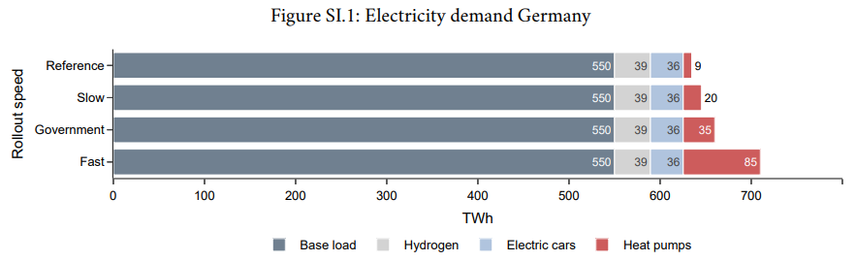
🆘 As they increase the electric load, critics argue they could overburden the #powersector. Hence, we need to understand the interaction of heat pumps with the power sector.

Our principal insights are:

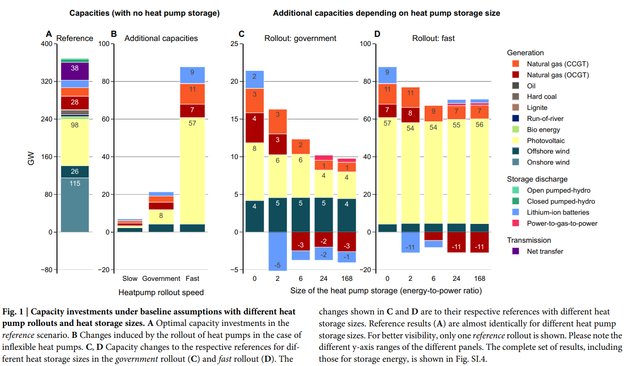
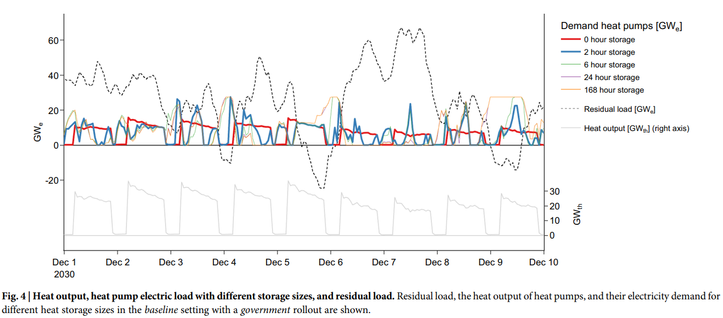
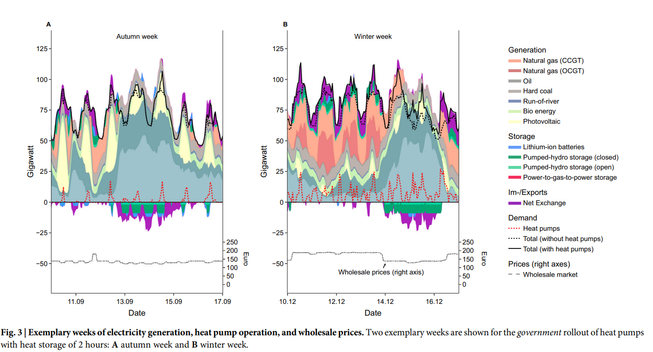
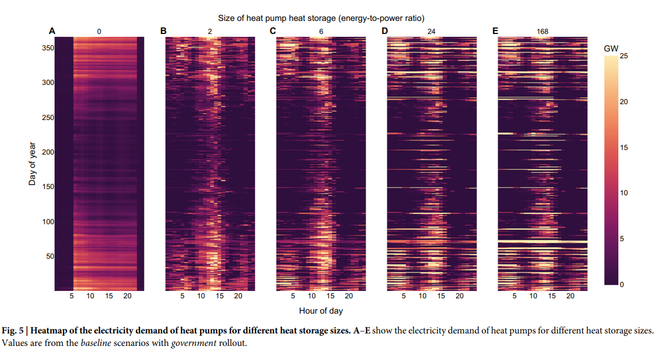
1️⃣ If equipped with a small heat thermal storage, heat pumps can store hot water for a few hours. By doing so, they can significantly reduce their peak demand and thus reduce the need for, e.g., batteries or gas-fired power plants.

2️⃣ Even with small thermal storage, heat pumps can absorb excessive renewable energy in the system. Instead of producing heat in the evening, when needed, they integrate cheap solar during the day.
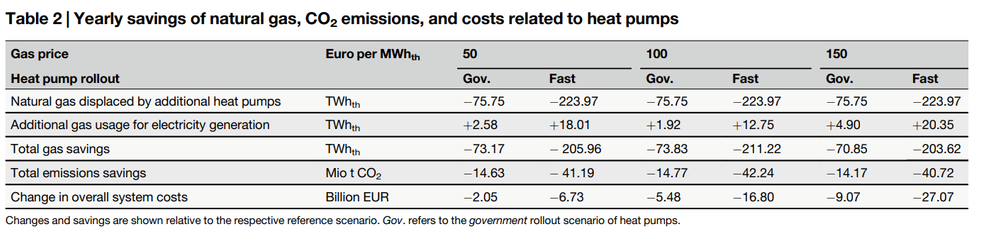
3️⃣ By installing more heat pumps, Germany could save natural gas, money, and emissions:
We estimate that annual household CO2 emissions could be reduced by
~ 18% (~14 mil. tons) for 6 million heat pumps
~ 51% 🤯 (~41 mil. tons) for 10 million heat pumps.

And some further points:

* An ambitious heat pump rollout would be best matched with additional wind power, but solar PV also works if combined with other technologies.
* We calculate that small (<2 h) heat storage makes sense economically; larger ones are too expensive and anyway unrealistic for private households and will be rather used in heating grids.

And for the nerds, some details on the method 🤓

* We use a linear cost-minimization model of Germany and its neighboring countries with the sexy name #DIETER.
* Different heat pump rollout scenarios until 2030 are modeled (1.7, 3, 6, and 10 million units).
* #BEV and #hydrogen demand is also included.

So, what are the main takeaways?

▶️ Flexible heat pumps with thermal storage can provide valuable flexibility to the power sector.
▶️ They can reduce the need to build other flexible power plants or storage.
▶️ Hourly electricity prices are key for incentivizing optimal heat pump use.
▶️ To that end, households need to be equipped with 'smart meters' (Germany needs to speed up).
▶️ An ambitious rollout of heat pumps can significantly reduce natural gas consumption, CO2 emissions, and costs.

Thanks for reading! This paper was a fantastic collaboration with my DIW colleagues Carlos Gaete-Morales, Dana Kirchem, and @wpschill.

⁉️ Got questions or comments? Reach out to us—we’d love to hear your thoughts!
🔗 Here’s the paper again: https://www.nature.com/articles/s43247-024-01861-2

Power sector benefits of flexible heat pumps in 2030 scenarios - Communications Earth & Environment

Investments in solar photovoltaics could cost-effectively support the expansion of heat pumps by 2030, and small thermal storage of heat pumps could reduce the additional need for firm capacity and battery storage, according to an analysis that uses an open-source power sector model.
Nature
And for a summary, please take a look at this blog post on the research community platform: https://communities.springernature.com/posts/heat-pumps
Flexibility in the power sector and the role of heat pumps

Heat pumps convert renewable electricity into heat, reducing reliance on fossil fuels. This makes them a key technology for decarbonizing the heating sector. However, their growing electricity demand requires a flexible operation to ensure an efficient integration into a renewable power system.

Springer Nature
@aroth Shouldn't heating sector be electricity sector in this post?
@burger_jaap Indeed, thanks for spoting this typo.