The Republican Party is the biggest threat to American democracy today.
It is a radical, obstructionist faction that has become hostile to the most basic democratic norm:
that the other side should get to wield power when it wins elections.

A few years ago, these statements may have sounded like partisan Democratic hyperbole.

But in the wake of the January 6 attack on the Capitol and Trump’s acquittal in the Senate on the charge of inciting it,
they seem more a plain description of where we’re at as a country.

https://www.vox.com/policy-and-politics/22274429/republicans-anti-democracy-13-charts

The Republican revolt against democracy, explained in 13 charts

The Trump years revealed a dark truth: The Republican Party is no longer committed to democracy. These charts tell the story.

Vox

Some of the most consequential Republican attacks on democracy happen at the state level

A map from the Brennan Center for Justice shows every state that passed a restriction on the franchise between 2010 and 2019.

These restrictions, ranging from #voter #ID laws to #felon #disenfranchisement, were generally passed by Republican majorities with the intent of hurting turnout among Democratic-leaning constituencies.

Republican state legislators were sometimes explicit about this:
💥“Voter ID ... is gonna allow Governor Romney to win the state of Pennsylvania,” then-state House Majority Leader Mike Turzai bragged during the 2012 presidential election cycle.

Because Republicans dominated the 2010 midterm elections, Republican statehouses got to control the post-2010 census redistricting process at both the House and state legislative level,
leading to extreme #gerrymandering in Republican-controlled states unlike anything in Democratic ones.

Conservative control of the Supreme Court enabled this state-level push.

In 2013, the Court
🆘 struck down the Voting Rights Act’s “preclearance” requirement
— that states with a history of racial discrimination would be required to get permission from the Justice Department on their maps and other major changes to electoral law.

In 2019, another Court ruling paved the way for further partisan gerrymandering.

The national Republican Party has broken functional government

⚠️Today’s Senate, where you need 60 votes to get virtually anything done, is a historical anomaly.

Its roots can be traced to the unyielding GOP opposition to President Barack Obama in 2009 and 2010

-- when Senate Minority Leader Mitch McConnell turned the Senate into a dysfunctional body
in which priority legislation was routinely subject to a #filibuster.

When Republicans won a Senate majority in 2014, McConnell found a new way to deny Obama victories:
blocking his judicial appointments.

🔥These actions were an expression of an attitude popular among Republican voters and leaders alike:

that Democrats can never be legitimate leaders, even if elected, and thus do not deserve to wield power.

The Trump presidency was a test of Republican attitudes toward democracy.

Time and again, the president abused his authority in ways that would have been unthinkable under previous presidents.

Time and again, members of Congress, state party leaders, right-wing media stars, and rank-and-file voters looked the other way
— or even cheered him on.

Two NBC polls taken about a year apart show that support for Trump’s first and second impeachment among Republicans remained exactly the same among Republicans:
8 percent.

Trump was impeached the first time because he tried to interfere with the integrity of the 2020 presidential election

— attempting to strong-arm the Ukrainian president into opening up a bogus investigation into Joe Biden.

Trump was impeached the second time because he ginned up a mob to attack the Capitol to disrupt the counting of the votes from the Electoral College.

And yet in both cases, the percentage of Republicans who supported impeaching him was the same
— a measly 8 percent.

There’s just very little popular appetite in the GOP for punishing anti-democratic excesses by Trump, regardless of the circumstances.

All the reasons for the GOP’s turn against democracy
— backlash to racial progress,
rising partisanship,
a powerful right-wing media sphere
— remain in force after Trump.

The leadership is still afraid of Trump and the anti-democratic MAGA movement he commands.

More fundamentally, they are still committed to a political approach that can’t win in a majoritarian system,
requiring the defense of the undemocratic status quo in institutions like the Senate and in state-level electoral rules.

Republicans still control the bulk of statehouses and are gearing up for a new round of voter suppression bills and extreme gerrymandering in electorally vital states like Georgia and Texas.

It’s very hard to see how any of this gets better.
It’s very easy to see how it gets worse.

Trump's supporters have embraced anti- democratic ideals

In their analysis of a two-part survey, conducted in late 2020 and early 2021, of hardcore Trump supporters,
the political scientists behind the survey, Rachel Blum and Christian Parker, identified so-called
“MAGA voters” by their activity on pro-Trump Facebook pages.

Their subjects are engaged and committed Republican partisans, disproportionately likely to influence conflicts within the party like primary elections.

These voters, according to Blum and Parker, are hostile to bedrock democratic principles.

They go further than “merely” believing the 2020 election was stolen -- a nearly unanimous view among the bunch.

⚠️Over 90 percent oppose making it easier for people to vote;

⚠️and roughly 70 percent would support a hypothetical third term for Trump (which would be unconstitutional).

💥“The MAGA movement,” Blum and Parker write, “is a clear and present danger to American democracy

The ultimate expression of anti-democratic politics is resorting to #violence.

More than twice as many Republicans as Democrats
— nearly two in five Republicans
— said in a January poll that force could be justified against their opponents.
It would be easy to dismiss this kind of finding as meaningless were it not for the January 6 attack on Capitol Hill
— and the survey was conducted about three weeks after the attack.

Republicans recently saw what political violence in the United States looked like, and a large fraction of the party faithful seemed comfortable with more of it.

These attitudes are linked to the party elite’s rhetoric:
The more party leaders like Trump attack the democratic political system as rigged against them, the more Republicans will believe it and conclude that extreme measures are justifiable.

A separate study by political scientists Lilliana Mason and Nathan Kalmoe found that “Republicans who believe Democrats cheated in the election (83 percent in our study) were far likelier to endorse post-election violence.”

Republicans see Democrats as worse than mere rivals

Democracy is, among other things, a system for taming the disagreements inherent in politics:
People compete for power under a set of mutually agreeable rules, seeing each other as rivals within a shared system rather than blood enemies.

But in the United States today, hyperpolarization is undoing this basic democratic premise:

Sizable numbers of Americans on each side see the members of the other party not as political opponents but as existential threats.

The rise of this dangerous species of “negative partisanship,” as political scientists call it, is asymmetric.

While many Democrats see Republicans in a dark light, a majority still see them more as political rivals than as enemies.

Among Republicans, however, a solid majority see Democrats as their enemy.

When you believe the opposing party to be an enemy, the costs of letting them win become too high, and anti-democratic behavior
— rigging the game in your favor, even outright violence
— starts to become thinkable.

Republicans dislike compromise

America’s founders designed our political system around compromise.
But for years now, majorities of Republican voters have opposed compromise on principle,
consistently telling pollsters that they prefer politicians who stick to their ideological guns rather than give a little to get things done.

It’s no wonder the past decade saw unprecedented Republican obstructionism in Congress (more on that later).
The hostility to compromise on the GOP side has at least two major implications for democracy.

First, it has rendered government dysfunctional and ineffective
— and consequently has decreased public trust in government.

Second, it has pushed Democrats in a more polarized direction;

in 2018, Pew found, Democratic support for political compromise plummeted to roughly Republican levels.

This seems in part like a reaction to years of GOP behavior:

If they aren’t going to compromise with us, the Democratic logic goes, then why should we compromise with them?

But the more Democrats eschew compromise, the more cause Republicans have to see them as fundamentally hostile to conservative values
— and to redouble their intransigence.

It’s a doom loop for political coexistence.

The Republican Party is a global outlier -- and not in a good way

The Global Party Survey is a 2019 poll of nearly 2,000 experts on political parties from around the world.

The survey asked respondents to rate political parties on two axes:
🔸the extent to which they are committed to basic democratic principles
🔸and their commitment to protecting rights for ethnic minorities.

As shown by the results of the survey for all political parties in the OECD, a group of wealthy democratic states:

The GOP is an extreme outlier compared to mainstream conservative parties in other wealthy democracies,
like Canada’s CPC or Germany’s CDU.

Its closest peers are almost uniformly radical right and anti-democratic parties.

This includes Turkey’s AKP (a regime that is one of the world’s leading jailers of journalists),

and Poland’s PiS (which has threatened dissenting judges with criminal punishment).

The verdict of these experts is clear:
The Republican Party is one of the most anti-democratic political parties in the developed world.

The Republican turn against democracy begins with racism

Support for authoritarian ideas in America is closely tied to the country’s long-running racial conflicts.

A September 2020 paper by Vanderbilt professor Larry Bartels, shows a statistical analysis of a survey of Republican voters -- analyzing the link between respondents’ score on a measure of “#ethnic #antagonism
and their support for four anti-democratic statements
(e.g., “the traditional American way of life is disappearing so fast that we may have to use force to save it”).

Their data show a clear finding:
💥The higher a voter scores on the ethnic antagonism scale,
the more likely they are to support anti-democratic ideas.

This held true even when Bartels used regression analyses to compare racial attitudes to other predictors, like support for Trump.

“The strongest predictor by far of these antidemocratic attitudes is ethnic antagonism,” he writes.

For students of American history, this shouldn’t be a surprise.

The 1964 Civil Rights Act and 1965 Voting Rights Act cemented Democrats as the party of racial equality,
causing racially resentful Democrats in the South and elsewhere to defect to the Republican Party.

⚠️This sorting process, which took place over the next few decades, is the key reason America is so polarized.

It also explains why Republicans are increasingly willing to endorse anti-democratic political tactics and ideas.

In the past, restrictions on the franchise served to protect white political power in a changing country

🔥Today, as demographic change threatens to further undermine the central place of white Americans, many are becoming comfortable with an updated version of the Jim Crow South’s #authoritarian #tradition.

The crucial impact of right wing media:

A study covering 1997 to 2002, when Fox News was still being rolled out across the country,
compared members of Congress in districts where Fox News was available to members in districts where it wasn’t
-- specifically examining how frequently they voted along party lines.

They found that Republicans in districts with Fox grew considerably more likely to vote with the party as it got closer to election time,

whereas Republicans without Fox actually grew less likely to do so.

The expansion of Fox News, in short, seemingly served a disciplining function:

making Republican members of Congress more afraid of the consequences of breaking with the party come election time
and thus less inclined to engage in bipartisan legislative efforts.

“Members with Fox News in their district behave as if they believe that more Republicans will turn out at the polls by increasing their support for the Republican Party,” the authors conclude.

Partisanship causes Republicans to justify anti-democratic behavior

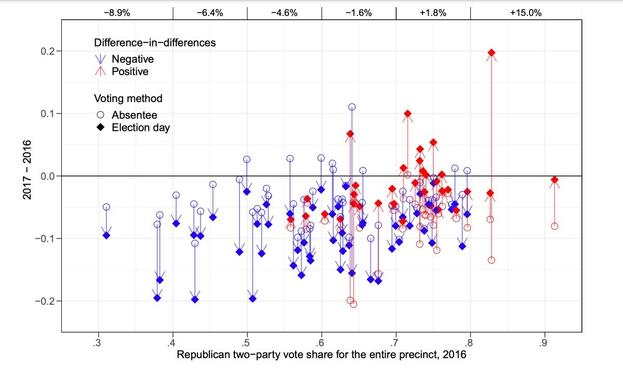
The chart in this post is a little hard to parse, but it illustrates a crucial finding from one of the best recent papers on anti-democratic sentiment in America:
⭐️how decades of rising partisanship made an anti-democratic GOP possible.

The paper, from Yale’s Matthew Graham and Milan Svolik, uses a number of methods to examine the effect of partisanship on views of democracy.

This chart shows a particularly interesting one:
a “natural experiment” in Montana’s 2017 at-large House campaign, during which Republican candidate #Greg #Gianforte assaulted reporter Ben Jacobs during an attempted interview just before Election Day.

Because many voters cast their ballots by mail before the assault happened, Graham and Svolik could compare these to the in-person votes after the assault in order to measure how the news of Gianforte’s attack shifted voters’ behavior.

The blue lines represent precincts where Gianforte did worse on Election Day than in mail-in ballots;
the red lines represent the reverse.

What you see is a clear trend:
In Democratic-leaning and centrist precincts, Gianforte suffered a penalty.
But in general, the more right-leaning a precinct was, the less likely he was to suffer
— and the more likely he was to improve on his mail-in numbers.

For Svolik and Graham, this illustrates a broader point:

Extreme partisanship creates the conditions for democratic decline.

If you really care about your side wielding power, you’re more willing to overlook misbehavior in their attempts to win it.

They find evidence that this could apply to partisans of either major party
— but only one party nominates candidates like Trump and Gianforte
(who won not only the 2017 contest but also his reelection bid in 2018 and Montana’s gubernatorial election in 2020).

@cdarwin most of this analysis matches my understanding of the last 60-70 years in us politics.

tbf, not sure where we go from here, but it is NOT BACKWARDS.

@cdarwin If we think Republicans have been compassionate or affable in any way since the 80's.... Really, it's using housing as an investment vehicle that's created the homelessness crisis. They will throw single moms out on the street and keep every dime of her damage deposit without reason for a single dollar.

They've been treating us like the enemy all along. They're just trying to justify it, now.