 Steve Hill
 Jason Gorman
In the future, we won't need programmers, just people who can describe to a computer precisely what they want it to do.
Instant water.
 Alerta! Alerta!
@jasongorman I also have some mugs of boiling water readily available in my fridge...
 Marcos Dione
@heiglandreas @jasongorman eh, wait, instant water _can_ be accomplished by exactly things you take out of the fridge, it's called condensation... :-P
I was going to say that one way we can distinguish ourselves from machines is by our ability to get a joke...
 Leslie Viljoen
@jasongorman yeah... ChatGPT already gets more jokes than I do.
 Coach Pāṇini ®
 CraigTP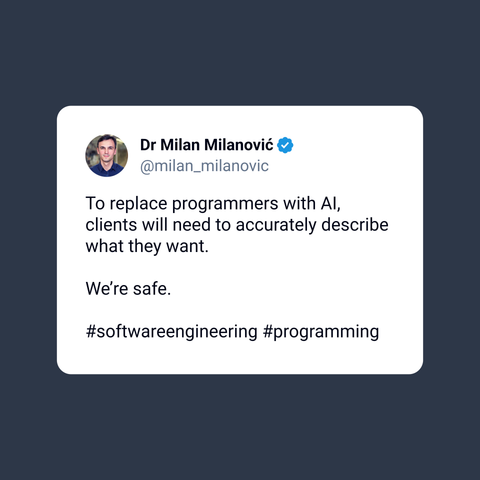
 Stuart Moore
@jasongorman The coding part of programming is generally the easiest part of the work, and agreeing on the problem to be solved and what good looks like the hardest.
I started out programming at the microcode and machine code level. Ever since it has just been further and further abstraction. I don't think the next stage will be that different.
I remember the hype around 4GL and the imminent demise of programmers. Didn't happen then and it will not happen this time. Programmers will just evolve and mover higher up the stack again.
@gruntfutuk I've read about similar "we won't need programmers" hype around 3GLs, too, in the late 1950s. It's been a regular merry-go-round throughout computing's history.
 The Long Tail
@jasongorman @gruntfutuk "Computers are useless. They can only give you answers" -- Pablo Picasso
 Bert Koorengevel
 Tristram Brelstaff
@sleepyfox @jasongorman @gruntfutuk Picasso had obviousy never used computers otherwise he would have known that they raise far more questions than they ever answer.
 Woke Leftist Trash
@jasongorman @gruntfutuk The problem is going to be when the models output code you yourself can’t understand.
It could be a decent tool in someone who is well educated.
It may seem like a good tool to those who aren’t but they won’t be able to tell the difference. That way lies subtle, non-obvious bugs compounding at a rate that they cannot be fixed.
And it doesn’t seem like we’ll be able to train a model to not hallucinate or choose appropriate abstractions.
 piofthings
@jasongorman 24 years and counting 😇😇😇
@piofthings It's more like 65 years and counting. Folks said this about COBOL and FORTRAN 🙂
@jasongorman I am sure that’s true ☺️. I am a relative new kid on the block 🙈
@piofthings Just to be clear, I wasn't around at the time 🙂
@jasongorman haa haa. I have been fortunate enough to work with folks who have been around that long. 24yrs is about the span of my career and my very first project was a bpmn based low code no code platform! Not to mention my engineering project was a crude attempt at the same 🙈
 TheFwGuy 🇪🇺🇮🇹🇺🇸🖖
@jasongorman @piofthings I did and I confirm 😜
 AlgoCompSynth by znmeb 🇺🇦
@jasongorman @piofthings I was. Ask me anything. 😉
"It's more like 65 years and counting. Folks said this about COBOL and FORTRAN"
IT was more along the lines of "There aren't enough programmers to write all the software that needs to be written, so we need to make it so scientists (FORTRAN) and managers (COBOL) can write programs."
Also, there were dozens of machine languages back then and two languages that could run on all of them was a huge win.
@jasongorman @piofthings So now we have dozens of higher-level languages and only one has any hope of becoming universal - Python.
 Angela Glansbury 🚽
@jasongorman @piofthings
I can imagine a lot more people were saying this when the majority of coders were women.
I can imagine a lot more people were saying this when the majority of coders were women.
@floppyplopper @jasongorman that’s a take I hadn’t considered, but now you say it, I feel like I’ve read about this in the recent past! Quite believable!
 Mathias Verraes
@jasongorman This is a common reasoning, but an interesting question is: what if that's not true? What if we could vaguely describe what we need, see a result, vaguely describe some improvements, and get by with things that are temporarily sufficient for it current needs? It sounds unattractive, but unlike current software, it would always be close to what we need _now_, as opposed to going through an 18 month laborious process of requirements gathering a development.
 Adam Davis
@mathiasverraes @jasongorman
This sounds like an argument for Agile methods. I don't think inserting AI in the process resolves the 'issues' with Agile development: lay people can't adequately describe a starting point, they're "too busy" to stay involved in the process, and they don't want to start using a new system until it's feature complete (which limits useful feedback).
This sounds like an argument for Agile methods. I don't think inserting AI in the process resolves the 'issues' with Agile development: lay people can't adequately describe a starting point, they're "too busy" to stay involved in the process, and they don't want to start using a new system until it's feature complete (which limits useful feedback).
@AdamDavis @jasongorman "Feature complete" is the assumption I'm trying to challenge here. No end point, just a willing assistant who more or less solves your problem today, and the next day you tell it to do "like yesterday but change this one thing" and there's never a notion of finished features.
@mathiasverraes @jasongorman
And I'm agreeing with the original statement: "we won't need programmers, just people who can describe to a computer precisely what they want it to do". Working from vague to precise either takes a lot of trial and error or a detailed understanding of the development system. Business-oriented subject matter experts will either not be suited to that work or they'll be too busy producing reports and analysis for upper management.
And I'm agreeing with the original statement: "we won't need programmers, just people who can describe to a computer precisely what they want it to do". Working from vague to precise either takes a lot of trial and error or a detailed understanding of the development system. Business-oriented subject matter experts will either not be suited to that work or they'll be too busy producing reports and analysis for upper management.
 Frank Heijkamp
@alterelefant @mathiasverraes @jasongorman
I would say that "people who can describe to a computer precisely what they want it to do" are coders. So, yes, we'll still need coders.
I would say that "people who can describe to a computer precisely what they want it to do" are coders. So, yes, we'll still need coders.
 Matthew Skelton
@mathiasverraes @AdamDavis @jasongorman that "LLM-generated throwaway app" might work for simple tasks, but not for important things like pensions, passport applications, e-commerce, banking, where a high degree if correctness is required. Surely?
Or are you suggesting that people will accept approximations of bank balances, pension pots, purchases, etc ?
🤔
@matthewskelton @mathiasverraes @AdamDavis I did a short gig once for a logistics firm. They'd paid 2 programmers a fixed price to develop a traffic management system for a client contract, and it had gone badly. Their monthly invoices were about 5% out. Which was about £25K a month.
The manager I dealt with actually said to me that "as long as it was 90%+ accurate, that was fine.
They hadn't realised their client had developed a reconciliation system in Oracle to check the invoices.
@matthewskelton @AdamDavis @jasongorman I'm not saying that all goes away. I'm just trying to stretch my imagination and see if there might be other forms of software that don't exist yet, for problems that are not quantifiable like bank statements.
@matthewskelton @AdamDavis @jasongorman An example: "Hey computer, put out a job ad and hire 5 line cooks". A month later: "Hey computer, hire 5 more, but make sure they are polite to customers". "Now hire a cook who's good with salads".
The user described a fluid set of criteria, but there's never a notion of accuracy or completeness. Payroll etc is of course still handled by a more traditional system.
The user described a fluid set of criteria, but there's never a notion of accuracy or completeness. Payroll etc is of course still handled by a more traditional system.
@mathiasverraes @AdamDavis @jasongorman that makes sense to me: ad-hoc tasks that are not (yet) a consistent ongoing need.
But this also suggests to me a kind of backwards step: people just using GenAI codegen like a human. It's effectively not repeatable and so then like a step backwards towards unspecified, random needs from business people without the clarity that comes from actually industralising the activities.
🤷🏼♀️
 Ed Blackburn
@matthewskelton @mathiasverraes @AdamDavis @jasongorman I was thinking of something similar to post-for-profit OpenAI news. Is a route to profitability to act as middleware that translates instructions into actions for third parties? For example, job descriptions for hiring or something more complicated for, say, wix.com? A kind of NLP -> command layer with added value with scheduling, feedback, suggestions, status updates, etc., depending on the richness of the underlying service provider.
@ed_blackburn @mathiasverraes @AdamDavis @jasongorman kind of like codifying human input into specifications that can be usefully executed by an LLM?
@matthewskelton @mathiasverraes @AdamDavis @jasongorman But one can envisage a more comprehensive offering for richer products. UX can be asynchronous and synchronous. For example, here's an update on your hiring request, if you tweak this requirement you'll have a larger pool, do you have time to triangulate? The interface could be a prompt or even via Siri for example. A lot I would imagine would be driven by the business models of the LLM-as-a-service. Less demo-ware; more value.
@matthewskelton @mathiasverraes @AdamDavis @jasongorman Expanding TAM by lowering barriers to I18n and improving accessibility. Commoditising integrations will make it easier to add more, with players like OpenAI potentially setting standards. While many GenAI use cases aren't convincing, I recognise its potential for accessibility, improving UX, and acting as a multiplier. Realising this value will require substantial design research and experimentation, but the opportunity is evident.
@matthewskelton Of course, at the time, I didn’t realise what I’d described. We now have async flows: agents and a protocol for LLMs to communicate: MCP. This enables products to use LLMs as an implementation detail. In other words, a good product will survive, in contrast to the tech bro LLM scramble, which is just a waste of capital and time because it doesn't solve a problem people have.
@matthewskelton @AdamDavis @jasongorman We're getting somewhere now 😀
Step 1: Random unspecified needs. Step 2: Traditional SDLC. Step 3: Profit!
Step 2 is where IT forces clarity, and business would rather skip it (and has always tried to skip it). Programmers assume AI will make step 2 faster. I'm speculating there could be a category of problems that benefits from not having a step 2.
Step 1: Random unspecified needs. Step 2: Traditional SDLC. Step 3: Profit!
Step 2 is where IT forces clarity, and business would rather skip it (and has always tried to skip it). Programmers assume AI will make step 2 faster. I'm speculating there could be a category of problems that benefits from not having a step 2.
@mathiasverraes @AdamDavis @jasongorman yep... And actually GenAI may provide a useful option where the business can skip the actual thinking... If they need something truly one-off, but with the risk that the business is creating a mountain of unfathomable dross code that slows things down later.
GenAI is going to create jobs, not take jobs in IT.
2030: "Dross-clearing Engineer wanted to clear up GenAI code" 🧹
 KrisBuytaert
@matthewskelton @mathiasverraes @AdamDavis @jasongorman so we're back to GenAI has replaced the juniors which we are now not training anymore to become senior ?
@krisbuytaert @mathiasverraes @AdamDavis @jasongorman hmm, well we're not training many juniors in Assembly or vanilla C language any more, but instead in higher level languages.
I expect to see some formalisation of how to constrain an LLM to generate useful code, so maybe that becomes the new "coding" ? Basically, prompt engineering v2 or v3?
@matthewskelton @krisbuytaert @mathiasverraes @AdamDavis The problem is that the output from LLMs is non-deterministic, so it doesn't really matter how precise the prompt is.
@jasongorman @krisbuytaert @mathiasverraes @AdamDavis sure but going back to Mathias example, some constraints might be "good enough" even with non-determinism.
And maybe that non-deterministic output is sometimes a feature, not a bug? Or at least marketed as such. "Personalised" "Unique" etc. 🤷🏼♀️
 pau∂irac ⊥
@mathiasverraes @matthewskelton @AdamDavis @jasongorman
I might be mistaken, but it started as a beautiful joke.
 Daniel Barlow
@mathiasverraes @matthewskelton @AdamDavis @jasongorman a year later: five unsuccessful job candidates are suing you alleging discrimination and you are unable to explain on what criteria you selected the successful candidate because the AI's reasoning(sic) is opaque
@dan @jasongorman @AdamDavis @matthewskelton I'm not saying it's the future I want, I'm just speculating about possible futures 🤷♂️
 Rupert Reynolds
@mathiasverraes @jasongorman
18 months? That sounds like 'waterfall' to me.
Continuous Delivery is a bit of a surprise at first, but it's worth the effort in quality, as well as speed.
 Pete Alex Harris🦡🕸️🌲/∞🪐∫
Humans can do that, in fact they have to in the normal development process. LLMs are incredibly bad at it.
You'd be in the "arguing with the LLM about how many 'r's are in the word strawberry" scenario, except with your company's financial reporting.
Although even with humans, developing incrementally from *clear but minimal* requirements is much less likely to be an expensive failure than working from *vague* requirements.
 Daniel Terhorst-North
@mathiasverraes @jasongorman that’s a false dichotomy. There is a world of variance between these, such as frequently (daily? hourly?) releasing a new _precise_ definition that can elicit feedback.
‘Be vague and iterate’ is a counter to a problem that largely no longer exists, and may introduce more risk than it eliminates.
Not to mention the planet-burning thing. Or the IP theft and plagiarism thing. Or the systematic bias thing. Or the privacy violation thing. Or the…
 Arthur van der Harg
@mathiasverraes @jasongorman “Next time, I want you to avoid smashing in his head.”
 jbhughes
@jasongorman Oh well, no problem, then.
O
 Eric Lawton
COBOL – the Business Oriented Language – is so simple that managers can do that.
Or so we were told when it was introduced.
 Matthew Martin
@EricLawton @jasongorman Title inflation, Jr Software Developers are now (computer) Managers.
 Rue Mohr
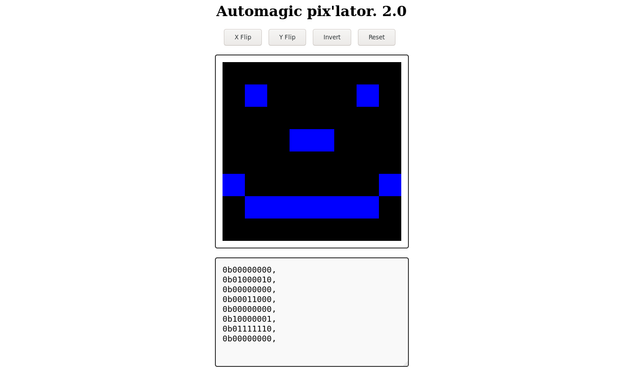
@jasongorman Yesterday I made this javascript tool. Although chatCPT cant code worth **** I prompted it along, correcting errors myself and gradually built this up.
There were two advantages to going to an AI for programming assist on this:
a) It was there. Where are all the f******* humans all the time? There are supposed to be billions of them.
b) chatGPT NEVER ONCE said "thats a stupid question, go read the manual" or "This question is below me, go ask someone else." Why are the few people that do exist on the planet such A**holes sometimes?
During *my* existence, web programming has changed a lot, divs, CSS, and even new versions of javascript can be like "you can do WHAT?" along with the huge selection of functions now available.
I have existed through a lot of programming languages and its often nice to be able to ask "How do I write a FOR loop in *this* language"
ChatGPT was able to give me (though intermittently wrong or bugged) guilt free assistance.
So don't be a jerk to someone asking for help and we wont need AI.
 mirabilos
@RueNahcMohr @jasongorman @gorplop fuck so-called “AI” and no thanks for burning down the planet even more
 The Doctor
@RueNahcMohr @jasongorman Can I quote you on that?
@drwho @jasongorman well I suppose, cause its not wonderful, bits its true.