 sky-guided
lol so ended up just using I^2 *R just given DC resistance of a few tenths of a ohm and amperages in the 6-10A range...
that's multiple tens of watts of heat.
Very rough estimates of thermal mass give many degrees per second rise.
...yep there's a problem.
So the standard trace width calculations just aren't remotely applicable here apparently!
I now slightly better understand why other folks haven't used PCB inductors here.
I suspect I might still be able to donut with much lower amperages though! If I get down below 3A in the inductor, that's only like four watts heat rather than dozens.
https://hackaday.io/project/194683-plasma-toroid-sky-guided-pcb-edition/log/227533-i-would-like-my-circuit-to-not-cook-itself
i would like my circuit to not cook itself | Details | Hackaday.io
<p>First Light accomplished. What did I learn?<br><br>The circuit in its current iteration,<br>1: gets hot alarmingly quickly<br>2: is trying to draw more power than I can actually supply. <br><br>Those seem related, yeah. <br></p><figure><img data-src="https://cdn.hackaday.io/images/6280501708053920075.jpg" class="lazy"></figure><p><em>apologies for the excessively american temperature units<br></em><br></p><p>Based on simulating the circuit in the condition tested, at 15 volts supply I'd expect to see something like 50W power draw, at around 3.5A. The tests discussed in the previous post sure looked like the USB-based bench supply was badly voltage sagging, so the next day I hooked up the beefier bench supply -- and very quickly started sagging, then blew another mosfet. I <em>suspect</em> that this very-budget bench supply has some sort of destructively un-graceful switch from constant-voltage to the constant-current mode it failovers to when it hits 5A, but it's also entirely possible that the mosfet blew first and I saw the power supply feeding a shorted chip. <br><br>My power budget is <5A @20V (the 100-watt maximum of USB-C-PD), but I'd prefer to stay <60W if possible.<br><br>If I simulate a lower primary capacitance (e.g. 66pF instead of the as-built 99pF), power draw is dramatically greater <em>and</em> the higher resonating frequency is also a closer match to what I observed on the
More progress on the plasma toroid! More videos! Less overheating!!
Writeup at https://hackaday.io/project/194683-plasma-toroid-sky-guided-pcb-edition/log/227790-tweakin
Higher-quality vid at https://www.youtube.com/watch?v=rEc76ckTJcg
tweakin' | Details | Hackaday.io
<p>Spent a big chunk of the weekend adjusting a variety of component values. <br></p> <figure><img class="lazy" data-src="https://cdn.hackaday.io/images/7189551708888806047.png"><br>Here's the waveforms with the circuit unloaded (no toroid), at 18V supply:<span></span></figure> <figure><img class="lazy" data-src="https://cdn.hackaday.io/images/2465921708889099062.png"></figure> <p>Yellow is Gate (5V/div), purple is Drain (50V/div), blue is feedback network bias input at TP5 (5V/div).</p> <p>Looks decently healthy to me. I suspect that the gate protection zener diode is doing its job and helping to keep drive voltages within operational limits.<br><br>Here's the traces when the xenon is fully toroid-ing:</p> <figure><img class="lazy" data-src="https://cdn.hackaday.io/images/1735241708891968601.png"></figure> <p>Hm. Clearly the device is overall functional but these waveforms aren't as clean as I'd prefer. Maybe it's fine?</p> <p><br>All right, so let's walk through the component changes. I'll spare the step-by-step of each individual test -- most of it was poorly documented and I was going for more of a "better or worse?" approach than robust characterization. <br><br>First off, primary tank capacitance was increased 99pF to 141pF. This was the first change made, as planned in previous project log "<a href="https://hackaday.io/project/194683-plasma-toroid-sky-guided-pcb-edition/log/227533-i-would-like-my-circuit-to-not-cook-itself" target="_blank">i would like my circuit to not cook myself</a>". <br><br>Increasing capacitor value was broadly successful -- overall power draw was reduced to ~2.9 - 3.2A depending on circuit configuration. Yay!<br><br>Decoupling cap C4 was removed because it caused some kind of runaway oscillation on
More plasma toroid progress! Things are going super well!
Video demo:
https://youtu.be/fBrOaj5pBa0
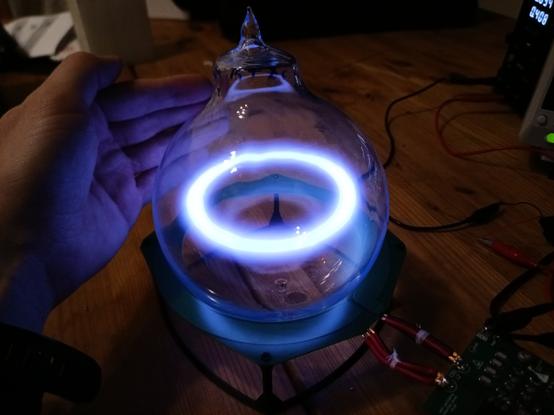

Plasma Toroid WIP demo #3 - ✨😇
I'm at a point where I could call this "done" if I wanted.
It's not done yet though ^_^
roflll, I'd been working hard to implement a subcircuit for monitoring current draw to indicate out whether or not the primary inductor was in oscillation, using a shunt resistor + op-amp + comparator etc.
And just now realized I can do the same thing *better* using nothing but a loop of wire and an LED.
Plasma toroid project writeup has been updated, with details of the non-contact indicator light shown in the previous video clip.
"status LED, galaxy brain style"
https://hackaday.io/project/194683-plasma-toroid-sky-guided-pcb-edition/log/228373

status LED, galaxy brain style | Details | Hackaday.io
<p>Since a key goal of this project is to run standalone -- no o-scope, no bench PSU, no amperage panel meter -- it's crucial to have some sort of indication of whether the circuit was in oscillation or just sitting idle.<br></p> <p>Overall power draw reliably reflects the circuit's state. When not oscillating, there's near zero draw -- just LEDs, leakages, etc. While running the draw is more like 2-3 amps, and can be reduced down to as little as ~1.2A by lowering mosfet gate bias. </p> <h1>The normal approach</h1> <p>I had initially planned to use the pretty typical current monitoring method of a differential op-amp measuring voltage across a low value shunt resistor. Since I'm looking for a threshold current indicator rather than a continuous analog signal, the op-amp is fed into a comparator, against a reference voltage.<br></p> <figure><img class="lazy" data-src="https://cdn.hackaday.io/images/3954551711072740439.png"></figure> <p><em>Yes, this diagram is kind of sloppy, but you won't need to linger on details here anyway. If the text is unreadable due to aliasing you can click to embiggen.</em></p> <p>The TSM102 IC seemed like a neat combo-wombo of packaging two comparators, two op-amps, and a 2.5V reference all in one. It's also relatively inexpensive and can run off of a 40V Vcc. Purpose-built current monitor
ANOTHER plasma toroid project update: Pushbutton Arc Start!
https://hackaday.io/project/194683
This one is a big deal, since I've now hit every core functional milestone. The next steps are putting all of the subsystems together into a single, unified board.
This subcircuit is also neat because it uses multiple different bits of antiquated technology: photo-flash trigger circuits and gas discharge tube surge arrestors.
(demo vid attached here; high-quality available on youtube https://youtu.be/Vi6Pb0WSCZw )

Plasma Toroid (sky-guided PCB edition)
status: v0.1 failure (mosfets destroyed: 5) v0.2 success v0.3 better performance Mission: Create an inductively coupled plasma toroid in a globe of xenon gas. The end goal is to have all electronics (including primary inductor) part of a single PCB running on USB-C-PD power, in a well-built and aesthetically attractive presentation. Inspired by "perfecting and explaining the plasma toroid" by BacMacSci https://www.youtube.com/watch?v=GbMAvn7nRWo The driving electronics is a "class E" self-oscillating circuit based on a SiC MOSFET. A ~2µH loop inductor is driven at 10-15MHz and >2kV, creating a strong electromagnetic field. If a 1-liter globe of ~15 torr xenon is placed in the middle of the inductor, the xenon will ionize into a conductive loop analogous to the secondary winding of a transformer. based on the work of Steve Ward and BacMacSci.
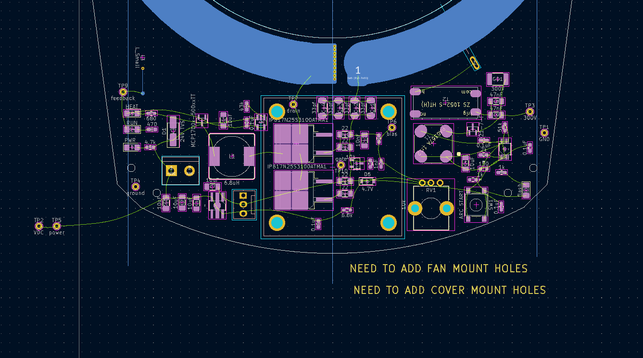
Like I spent literal hours today trying to pick out a heatsink.
Digikey has literally one hundred *thousand* heatsink SKUs from one vendor, and they're all permutations of solution space for the same basic design.
Neither digikey parametric search nor the manufacturer website narrowed things down very well. Even after several different dead ends to figure out what I actually wanted, I basically had to manually decipher the under-documented way this mfg was assigning model numbers.
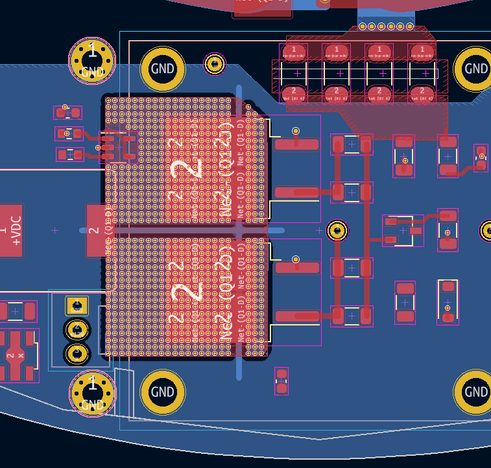
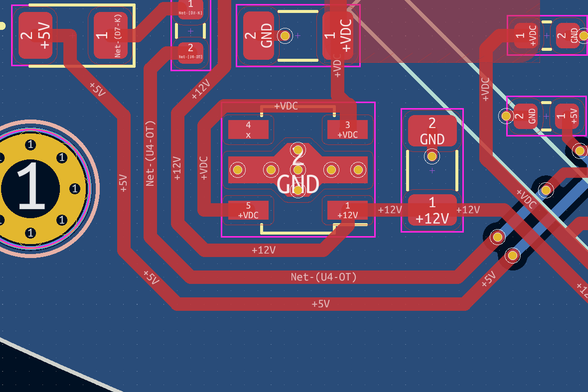
At long last I am getting to the "finishing touches" stage of this design.
Mechanical CAD is already done.
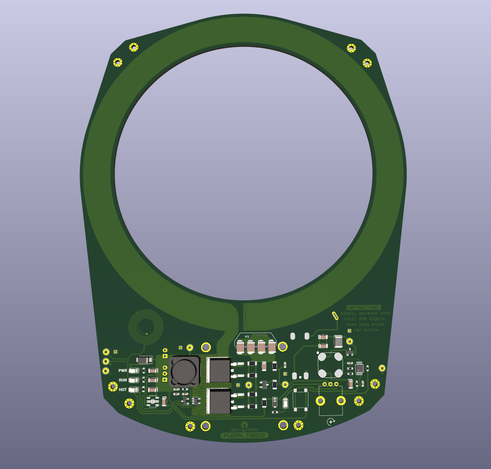
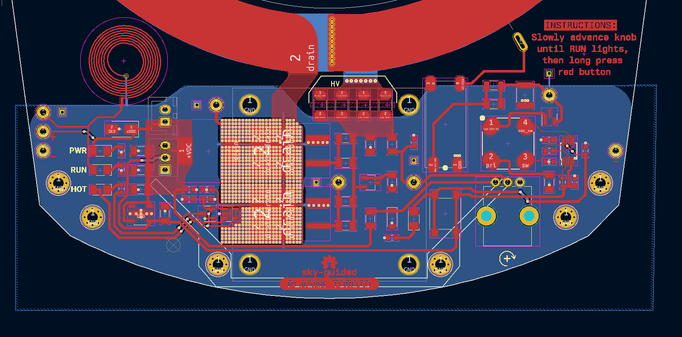
Btw: plasma toroid is still being very actively worked on! I did a circuit/board integration test "off-camera" because the prototype is very nearly identical to what the final version will be, but lacking in just a bit of ✨ sparkle  that I want to publish fully-formed.
Currently waiting on another round of overseas PCB fab which I expect to take a couple weeks.
Feature added since my last update: overheat indicator light
(plus it runs cooler in general.)
So I said last update that I was gonna be doing a li'l something special for the final version of the plasma toroid board.
Here's the something special ✨
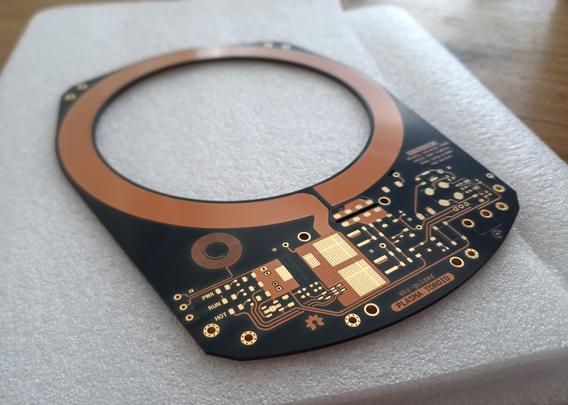
This is a board with dyed-black FR4 fiberglass and transparent soldermask (the layer that's traditionally green).
Not necessarily a *reasonable* expenditure but, woah.
Roadmap for Done is basically:
- assemble
- take good photos (Friend With a Macro Lens is out of town rn...)
- shoot a project video (probably a yak stack in its own right)
- so much writeup
- edit video...
Plasma toroid writeup updated
https://hackaday.io/project/194683-plasma-toroid-sky-guided-pcb-edition/log/230046
"#8: A Unified Board"
#8: A Unified Board | Details | Hackaday.io
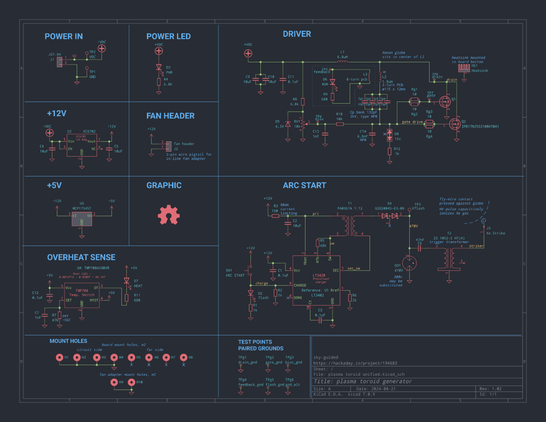
<p>It's been a busy couple of months behind the scenes -- this project is basically finished! I'll be breaking the final few updates into a couple posts, while I wrangle loans of camera equipment for the beauty shots. </p> <h1>Circuit Unification</h1> <p>Taking the different prototyped modules and banging them together:</p> <figure><img class="lazy" data-src="https://cdn.hackaday.io/images/4564281716833141406.png"></figure> <p><em>(you might have to click to embiggen)</em><br>I've paralled the mosfets for better heat dissipation. This doesn't help quite as much as one would like (since a lot of the losses are switching and not resistive), but it does help. The mosfet gate resistors are also paralled since they get <em>quite</em> hot before the arc is struck. I'm not sure why that behavior is occurring -- if you know, drop me a line!<br><br>The 4.3V zener diode (D5) for regulating gate bias is a carefully chosen value for this particular mosfet and circuit. Cranking the knob full-clockwise guarantees oscillations start, but doesn't set the bias so high as to cause excessive power draw and heating. The use of full knob range also makes adjustments more precise and controllable.</p> <p>A bank of four 33pF capacitors is a balance between heat distribution and board space. While the board itself has plenty of room (see below), I ran into
Plasma toroid writeup updated, with something a bit different:
an in-depth look at black-core FR4 and transparent soldermask PCB stackup, sponsored by PCBWay
https://hackaday.io/project/194683-plasma-toroid-sky-guided-pcb-edition/log/230233
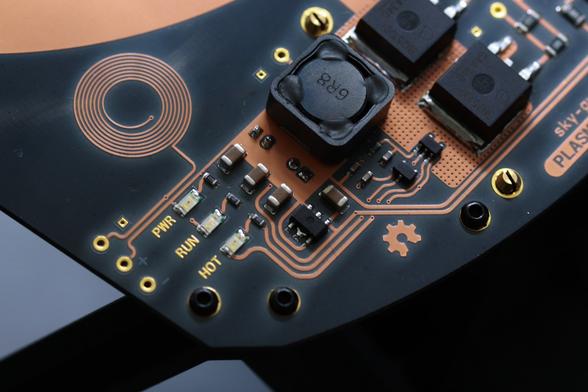
#9: Black FR-4 and transparent soldermask, by PCBWay | Details | Hackaday.io
<p>For the final build of this project, I wanted something special.</p> <figure><img class="lazy" data-src="https://cdn.hackaday.io/images/1192521717273710046.jpg"></figure> <p>Typical PCBs use a olive-green fiberglass core, layers of copper, and a (traditionally green) soldermask layer to protect the copper and define areas where solder/component pads should stick. This board instead has a dyed-black fiberglass core and a transparent soldermask layer. This means that all traces are visible as their natural copper color, which is delightfully high-contrast against the black substrate. Component pads and other areas left uncovered by the transparent mask are plated (ENIG) gold. <br><br>This order of circuitboards was <em><strong>(partially) </strong><strong></strong></em><strong>Sponsored by <a href="https://www.pcbway.com/" target="_blank">PCBWay</a>! </strong>They covered about 60% of the cost of these boards, and I paid the remainder out-of-pocket. <br><br>There's <em></em>very few photos out there of real PCBs made using this stackup, so I'm taking the time to write out a review. <br><br>(Transparency: being partially sponsored will likely bias my opinions, but I did also pay enough to feel like I have skin in the game. I have not given PCBWay any editorial control and they will not have seen this review prior to publication. Photos have been lightly post-processed and are broadly representative of how things look irl under good lighting. An order number [visible on the unpopulated
UPDATE:
I've finally released KiCAD source files for the plasma toroid driver.
still need to flesh out documentation.
video status is: still need to shoot one more bit of pick-up footage, do a bit of polish on graphics, finalize the edit, sound cleanup, color grade.
So coming a lot closer to done, at last.
AND IT IS DONE
"A plasma toroid for the modern era."
https://www.youtube.com/watch?v=Bl3zHuih_CY

A plasma toroid for the modern era.
 merlin / alex glow
@skyguided Oh my GODDDDD WHAT 😱✨ holy crap bookmarking to watch later
That's freaking gorgeous