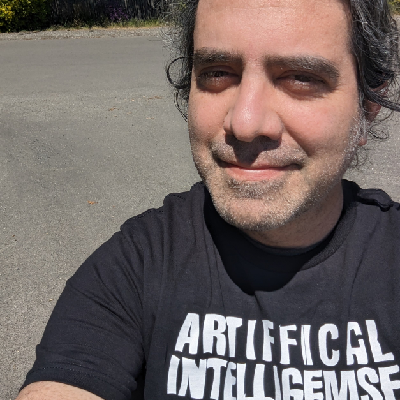
Today I'm launching something near and dear to my heart...VERY near and dear 😂 -- a podcast project with my phenomenal favorite neuroscientist (& wife), @analog_ashley !

On "Change, Technically" we're coming to your ears to share tales of who gets to be technical. We dig into STEM pathways & how leaders can learn from psych and neuroscience to think about cultivating innovation. We share our stories from classrooms to software teams. Plus new Cat & Ashley lore!

https://www.changetechnically.fyi/

Change, Technically

Ashley Juavinett, PhD and Cat Hicks, PhD explore technical skills, the science of innovation, STEM pathways, and our beliefs about who gets to be technical—so you can be a better leader and we can all build a better future.Ashley, a neuroscientist...

Buzzsprout
Mega warm thanks to @danilo who is our big-hearted and big-brained producer on this project! It's so fun to cook with you on the work and the hope we all believe in 🔥

@grimalkina THANK YOU FOR YOUR GENEROUS CURIOSITY ABOUT THIS EXPERIMENT

what a blast to dig into this with y'all!

@grimalkina @danilo Wow, he finally got you to do it! Mark me down as a subscriber, then
@jenniferplusplus @danilo the real ones know how this happened 🤣🤣🤣
@grimalkina @jenniferplusplus sometimes we just pick up a shovel for the world we need!

@grimalkina @danilo
What a delightful episode! I learned a lot from this, and it has me thinking about how to meet people in their spheres of interest to contextualize coding. I'm not sure I'm equipped to do that, but it sounds like great fun!

Since I grew up in an age when essentially *all* coders were self-taught, it's weird to me that people think they are "the only one" who learned programming that way.

@bogosity @grimalkina @danilo this is such a great point; it's the double-edge sword of formalizing these kinds of things in coursework and degree programs, imho.

might i recommend @thecarpentries for finding folks in their respective disciplines!

@bogosity That was my reaction as well. I both came of age at a time where a large number of coders were self taught (due to the personal computing revolution followed by the WWW revolution) and worked around physicists, electrical engineers, and astronomers who generally seemed to assume they could teach themselves to code and didn't need instruction (for good or ill...definitely ill in some cases 😄 ). It hadn't really occurred to me that times had likely changed and also norms might be different in other scientific disciplines. @grimalkina @danilo
@internic @bogosity @danilo Ashley and I both have spent most of our time working with people who have been discouraged by others at every turn and who have a need to have every credential in order to be given a chance so we're really aware of the other side...! This is definitely what I experience as a social scientist in tech vs having a degree in a field that people see as "math adjacent", even though I have often done relevant statistical work and some other person hasn't!
@internic @bogosity @danilo and these beliefs carry through in hiring way more than we might like, relative to the true state of where the skills are. I think one simple thing is that a lot of companies, every one I've ever consulted with on hiring, drastically overestimates how many people even have access to the degree pathway they are setting their filter by
@grimalkina Oh yeah, certainly if one is subject to prevailing biases that would question one's competence, then any formal recognition of expertise is more valuable. I guess I hadn't fully considered that beyond the more typically discussed dimensions of privilege there's also the question of whether your degree is in something considered to be "mathy" or "technical" nor that some of my experience with coding specifically may be highly historically contingent based on when I was learning it. @bogosity @danilo

@internic love your thoughtfulness about this. Yes!! I think this is a super underappreciated thing. I don't know that I've articulated it on the podcast super eloquently yet 😅 but it blew my mind when I learned more about these layered biases that go deeper than just "STEM or not-STEM" & include associations we make about "pure intellect" & "technical prowess" (a non-STEM example is music). & ++ to the context of when we first learnt as a heritage we don't always see!

@bogosity @danilo

@grimalkina On the hiring front, when I've been involved in making hiring decisions my issue has been that I recognize really great contributions can come from people who are self-taught or have less conventional backgrounds, but what isn't clear is how to recognize those people. Part of me thinks "just spend time with them and talk to them and you'll figure it out," but that also seems like the sort of highly subjective gut judgement where unconscious bias looms large, so I fear it might do more harm than good.

It is ironic that in the hiring where I've been involved, I'm often the only one in the discussion with a PhD, but I often find myself arguing not to weight education too strongly. My feeling is just that if you are trying to find someone to do task X, having actually done task X before is better evidence of capability than having been in a program that nominally teaches how to do X (especially if X isn't domain-specific research).

@bogosity @danilo

@grimalkina @danilo oh wow this looks super cool! Gonna add to my podcatcher ASAP
@grimalkina @analog_ashley Ok this may be what finally gets me back into podcast listening 😁 SO excited to listen!!!
@magsol @analog_ashley custom design it and tell us what you want us to talk about 😂
@grimalkina @analog_ashley Hammering the subscribe button at lightspeed.
@grimalkina @analog_ashley Yus!! That's a big subscribe from me!
@grimalkina @analog_ashley I listened and it was great. Will share such an accessible format with people in teams who might benefit from topics discussed.
@grimalkina @analog_ashley Bravo! Thank you

@grimalkina @analog_ashley ...yeah. Finished listening to this 45 minutes ago and am still just sitting here thinking it over.

I had a very different experience growing up homeschooled and haven't had much to do with tech or education in a couple decades except as a hobby and it's heartbreaking hearing you telling stories about the effects of those fields apparently doubling down on lots of the worst ideas and attitudes and behaviors in that time... grah.

So hey, thank you for all you do.

@grimalkina @analog_ashley As a software engineer with a physics education who's wife is a mathematics PhD candidate, this is SO GOOD and FAMILIAR and I LOVE IT! Also I was homeschooled, they just like me fr AAAH 

@Qenupve @analog_ashley MY PEOPLE 😭😭😭😭

I only just started getting comfortable being more open about the fact that I was homeschooled so this means a lot, fr 😭

@grimalkina @Qenupve @analog_ashley My spouse was homeschooled due to intense bullying but also because he tested as a prodigy. My fave fact about this is that he graduated with his B.A. in Linguistics at 17. :D

@grimalkina @analog_ashley
I finally found the time to listen to this today. It is SO FANTASTIC. I hope you encourage people from all sorts of starting points to take control of their own computers and bend them to their will.

After all, the computers are supposed to be OUR servants. We just have to learn to speak their language.

@gdinwiddie @analog_ashley I love this way of putting it. It resonates with me not just for things like teaching folks to code but even helping my older family feel like they are allowed to have opinions about their technology and technologically mediated interactions around them

@grimalkina
@analog_ashley
I AM LOVING THIS. esp when ya'll are getting to this conversation of "do only the rich kids get to have fun" - if there's one way I would describe how I teach it would be "empowerment first," and that includes all the things like giving license for errors by conspicuously making them myself, telling them about the kinds of mistakes that can be made, and creating conditions where I can say to them "now there is nothing you could possibly do to break anything," BUT ALSO CULTIVATING JOY like "you get to invent the reason for why you are doing this, so lets pick a fun thing you would never have imagined being able to talk to a computer about and make that happen"

First podcast ive ever listened to about programming (except darknet diaries, which is sorta a different thing) and only time I feel like I can hard relate to how people are talking about programming education in particular

Also I hope this doesnt mess up the research but
@analog_ashley when I talked to your lab member a few months ago for a survey I was basically saying the same thing re: my programming history as you, it's uncanny, and @grimalkina the "everyone thinks they are the untrained one but actually everyone is untrained" is so so real and a frequent mantra I try to give students when im teaching them - im teaching you because nobody taught me, and hopefully one day you teach someone else, because none of us know what we're doing and the only thing we can do about that is help each other as much as we can.
@analog_ashley
@grimalkina
Sharing this with my STS, scholcomm, and library friends who I feel like are thinking along very similar lines from very different perspectives
@analog_ashley
@grimalkina
Also saw this first shared in the @pyOpenSci slack and I think yall would love hanging with this group if ya havent already been invited a million times ♥
@jonny @grimalkina @pyOpenSci ahh hey! thanks so much for all of this thoughtful commentary. thanks for helping spread the good word!!
@grimalkina @analog_ashley Stuck at minute 21 of the podcast and something just hit me: focusing on actual, personal outcomes over "get a better job" is a generally much more empowering mindset. I‘m referencing Brian Merchants "democratic discourse of introducing tech" here. The biologists who does empowering new things with her data meets what *she* needs - not what someone offering a job needs. The reversal of an implicit power asymmetry is something really, really cool, is my point.
@Sevoris @grimalkina ooh i'm not familiar with what you're referencing, could you link? (couldn't find with a quick search)

@analog_ashley @grimalkina It‘s kinda messy, and idk if Merchant ever wrote it out like that.

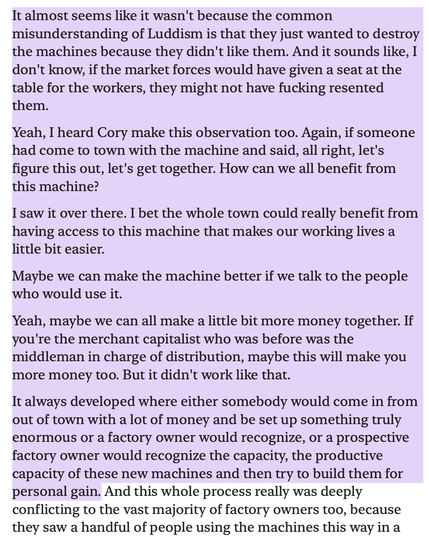
But he framed it repeatedly like this in a podcast: “The fact that this was a profoundly undemocratic process, that [The Luddites] are being forced to either succumb, to either go work in the factories or to find and give up, which wasn't an option, by the way. This isn't a diverse economy that we recognize today.”

Better Offline: Enzittification with Cory Doctorow & Brian Merchant, 7. Aug. 2024

@analog_ashley @grimalkina I may well be paraphrasing words into his mouth, but from somewhere around there comes an idea nugget of "the true way of introducing a technology is when the community as a whole understands, shapes and adopts what happens how, and why, with considerations from everybody." It asks "how does this build on what‘s already there." It doesn‘t invalidate perspectives without critical cause. It understands expression, power and freedoms.
@analog_ashley @grimalkina but yeah, I‘m going to credit Brian Merchant with it. One day I‘ll probably find whatever fleeting note I made when this observation struck me - so far I haven‘t :P
@analog_ashley @grimalkina And no, I wasn't. I found the full citation again:

@Sevoris

I love this and it makes me think of "green" ways to deploy industry

So this strategy would be "morally green" forms of deploying automation

@analog_ashley @grimalkina

@Sevoris

And I also wonder if there are "morally regreening" strategies to deal with automation that deal with industries that have been wrecked by bad automation, just as there are ways to clean up environmentally distressed areas after a spill

@analog_ashley @grimalkina

@trochee @analog_ashley @grimalkina there's definitely a connection there. Both the aspect of "rolling back the bad material impacts" and "rolling back the impacts on the community".

also I just love "moral regreening". It's very evocative. Would make for a nice image on a mug :D

@Sevoris

I'm pretty happy with "morally green tech" in general
And "moral regreening" is a fun idea.

@analog_ashley @grimalkina

@LauraLangdon @analog_ashley @grimalkina I *just* managed to find the better citation for where he talks about this, and posted it in this thread. And I suspect it's then also elaborated on in his book.
@grimalkina @analog_ashley Just listened to the first episode. Speaking as an engineer working as a software dev with a kid studying bio and stats, a lot of this resonated with me. Looking forward to more. Well done!
@michaelcoon @grimalkina thanks for listening, so glad it resonated with you!
@grimalkina @analog_ashley really enjoyed ep1 and very much looking forward to more! Thank you both

@grimalkina I was really interested to hear the story of your first grad stats class in this first episode. Hearing you talk about having to ask about all the Greek symbols (due to the less conventional path you took to get there), put me in mind of two things:

1. Once in grad school I sat through a whole lecture on nonlinear dynamics I really wasn't following. At the end someone asked a question on some specific point, and this lead to another few and then a deluge. It became clear that no one had followed the lecture, and the professor actually started over in the next class. So you were braver than a room full of physics grad students (including me).

2. I was recently helping a colleague who was taking a course in quantum computing. He is a couple years out of CS undergrad, and he said that his university was not very math and science focused, so his math training was not that rigorous. One result of this was that he was not familiar with the Greek alphabet (names or symbols), and this was a constant source of confusion for a while; it's hard to keep the symbols straight when they're unfamiliar. Before this experience I had never thought about what an unnecessary stumbling block this can be, and how radically different that is for students from different backgrounds.

@analog_ashley