Today I'm launching something near and dear to my heart...VERY near and dear 😂 -- a podcast project with my phenomenal favorite neuroscientist (& wife), @analog_ashley !

On "Change, Technically" we're coming to your ears to share tales of who gets to be technical. We dig into STEM pathways & how leaders can learn from psych and neuroscience to think about cultivating innovation. We share our stories from classrooms to software teams. Plus new Cat & Ashley lore!

https://www.changetechnically.fyi/

Change, Technically

Ashley Juavinett, PhD and Cat Hicks, PhD explore technical skills, the science of innovation, STEM pathways, and our beliefs about who gets to be technical—so you can be a better leader and we can all build a better future.Ashley, a neuroscientist...

Buzzsprout
@grimalkina @analog_ashley Stuck at minute 21 of the podcast and something just hit me: focusing on actual, personal outcomes over "get a better job" is a generally much more empowering mindset. I‘m referencing Brian Merchants "democratic discourse of introducing tech" here. The biologists who does empowering new things with her data meets what *she* needs - not what someone offering a job needs. The reversal of an implicit power asymmetry is something really, really cool, is my point.
@Sevoris @grimalkina ooh i'm not familiar with what you're referencing, could you link? (couldn't find with a quick search)

@analog_ashley @grimalkina It‘s kinda messy, and idk if Merchant ever wrote it out like that.

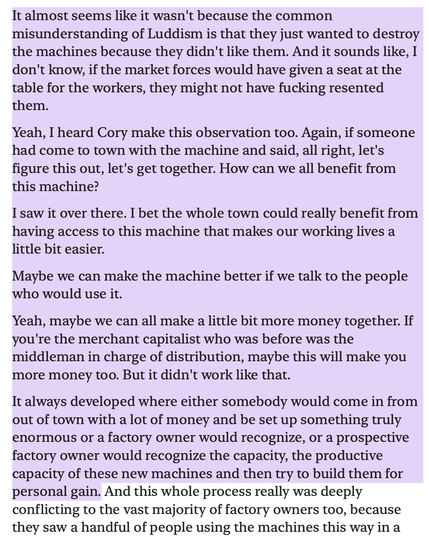
But he framed it repeatedly like this in a podcast: “The fact that this was a profoundly undemocratic process, that [The Luddites] are being forced to either succumb, to either go work in the factories or to find and give up, which wasn't an option, by the way. This isn't a diverse economy that we recognize today.”

Better Offline: Enzittification with Cory Doctorow & Brian Merchant, 7. Aug. 2024

@analog_ashley @grimalkina I may well be paraphrasing words into his mouth, but from somewhere around there comes an idea nugget of "the true way of introducing a technology is when the community as a whole understands, shapes and adopts what happens how, and why, with considerations from everybody." It asks "how does this build on what‘s already there." It doesn‘t invalidate perspectives without critical cause. It understands expression, power and freedoms.
@analog_ashley @grimalkina but yeah, I‘m going to credit Brian Merchant with it. One day I‘ll probably find whatever fleeting note I made when this observation struck me - so far I haven‘t :P
@analog_ashley @grimalkina And no, I wasn't. I found the full citation again:

@Sevoris

I love this and it makes me think of "green" ways to deploy industry

So this strategy would be "morally green" forms of deploying automation

@analog_ashley @grimalkina

@Sevoris

And I also wonder if there are "morally regreening" strategies to deal with automation that deal with industries that have been wrecked by bad automation, just as there are ways to clean up environmentally distressed areas after a spill

@analog_ashley @grimalkina

@trochee @analog_ashley @grimalkina there's definitely a connection there. Both the aspect of "rolling back the bad material impacts" and "rolling back the impacts on the community".

also I just love "moral regreening". It's very evocative. Would make for a nice image on a mug :D

@Sevoris

I'm pretty happy with "morally green tech" in general
And "moral regreening" is a fun idea.

@analog_ashley @grimalkina

@LauraLangdon @analog_ashley @grimalkina I *just* managed to find the better citation for where he talks about this, and posted it in this thread. And I suspect it's then also elaborated on in his book.