 Martin Escardo
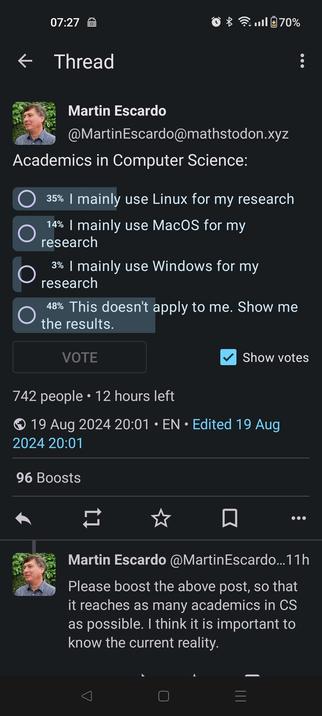
Academics in Computer Science:
I mainly use Linux for my research
I mainly use MacOS for my research
I mainly use Windows for my research
This doesn't apply to me. Show me the results.
Poll ended at .
Thanks to all who replied to this poll.
I mainly use MacOS recently, not because I love it, but because the M series is damn fast for my use case (Agda).
Since 1997 until 2020, I used Linux exclusively, with an overlap with Solaris from 1989 to 2000-something for my desktop office machine.
I still need Linux a lot, and I have Linux machines, which are old and slow, but are able to run my old and new scripts and specialized programs.
If I could, I would use Linux exclusively.
I don't love Apple, but a plus is its security, which seems to be just as good as that of Linux, or at least close.
I don't like Windows. It's such an awful operating system. Never mind the company which produces it.
I have Linux installed on my Mac M2, and it works wonderfully, although there are a couple of things to iron out, which don't matter much if you use the machine for research in CS.
It is good to know that I am not alone as a Linux fan for research in CS.
Can you believe that our IT Services at the University of Birmingham, UK, doesn't currently allow us to install Linux on university-provided new machines at the School of Computer Science?
Poor understanding of security and lack of trust with Computer Scientists.
@brillenfux @MartinEscardo macs have lots of anti-theft features built in. You can prevent erasing the OS and reinstalling, and stolen mac parts can't be sold and used.
So, the insurance costs for macs are likely much lower.
Btw, my work forces me to use mac, and I bang my head against the wall often.
@MartinEscardo that is so crazy. Funny enough it is very soon impossible for german public sector to use windows, because the privacy problems on 11 are just too severe.
Also the math department as far as i can tell at my uni (Dresden) runs on linux
I only see one.
@MartinEscardo Can you do a poll who has root access on the OS they use?
(For selfish reasons, I work on a small toy interpreter that mostly needs root access to compile and install.)
Make three accounts and vote three times.
@MartinEscardo fun fact: high performance compute clusters (#HPC) run only Linux these days. Usually a RedHat derivative (e.g. #AlmaLinux ).
Guess, the HPC community did not take part ... 😉
We shouldn't need to have to buy our own machine for doing research for which the university gets the credit (in REF, in the case of the UK).
Also, I worry that if I write a grant application and say that I need a Linux machine with a certain specification, then IT Services may decide to veto the grant application. Or that If I don't tell them in advance, once the grant is approved, they may say that no, we should have consulted them in advance.
@MartinEscardo ah, "my" here means whatever I put in my office. It usually comes with a pre-installed Windows 😉.
As I work as a HPC support scientist, they let me do.
I guess this is fine: if you do research on CS, maths, physics, engineering, chemistry etc., it's fine if you voted for an option other than the last one.
Any research that needs computers would do.
The reason I emphasized CS is that I am in a CS department and I am outraged that our IT Services were moved from local to central, with new people, and they decided that Linux machines is not something that people in a CS department need.
So I wanted reality out there to be recorded in the poll.
@MartinEscardo Wow, that sounds rediculous to me. At least give people an option!
I work with a lot of researchers now adays as support and in my experience it's the STEM area that are mostly on linux.
Except if there is some machine in the lab (laser, spectroscope, etc) that only runs on windows.
Yes, wow.
@MartinEscardo on vacation, so I missed this poll 🙂
I typically use Linux, or, sometimes, OpenBSD. I used a variety of Unix systems in the past: SunOS/Solaris, HP AIX, Cray (yes :-)). For a year, I worked on Windows as a research programmer, got a "mouse arm" (RSI), and a PTSD :-). For few years I used macOS, while it was still much closer to Linux.
However, I am involved in maintenance of @sagemath - which is multiplatform.
And these entitled macOS bros, arrgh :-)
With the grip of a duopoly driving price gouging and planned obsolescence, Linux is poised to become the default operating system—not just for academia but also for professionals and casual users, offering freedom, sustainability, and long-term value.
 brillenfux
 Abdullah Khalid
 Benjamin Rogoll
 Low Rank Jack
 Sg
Sg Adlangx
 ahistorical immaterialist
 Brooks Davis
 🛠️大工のビオトープ寿司ロスはかせやん🛠️
 Caoilte O'Connor
 Troels
 Marco Devillers
 Jacques Carette
 Christian Meesters
 logBoy
 noodle
 Dima Pasechnik 🇺🇦 🇳🇱
 Jay A. Etchings