So this, from Firefox, is fucking toxic: https://mstdn.social/@Lokjo/112772496939724214

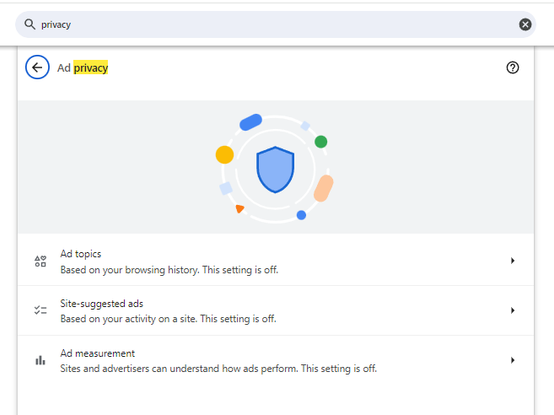
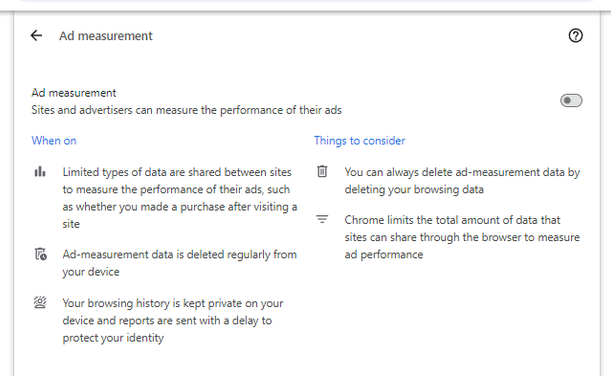
You might be aware Chrome— a browser made by an ad company— has been trying to claw back the limitations recently placed on ad networks by the death of third-party cookies, and added new features that gather and report data directly to ad networks. You'd know this because Chrome displayed a popup.

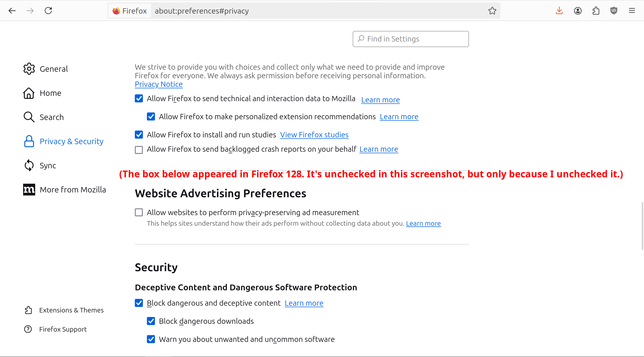
If you're a Firefox user, what you probably don't know is Firefox added this feature and *has already turned it on without asking you*
Lokjo - EU's Gmaps replacement (@[email protected])

Attached: 1 image Firefox is just another US-corporate product with an 'open source' sticker on it. Their version 128 update has auto checked a new little privacy breach setting. If you still use a corporate browser, at least do some safety version! We mainly use @[email protected] based on firefox. (yes, we know, a stable european or even non-US browser is still considered 'futuristic' in europe) #eu #browser #firefox #meh

Mastodon 🐘

This is weird & bad for so many reasons. But what I focus on is:

1. I believe, morally if not practically, this tracking is *worse* than the old 3rd-party cookies. This is because 3rd-party cookies were a legitimately useful tech that could be misused for ads. This tech is *designed* to benefit advertisers from word go, yet is installed on *your* computer, like Malware.

2. Firefox is *worse than Chrome* in their implementation of ad snitching, because Chrome enables it only after user consent.

Now to be clear, the disclosure Chrome provides to users is not *adequate*. Their wording of the "Ad Privacy" feature popup is highly disingenuous and the process to disable once notification is given is too complex and must be performed on a per-profile basis. But at least they *do it*, and to my knowledge don't track/send the data until the popup is displayed. Whereas Firefox just snuck this in in a software update, checked by default and you're probably learning about it now, on social media.

Other, loose angles to consider this from:

- Google/Firefox claim their tracking features are not "tracking" because they use something called "differential privacy". I don't have room to explain this class of technology, but I sincerely consider it to be fake. Without getting into the details, they provide *less* information to the advertisers than a cookie would have. But I'd prefer they provide none. Steps are taken to anonymize the data, but what is anonymized can often be de-anonymized.

- The language Google/Firefox use to describe their ad snitching policies just makes my blood boil, an insult on top of the injury of the features themselves. Google uses the label "Ad Privacy" for a feature group that strictly decreases privacy over doing nothing. Firefox calls it "Privacy-preserving ad measurement". You know what would preserve my privacy more? *Not measuring*. I understand why Google is lying to me to protect their own business, but Firefox is supposed to be a nonprofit. WTF.

- Firefox's "Privacy-preserving" ad tracking has other interesting issues. In another way the new ad snitching is worse than the old tracker cookies, Firefox doesn't *tell* you what data it's collected or reported, and unlike with cookies doesn't give you the ability to delete recorded "impressions".

Also interestingly, the feature is not available to *all* advertisers currently, only a "small number" of partner sites. *Firefox doesn't disclose who they are*, again making this worse than $GOOG.

- This event seems to tie in with other confusing developments around Mozilla as a company/"Foundation". I do not know enough about these issues to comment on them intelligently. I know only that Mozilla has, inexplicably for a nominal nonprofit, recently bought an advertising firm: https://mastodon.social/@jwz/112650295543215212

and that I have seen… let's say "criticism" of recent changes to the board makeup: https://www.spiceworks.com/tech/tech-general/news/mozilla-cpo-sues-company-over-disability-discrimination/

Mozilla CPO Sues Company Over Cancer-Related Disability Discrimination

Mozilla’s product chief is suing the company over alleged discriminatory practices stemming from his cancer diagnosis.

Spiceworks

Anyway, I guess that's a lot of typing. The TLDR is:

- There is now a feature labeled "Privacy-preserving ad measurement" near the bottom of your Firefox Privacy settings. I recommend turning it off, or switching to a more privacy-conscious browser such as Google Chrome.

- I have filed two bugs on Firefox about this, which I am choosing not to link to dissuade brigading. If I have not been banned from the bug tracker by next week I will file another bug about the ChatGPT integration in nightly

@mcc maybe i just need to give up on not be a product, but to concentrate on how to be a terrible product.
@Bigshellevent @mcc I can’t find it now but there was a user program that generated garbage data to mask your movements. I think it was called Noize, Noisr, or something
@Bigshellevent @mcc

Judging by how poorly ads are targeted at me (do they
really think that I'm a core demo for Spanish language dubs of commercials originally produced in English??), probably doing good at being terrible to collect useful data from.
@mcc this sort of stuff is the reason why I use librewolf
@bob @mcc LibreWolf is really good, I just wish I could relax the timezone masking... ah, well.
@xgranade @mcc librewolf has really good build tooling that makes compiling from source a reasonable thing to do. you can have your own patches if you wnat
@bob @xgranade In this situation (or in the situation where I use LibreWolf official builds for that matter) will LibreWolf contain the drm modules that would allow me to use (for example) Tidal on LibreWolf for Windows?
LibreWolf Browser

A custom version of Firefox, focused on privacy, security and freedom.

@mcc Yes, LibreWolf has everything needed to play DRM media included, it's just disabled by default. You enable it in "Settings -> General" just like in Firefox
@KDHofAvalon thanks. Can this module be integrated in a case where I compiled my own copy of LibreWolf?
@mcc That, I don't know. I haven't had a need to compile it myself yet in my testing. LibreWolf is just a fork of Firefox though, so it it works there it should also work for LibreWolf
@xgranade @bob Yeah, this is the problem with using "privacy-conscious software". Privacy is not a very high priority for me. It's just the situation has got *so* bad that even I, a person who doesn't give a shit, is worrying about privacy
@mcc @bob One of the most fundamental aspects of privacy is autonomy — being able to choose how much you share, with whom, and how. Contrary to how most privacy-conscious software projects tend to see it, that isn't always "no information shared ever." I wish it was easier to tune and express autonomy instead of either just locking everything to zero or letting ad-tech run my life.
@xgranade @bob Yeah. Actually, more than half of the time when I get angry about a privacy violation, the thing I am angry about is not actually the privacy violation but that the company doing the privacy violation *lied to me*. I want to be able to make decisions and have them be honored.

@mcc Same here. For example, I donʼt mind ads, but I donʼt like tracking. I block trackers, but not ads themselves. However, that will often bring up a big warning message asking me not to use an ad blocker. Um, I donʼt use an ad blocker, the site does! Just show me non-tracking ads, contextual ones are fine, just like what we had in the 2000s (when advertisers and publishers actually did better from online advertising!).

@xgranade @bob

@mcc
I can relate to this. I honestly don't mind sharing lots of types of data. I would be happy to let my phone help track traffic or various devices report software issues or even let certain survey data get shared. In fact, my reaction to most asks to share data requests is "sure" except that I know it doesn't stop there. Since I can't control my data or share input on how I want it shared it just all has to be stopped.

"What do you have to hide" is what is always presented to me (and the answer from me is generally nothing)...... I don't understand why this is never turned around..... Why do the trackers seem to have TONS to hide? If corp/orgs have to hide these "features" then clearly they have a lot more to hide than I do.
@xgranade @bob

@bob @mcc i tried librewolf. unfortunately, it seems to force disable some acfessibility features i need, so i can't use it

@yukijoou @bob Ugh

Just checking, do they turn back on if you disable "resist fingerprinting"?

@mcc @bob i'll check tomorrow, haven't tried LW in a year, but i remember spending ~1h trying to get it to let me turn on reduced motion, and it wouldn't budge
@mcc I'm sorry, the ChatGPT integration???
@Ongion I AM UPSET
@mcc @Ongion is there a commit/PR you could share on this? ChatGPT is *not* something I want deeply integrated into my browser.
@mcc @Ongion nvm this reply later suffices. Thanks for bringing this to our collective attention! https://mstdn.social/@hazz223/112777865041917136
Harry W. (@[email protected])

@[email protected] Link about the AI integration if people want to know more. I can see *why* they've done it. But really wish they wouldn't.... https://blog.nightly.mozilla.org/2024/06/24/experimenting-with-ai-services-in-nightly/

Mastodon 🐘

@mcc Wow. If the direct comparison leads to sentences like "or switching to a more privacy-conscious browser such as Google Chrome", things must be REALLY off. (Yeah, they are.)

So, which browser is still a good approach?! I'm so tired of all the enshittification!

And of ChatGPT and all the other LLM stuff! 😤😒

@jesterchen I've been hearing about LibreWolf, but I don't know enough about it to endorse it.

@mcc @jesterchen LibreWolf is decent. Firefox is more polished, but LibreWolf definitely has the privacy defaults ert to max to the point where I loosened settings to allow for a better login experience.

Definitely worth a try if FF is getting bad.

@mcc Google Chrome, or even degoogled Chromium, is NOT "a more privacy-conscious browser". It's 1000x worse. Yes this is (yet another) betrayal by Mozilla management clowns, but in browsers like in politics, "X betrayed us" doesn't justify "so we should turn to Y who was 1000x worse to begin with".

@mcc Link about the AI integration if people want to know more.
I can see *why* they've done it. But really wish they wouldn't....

https://blog.nightly.mozilla.org/2024/06/24/experimenting-with-ai-services-in-nightly/

Experimenting with AI services in Nightly – Firefox Nightly News

In the coming months, we will experiment with providing easy access to optional AI services in Nightly to improve productivity as you browse. This work is part of our improvements ...

Firefox Nightly News

@mcc WTF? Chrome is not "privacy-conscious browser"

That's BS… 🤮

- google IS an ad company, Mozilla iis imitating them because someone though it was a good idea to have hire silicon valley assholes as management
- google has a long track record of spying it users
- google is actively fighting against ad/trackers blockers
- chrome has trackers and phonew home
- chrome/chromium tries to run as root with setuid on GNU/Linux and probably runs with high privileges (whatever its called) on winblows

@adamsaidsomething Well, There are much better ways to emphasize criticism of Mozilla bullshit… 🤷‍♂️

This should be avoided since many people are actually convinced by google fanclub rhetorics and do believe it's "better" to use chrome or chromium's more-or-less locked down, proprietary forks, despite facts such as those "browsers" are constantly phoning home (google's or some other for profit company servers), undermine ad/trackers blockers, do crypto-money BS, inject their own ads and so on…

@devnull

Its effective cricticism for people in on the joke but I see you're point as well, some people will take it too literally. Anyway I untagged mcc because I see she already got a lot of replies in this thread but you can direct your feed back to her directly if you think it will help, tho other people have probably already given similar feedback

@mcc I would very strongly advise to recommend @Vivaldi instead of Chrome, if one needs a Chromium-based. Because I still don't trust Google on privacy issues.
@mcc did you just call chrome a privacy conscious browser?!
@betalars yep, that's the joke. In this instance, mozilla have managed to out-google google.
@wouldinotcallmyselfahumanbeing @betalars Like, Google *tried* to track me, but they failed, because they warned me they were going to do it before they started, so I was able to turn it off. But Firefox didn't tell me they were going to track, they just started doing it secretly. So they did actually manage to track my "Impressions" for a while there. Firefox tracked me and Chrome didn't.
@wouldinotcallmyselfahumanbeing @betalars Note, I don't believe this happened because Google is actually more privacy conscious than Firefox. I believe the difference in the two features is because Google ran what they were going to do by a lawyer and asked "is this GDPR compliant?" and Firefox didn't
Google accused of privacy breaches over alleged Chrome tracking

Alphabet Inc., the parent company of Google, has been targeted by privacy advocacy group, NOYB, over allegations of unauthorised user tracking in the Google Chrome web browser.

GRC World Forums
@twcau Can you please turn off the setting that tags the person that boosted a toot into your reply mate?
@ThermiteBeGiants Doesn’t seem my client has a setting for that, at least one I could find looking through settings.
@twcau @mcc @ThermiteBeGiants The absurdity of the statement is for this exact shock value
@mcc The replies to this lead me to believe that your other followers don't appreciate understated irony as much as I do.
@mcc i will watch closely to see if this drops in ESR and thus IceCat.... hunch says yes, though ESR is "corporate aligned" in a sense....
@jessienab It seems like all IceCat would need to do is change one preference default from true to false. Although I suspect also that Firefox will also *eventually* change this preference default from true to false, or add a clickthrough box like Chrome has, once a lawyer talks to them about how the GDPR works
@jessienab @mcc the next version of firefox-esr is based on 128, the one with this ad tracking turned on, so will inherit this.
Possibly some of the (linux) distributions will turn the default to 'off' in their repository versions. Debian has been known to correct 'bad' defaults in the past.

@marjolica @jessienab Would it make sense for someone to bring this to the attention of debian and request that when they pick up 128 they do target this default for default disabling?

(I don't know if I would be the right person since I don't use Debian, I use Ubuntu, which ships Firefox via "Snap")

@mcc @marjolica Apologies for my delayed reply, yes I think Debian should be the leader in disabling or rather setting appropriate build flags TO disable this passive-ad-tracking feature. Many many repos and distros pull/source from Debian's version of applications, so it would be good they be the reliable base for a thing like this.

(I am also not the right person to report, I use Arch on everything... I have to imagine Arch will do the same with their deployment of FF in the future perhaps? Haven't checked my install yet)

@marjolica @mcc My hope so far is that IceCat maintainers check these new settings and disable them. The AUR maintainer seems to keep the privacy respecting features active, or it could perhaps be from upstream; it's a little confusing who's exactly behind things since IceCat is more an ESR rebrand than a soft fork like Librewolf.
@mcc the WHAT in nightly 🧐
@mcc Wait, what about ChatGPT in Firefox now?
@mcc isn't this a different thing to the Chrome stuff that was a subject of controversy? tracking the user is bad, but Chrome's big idea was to spy on all your online activity to figure out your “interests” and then tell advertisers about them, whereas this Firefox feature is, I guess, purely to know if ads are effective? at least that's the intention…
@hikari Chrome "Ad privacy" (formerly "Ad sandbox", formerly "Ad labs") comprises three distinct features with individual toggles. You are referring to one of them ("Topics"). However, another one of the three, "Ad measurement", appears to be identical to the feature implemented by Firefox (and Safari, for that matter). Unlike Firefox (or Apple?), Google as far as I know/have tested will not turn any of these three features on without disclosing to the user and giving them a chance to opt out.
@hikari I do not consider any of these three features acceptable. My browser should not be surveilling me, *especially* not if it's specifically for the benefit of advertising companies.
@hikari @mcc Yes. Also Safari has been shipping what I assume is the same thing or something very similar for several years
@saagar @mcc oh huh yeah there's a defaulted-on checkbox in my safari advanced privacy settings
@mcc yeah. we believe Mozilla's thing to be an independent thing of a technology that was in early negotiations when we left Google, which we had serious objections to and waited several years for it to become public so we could speak against it
@ireneista It appears that now there is an attempt to standardize it at the W3C, which is… I don't like it.