
So this, from Firefox, is fucking toxic: https://mstdn.social/@Lokjo/112772496939724214

You might be aware Chrome— a browser made by an ad company— has been trying to claw back the limitations recently placed on ad networks by the death of third-party cookies, and added new features that gather and report data directly to ad networks. You'd know this because Chrome displayed a popup.

If you're a Firefox user, what you probably don't know is Firefox added this feature and *has already turned it on without asking you*
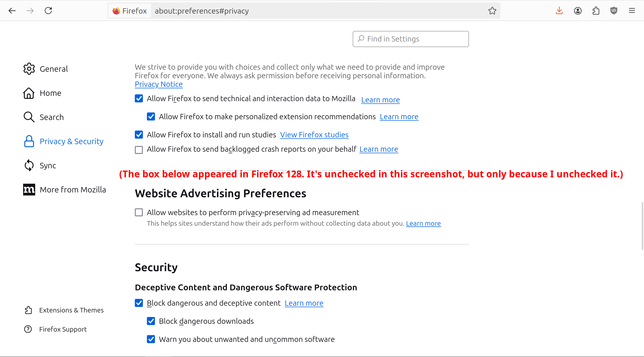
Lokjo - EU's Gmaps replacement (@[email protected])

Attached: 1 image Firefox is just another US-corporate product with an 'open source' sticker on it. Their version 128 update has auto checked a new little privacy breach setting. If you still use a corporate browser, at least do some safety version! We mainly use @[email protected] based on firefox. (yes, we know, a stable european or even non-US browser is still considered 'futuristic' in europe) #eu #browser #firefox #meh

Mastodon 🐘

This is weird & bad for so many reasons. But what I focus on is:

1. I believe, morally if not practically, this tracking is *worse* than the old 3rd-party cookies. This is because 3rd-party cookies were a legitimately useful tech that could be misused for ads. This tech is *designed* to benefit advertisers from word go, yet is installed on *your* computer, like Malware.

2. Firefox is *worse than Chrome* in their implementation of ad snitching, because Chrome enables it only after user consent.

Now to be clear, the disclosure Chrome provides to users is not *adequate*. Their wording of the "Ad Privacy" feature popup is highly disingenuous and the process to disable once notification is given is too complex and must be performed on a per-profile basis. But at least they *do it*, and to my knowledge don't track/send the data until the popup is displayed. Whereas Firefox just snuck this in in a software update, checked by default and you're probably learning about it now, on social media.

Other, loose angles to consider this from:

- Google/Firefox claim their tracking features are not "tracking" because they use something called "differential privacy". I don't have room to explain this class of technology, but I sincerely consider it to be fake. Without getting into the details, they provide *less* information to the advertisers than a cookie would have. But I'd prefer they provide none. Steps are taken to anonymize the data, but what is anonymized can often be de-anonymized.

- The language Google/Firefox use to describe their ad snitching policies just makes my blood boil, an insult on top of the injury of the features themselves. Google uses the label "Ad Privacy" for a feature group that strictly decreases privacy over doing nothing. Firefox calls it "Privacy-preserving ad measurement". You know what would preserve my privacy more? *Not measuring*. I understand why Google is lying to me to protect their own business, but Firefox is supposed to be a nonprofit. WTF.

- Firefox's "Privacy-preserving" ad tracking has other interesting issues. In another way the new ad snitching is worse than the old tracker cookies, Firefox doesn't *tell* you what data it's collected or reported, and unlike with cookies doesn't give you the ability to delete recorded "impressions".

Also interestingly, the feature is not available to *all* advertisers currently, only a "small number" of partner sites. *Firefox doesn't disclose who they are*, again making this worse than $GOOG.

- This event seems to tie in with other confusing developments around Mozilla as a company/"Foundation". I do not know enough about these issues to comment on them intelligently. I know only that Mozilla has, inexplicably for a nominal nonprofit, recently bought an advertising firm: https://mastodon.social/@jwz/112650295543215212

and that I have seen… let's say "criticism" of recent changes to the board makeup: https://www.spiceworks.com/tech/tech-general/news/mozilla-cpo-sues-company-over-disability-discrimination/

Mozilla CPO Sues Company Over Cancer-Related Disability Discrimination

Mozilla’s product chief is suing the company over alleged discriminatory practices stemming from his cancer diagnosis.

Spiceworks

Anyway, I guess that's a lot of typing. The TLDR is:

- There is now a feature labeled "Privacy-preserving ad measurement" near the bottom of your Firefox Privacy settings. I recommend turning it off, or switching to a more privacy-conscious browser such as Google Chrome.

- I have filed two bugs on Firefox about this, which I am choosing not to link to dissuade brigading. If I have not been banned from the bug tracker by next week I will file another bug about the ChatGPT integration in nightly

@mcc this sort of stuff is the reason why I use librewolf
@bob @mcc LibreWolf is really good, I just wish I could relax the timezone masking... ah, well.
@xgranade @bob Yeah, this is the problem with using "privacy-conscious software". Privacy is not a very high priority for me. It's just the situation has got *so* bad that even I, a person who doesn't give a shit, is worrying about privacy
@mcc @bob One of the most fundamental aspects of privacy is autonomy — being able to choose how much you share, with whom, and how. Contrary to how most privacy-conscious software projects tend to see it, that isn't always "no information shared ever." I wish it was easier to tune and express autonomy instead of either just locking everything to zero or letting ad-tech run my life.
@xgranade @bob Yeah. Actually, more than half of the time when I get angry about a privacy violation, the thing I am angry about is not actually the privacy violation but that the company doing the privacy violation *lied to me*. I want to be able to make decisions and have them be honored.

@mcc
I can relate to this. I honestly don't mind sharing lots of types of data. I would be happy to let my phone help track traffic or various devices report software issues or even let certain survey data get shared. In fact, my reaction to most asks to share data requests is "sure" except that I know it doesn't stop there. Since I can't control my data or share input on how I want it shared it just all has to be stopped.

"What do you have to hide" is what is always presented to me (and the answer from me is generally nothing)...... I don't understand why this is never turned around..... Why do the trackers seem to have TONS to hide? If corp/orgs have to hide these "features" then clearly they have a lot more to hide than I do.
@xgranade @bob