I’m more accustomed to the science coming from photon-counting x-ray telescopes, not so much being the target of a photon-counting x-ray microscope, but … 🤷‍♂️

Anyway, a CT scan was just part yesterday’s emergency visit to the urology department of the Heidelberg University Clinic 😬

A pretty miserable way to spend seven hours on a Saturday, so do yourselves a favour:

Drink more water, folks 🚰
No, more than that 🚰🚰
Keep going 🚰🚰🚰✌️
#KidneyStonesSuck
#DerKaiserMussVersteinen

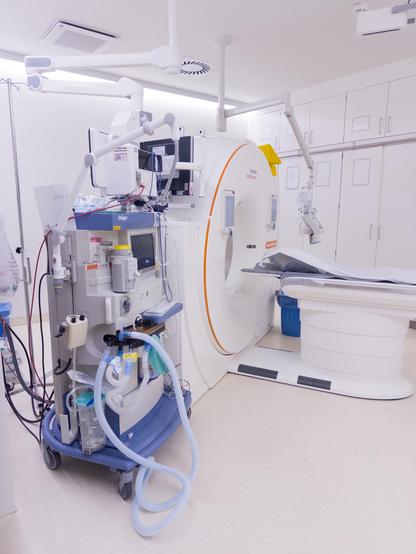
FWIW, to satisfy the geek in you, this particular CT scanner was a Siemens Somatom Edge Plus. It emits 70-140keV x-ray photons which are converted into visible photons using a ceramic scintillator material & registered by CMOS arrays with built-in A/D converters, in Siemens' Stellar-Infinity detector. The scanner takes 128 slices in a few seconds, has a 0.3mm spatial resolution, & the drum rotates at over 200rpm.

https://marketing.webassets.siemens-healthineers.com/1800000003369873/c3565f4372f7/Computed-Tomography_Machine-Technology_Stellar-detector_Whitepaper_1800000003369873.pdf

@markmccaughrean Thnx! I was very curious (my job before retirement: clinical physicist specialized in medical imaging). I had several CT scans myself in the past three months, but the technologists were not willing to divulge the information. By the way, since my retirement Siemens claims to have developed a truly photon counting CT scanner: https://www.siemens-healthineers.com/computed-tomography/photon-counting-ct-scanner
Photon-counting CT Scanner

@saarmuller Ah, good spot – I must’ve jumbled up some information when googling yesterday (blame the drugs 🤪). Indeed the SOMATOM model CT scanner used on me wasn’t photon counting, but the new NAEOTOM is. It avoids the x-ray to optical photon conversion via a scintillator, using a CdTe detector to measure the x-rays & their energy directly. Similar to what we do in astronomy.

The hospital staff didn’t offer this info though; I just searched for it after based on the machine name 🤷‍♂️🙂

@markmccaughrean The discussion in my field always is whether such a new technology really improves patiënt outcome. I was always cautious and in this case it is interesting that they quote a technologist to prove how good it is. However, he mentions a software improvement, not better imaging!
"As a radiographer, the new way of setting up the protocols and to be able to use the different features of NAEOTOM Alpha has the biggest impact.
Marcel Dijkshoorn
CT Technologist,
Erasmus Medical Center"

@saarmuller I’m guessing that if they can now single photon count, that will improve the signal-to-noise quite a lot, & thus allow them to turn down the x-ray dose. Which is a good thing, I guess.

Plus the energy resolution of the direct x-ray detectors should be much better & could that yield better discrimination between various densities etc. in the body?

@markmccaughrean Yes, those are the claims, and I do not doubt those are at least partly true. The main problem will be the price, I suspect.
@saarmuller I’m curious – roughly how much do state-of-the-art CT machines cost?
@markmccaughrean My knowledge is outdated but I think they are still between 1/2 and 1 million euro. However, I would not be surprised if you have to pay 2 million for a truly new technology that is available from only one vendor. And that raises the question whether the improvement is worth double the price.